
Texas Roadhouse: Navigating Expansion Pressures, Capital Intensity, and the Evolving Casual Dining Playbook
As Texas Roadhouse expands its multi-concept restaurant footprint, the company faces a rising capital burden and tight liquidity, even as its owner-operator model and focus on food quality drive operational consistency. The challenge lies in sustaining growth and margins amid industry headwinds and shifting consumer preferences.
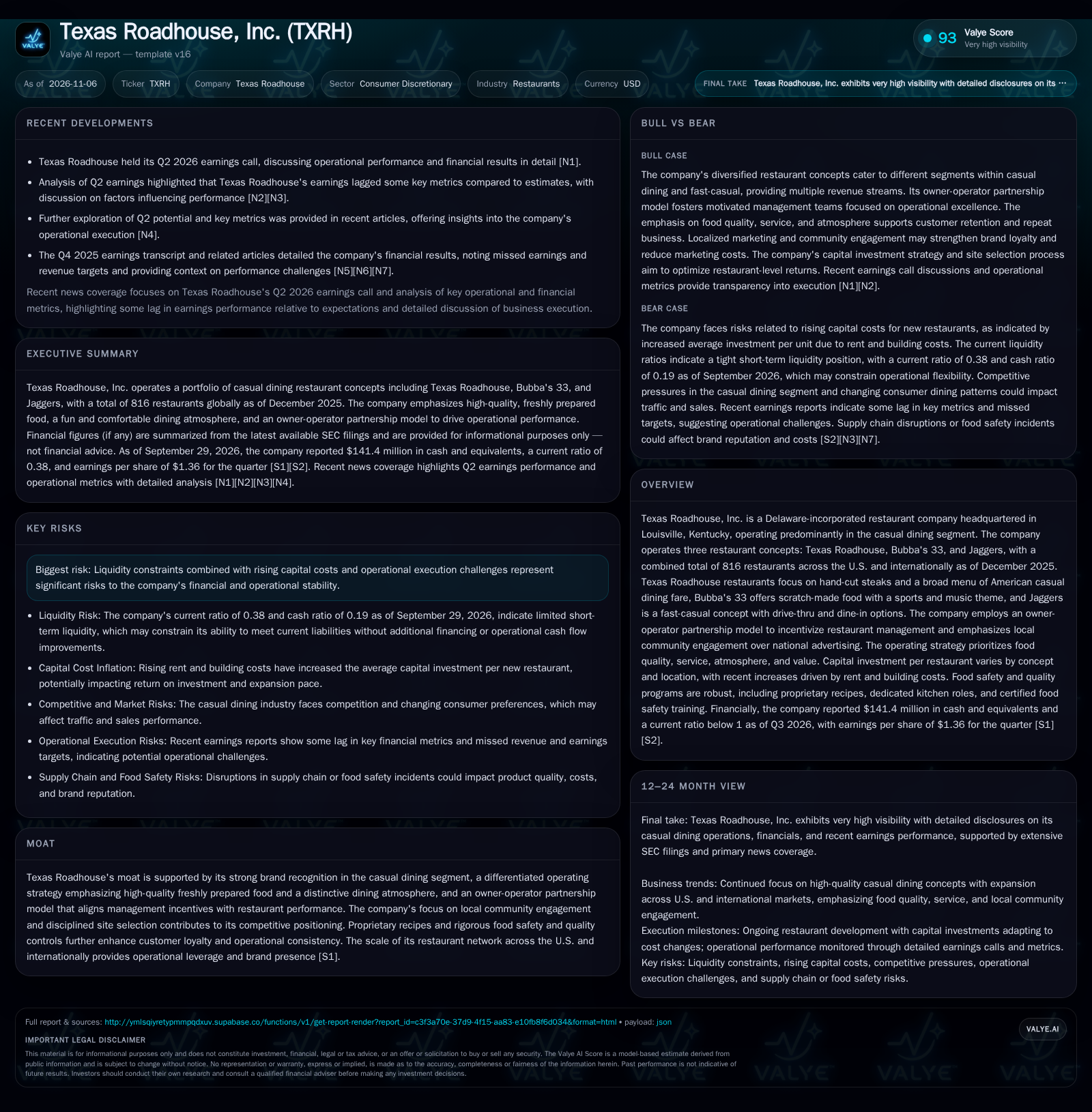
The company's ability to balance capital discipline, menu value, and customer experience will shape returns as competition and consumer trends evolve. [S1] [S2] [N2] [N3] [N7]
Texas Roadhouse, Inc. stands as a leading multi-concept operator in the highly competitive U.S. casual dining segment, with over 800 locations under the Texas Roadhouse, Bubba's 33, and Jaggers banners. As industry dynamics shift—with rising costs, evolving consumer habits, and aggressive competition—the company’s future returns will hinge on its ability to balance disciplined capital deployment, menu value, and the operational advantages of its unique management approach. [S1] [S2] [N2] [N3] [N7]
Liquidity Squeeze and Rising Restaurant Investment: The Latest Operating Realities
The company reported cash and liquidity metrics for the period; these figures do not by themselves establish operating runway, investment capacity, financial flexibility, or financing capacity. This comes as the company continues to invest heavily in new locations, with average capital investment per Texas Roadhouse restaurant rising to $8.9 million in 2026 due to higher rent and building costs. Bubba's 33 unit investment is expected to decline to $8.5 million as smaller prototypes roll out, but the overall trend signals elevated capital intensity for expansion. These financial constraints are paired with recent earnings shortfalls: both Q2 and Q4 2025 earnings lagged estimates, indicating operational and possibly demand-side challenges. The question is whether the company’s operating model and local-market strategies can offset these cost and liquidity pressures—or whether expansion ambitions will need to moderate. [S1] [S2] [N2] [N3] [N5] [N6] [N7]
The interplay between escalating capital requirements and constrained liquidity necessitates a more nuanced approach to expansion prioritization. In particular, the timing and geographic distribution of new openings become critical levers. Selective market entry, favoring regions with demonstrated demand resilience and favorable real estate economics, could mitigate some pressure on cash flows and capital allocation. Additionally, the company might explore alternative financing structures or partnerships to alleviate upfront capital burdens, though such strategies would introduce complexity in governance and profit-sharing.
How Texas Roadhouse Makes—and Spends—Its Money
Texas Roadhouse’s core economic engine is company-owned, full-service casual dining, supported by a smaller share of franchised and fast-casual units. Revenue is driven by high-volume, moderately priced menu offerings, with most Texas Roadhouse locations focused on dinner service and select lunch openings to optimize throughput and labor efficiency. The owner-operator model ties local management compensation to pre-tax profit, theoretically incentivizing cost control and sales execution at the unit level.
Food and labor costs are substantial fixed and semi-variable outlays, with proprietary recipes and rigorous quality controls designed to limit waste and pricing volatility. The company’s menu strategy—generous portions, value positioning, and scratch-made items—supports ticket size and perceived value, though it also exposes margins to commodity cost spikes and wage inflation. Capital requirements are pronounced: with nearly $9 million needed per new full-service unit, returns on invested capital hinge on sustained traffic, local market selection, and the ability to manage rising build and leasing costs. Franchise and fast-casual concepts like Jaggers may offer higher marginal returns per dollar invested if growth accelerates, but disclosure is limited.
The owner-operator model, while incentivizing localized operational excellence, also introduces variability in unit-level performance that can impact consolidated economics. Differences in management skill and local market conditions may lead to asymmetric returns across the portfolio, complicating capital allocation decisions. Furthermore, the fixed cost base inherent in full-service casual dining means that underperforming units can disproportionately erode overall profitability. In this context, rigorous performance monitoring and the ability to reallocate resources or intervene in weaker units become vital. From a capital efficiency standpoint, the contrast between high-investment full-service units and potentially more scalable fast-casual formats suggests a strategic tension between pursuing steady, lower-risk growth and chasing higher-margin, faster-expanding concepts.
Brand, Experience, and Execution: Competitive Levers and Industry Headwinds
Texas Roadhouse’s enduring advantage lies in its brand recognition, fun atmosphere, and commitment to food quality—supported by proprietary recipes and consistent service standards. The owner-operator partnership model aligns local incentives, potentially reducing unit-level turnover and enhancing execution. Community-focused marketing (rather than national campaigns) may foster local loyalty and lower customer acquisition costs, but it also limits broad brand amplification.
Counterforces are formidable: the casual dining sector is crowded, with both national chains and regional operators vying for share. Fast-casual and quick-service competitors continue to pressure the value equation, while delivery aggregators and changing consumer dining preferences threaten traffic and ticket growth. Given the capital intensity of new units and higher fixed costs, any sustained traffic softness or margin erosion could quickly impact returns. The company’s disciplined site selection and operational playbook provide some moat, but market saturation and evolving consumer tastes remain ongoing risks.
The competitive landscape also exerts pressure on the company’s strategic choices around innovation and differentiation. As consumer preferences shift toward convenience and experiential dining, Texas Roadhouse’s emphasis on atmosphere and quality must be continually refreshed to maintain relevance. However, balancing innovation with operational consistency is challenging, especially when incremental menu or service changes can introduce complexity and cost. Moreover, the rise of digital ordering and delivery platforms requires investment in technology and logistics capabilities, which may strain resources but are increasingly necessary to capture off-premise demand. The company’s ability to integrate these elements without diluting its brand promise will be a critical determinant of its competitive resilience.
What Sustained Execution and Disciplined Expansion Could Unlock
If Texas Roadhouse manages to control build costs, optimize site selection, and drive consistent same-store sales growth through menu innovation and service quality, the business could leverage its scale for higher margins and returns on capital. Expansion of Bubba’s 33 and Jaggers—especially if smaller prototypes prove successful—could boost systemwide growth with lower per-unit capital requirements. The owner-operator model may continue to deliver above-industry operational consistency, especially if local partnerships attract and retain talent amid industry-wide labor shortages.
Evidence for this scenario would include a steady or reported liquidity-ratio trends, margin stabilization or expansion despite rising costs, and a return to outperforming earnings expectations. Confirmation would also come from disclosed increases in franchise or fast-casual unit growth, improved unit-level economics, and positive same-store sales trends.
Pragmatic Growth: Maintaining Relevance in a Competitive, Cost-Pressured Market
The most plausible trajectory is continued unit growth at a moderated pace, as capital cost inflation and tight liquidity temper the rate of new openings. The core Texas Roadhouse concept likely remains a traffic driver in many markets, but margin pressure from wage and ingredient inflation may persist, especially if menu price increases cannot fully offset cost growth without impacting value perception.
Bubba’s 33 and Jaggers may gain incremental share but are unlikely to materially shift the overall economic mix in the near term. Performance may hinge on operational execution—food quality, service, and local marketing—offsetting industry headwinds. Conversely, further misses on earnings or persistent traffic declines would challenge the base case.
When Rising Costs and reported liquidity position Constrain the Playbook
Should capital costs continue to escalate and liquidity remain tight, Texas Roadhouse may be forced to slow or halt new unit development, especially in higher-cost markets. If traffic weakens further—whether from consumer belt-tightening, increased competition, or a shift to off-premise and lower-margin channels—fixed-cost leverage could swing negative, compressing margins and pressuring cash flow.
Food safety incidents, supply chain disruptions, or execution missteps could exacerbate these pressures, damaging brand equity and incurring remediation costs.
What Will Determine Whether Texas Roadhouse Sustains Its Growth Thesis?
Quarterly and annual trends in same-store sales growth across all concepts—if disclosed—would help assess demand resilience and competitive positioning.
Disclosure and trajectory of new unit openings by concept, as well as capital investment per new restaurant, will illuminate expansion discipline and capital efficiency.
Movement in the current ratio and cash balance should be monitored for signs of improving or deteriorating liquidity.
Gross and operating margin trends, especially relative to commodity and wage inflation, would help test the model’s margin resilience.
Any shifts in average check size or traffic—if broken out—would clarify whether menu strategy and value perception are holding up.
Evidence of successful scaling or franchising of Bubba’s 33 and Jaggers, including unit economics and customer adoption, would clarify longer-term mix potential.
Material supply chain or food safety events, or their absence, will remain crucial for safeguarding brand equity and cost control.
If disclosed, trends in unit-level profitability and managing partner turnover would further validate the owner-operator incentive structure.
Disclaimer: This is research-only, informational analysis and not investment advice. It may include AI-generated interpretation and general industry context. Always verify important details using primary sources.

Comments