
Dogwood Therapeutics Approaches Crucial Readout: What’s at Stake as Halneuron Data Nears
With topline Phase 2b results for Halneuron in chemotherapy-induced neuropathic pain imminent, Dogwood Therapeutics stands at an inflection point. The company’s recent financing and clinical progress provide runway for this binary event, but commercial prospects, financial sustainability, and differentiation in a competitive pain landscape will hinge on the forthcoming data.
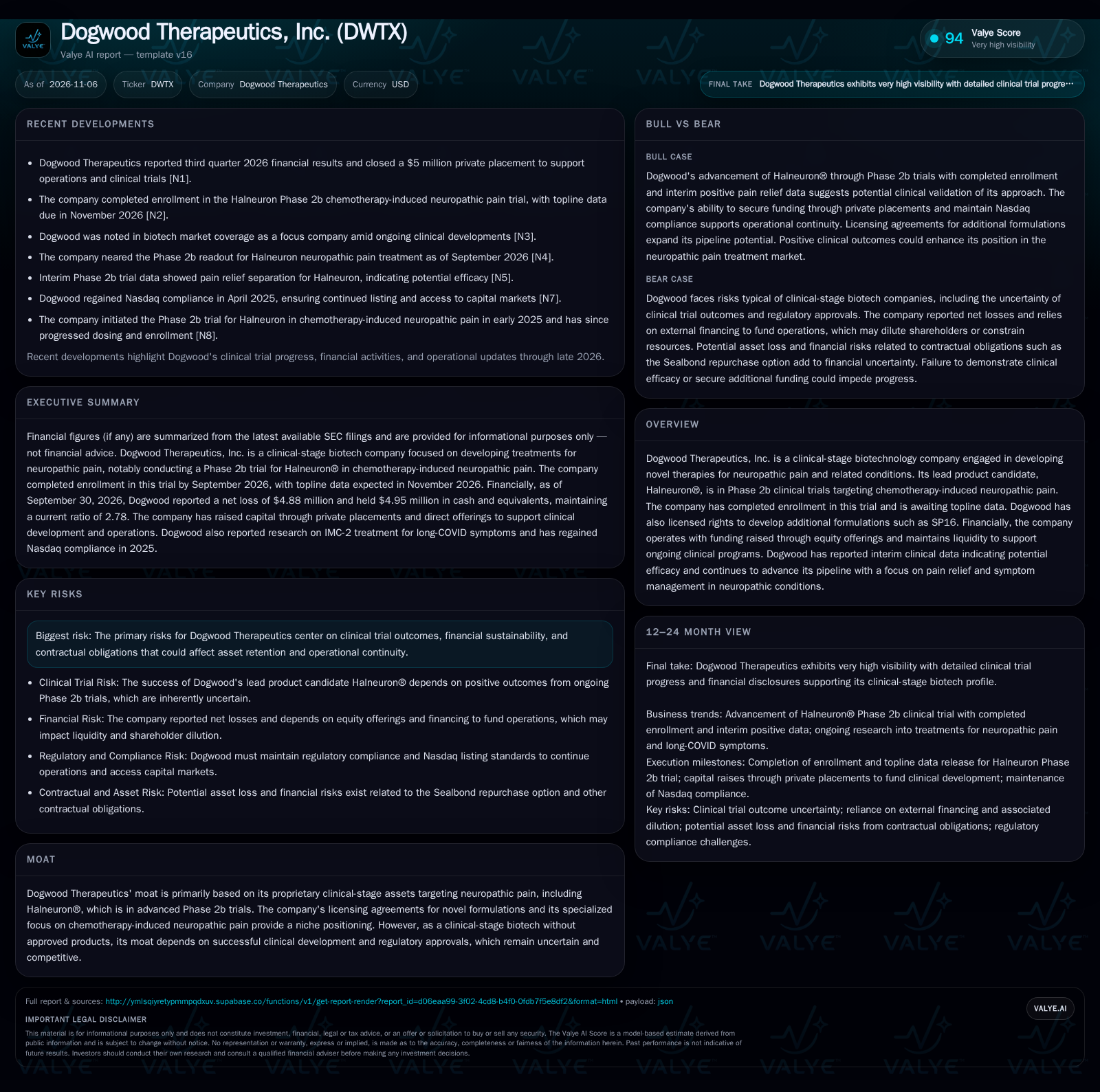
Dogwood Therapeutics has completed enrollment for its Phase 2b trial of Halneuron® in chemotherapy-induced neuropathic pain, with topline data expected in November 2026. Competitive and regulatory risks remain material as Dogwood seeks to demonstrate lasting differentiation and financial resilience. [N1] [N2] [S2]
Dogwood Therapeutics, Inc. is approaching a defining moment as it awaits topline Phase 2b data for Halneuron®, its lead candidate for chemotherapy-induced neuropathic pain (CINP). With patient enrollment completed and the trial’s pivotal results expected in November 2026, the stakes are high: positive data could unlock new funding, partnerships, or even acquisition interest, while a setback would force a strategic reset. Recent financing rounds have kept the company operationally afloat, but the binary nature of clinical-stage biotech means Dogwood’s prospects—and investor attention—now rest squarely on the upcoming clinical readout. [N1] [N2] [S2]
Imminent Halneuron Data, Recent Financing, and Clinical Milestones
Dogwood Therapeutics completed enrollment for its Phase 2b clinical trial of Halneuron® in chemotherapy-induced neuropathic pain (CINP) as of September 2026, setting the stage for a topline data readout in November 2026. This milestone is pivotal: the trial’s outcome will determine whether Halneuron can advance toward late-stage development or partnering opportunities. Interim results from the trial showed pain relief separation, hinting at efficacy but falling short of regulatory proof. Financially, Dogwood reported a net loss of $4.88 million for the third quarter of 2026, with $4.95 million in cash and equivalents as of September 30, 2026. To support operations through this critical period, the company closed a $5 million private placement in November 2026. [N1] [N2] [S2]
Clinical-Stage Economics: Funding, Burn, and the Value of Success
Dogwood’s current business model is typical of clinical-stage biotech: value is created through clinical progress rather than product revenue, with operations funded primarily by equity offerings. The company reported cash and liquidity metrics for the period; these figures do not by themselves establish operating runway, investment capacity, financial flexibility, or financing capacity. This runway is tightly coupled to the timing of the Halneuron readout; positive data would likely enable further financing on improved terms or open doors to partnerships and licensing deals that could provide non-dilutive capital. Conversely, a negative outcome would increase financing risk and could force asset sales or pipeline reprioritization. There is no recurring revenue, and future commercial economics hinge entirely on clinical and regulatory success. If Halneuron advances, Dogwood could transition toward a milestone/royalty or specialty commercialization model, but those economics would depend on pricing, payer adoption, and competitive positioning in the pain market.
The interplay between clinical milestones and financing capacity is critical in clinical-stage biotech companies like Dogwood. Given the absence of product revenue, the company’s valuation and ability to secure capital are highly sensitive to clinical trial outcomes. If Halneuron’s data are positive, Dogwood could leverage this to negotiate better financing terms, such as higher valuations or lower dilution, enhancing shareholder value. However, even with favorable data, the company must consider the timing and scale of subsequent trials, which require substantial capital and may extend the timeline before revenue generation. This dynamic underscores the importance of strategic capital allocation and the potential need for partnerships that can share development costs and risks.
Moreover, the potential transition from a development-stage to a commercial-stage entity involves complex operational shifts. Should Halneuron advance, Dogwood must prepare for commercial infrastructure investments or negotiate commercialization partnerships. These decisions will depend on the anticipated market size, expected pricing, and reimbursement landscape in chemotherapy-induced neuropathic pain. The company’s future financial sustainability will hinge not only on clinical success but also on its ability to manage this transition efficiently, balancing investment in commercial capabilities against the risk of overextension if market uptake is slower than expected.
Specialization Amidst Intense Competition in Neuropathic Pain
Dogwood’s competitive positioning is defined by its focus on chemotherapy-induced neuropathic pain—a sizable but crowded indication with significant unmet need. The company’s proprietary clinical asset Halneuron®, and its licensing of formulations like SP16, provide differentiation, but Dogwood faces entrenched competitors including both generic and branded pain management drugs (e.g., duloxetine, pregabalin, and emerging non-opioid candidates from larger biopharma). Barriers to entry in this space are high due to regulatory demands and the need for strong clinical evidence of efficacy and safety. Dogwood’s moat, if it emerges, would depend on Halneuron demonstrating not just statistical significance but clinically meaningful and durable pain relief, ideally with a differentiated safety/tolerability profile. However, larger competitors could quickly respond to positive data with their own trials or business development moves, and payer skepticism toward new pain drugs could limit pricing power absent clear superiority.
A Positive Readout Catalyzes Partnerships or Acquisition Interest
In the bull case, Halneuron’s Phase 2b topline data demonstrate robust, statistically significant pain relief and an acceptable safety profile. Such a result would likely prompt interest from larger biopharma companies seeking assets in neuropathic pain, potentially leading to out-licensing, co-development, or acquisition discussions. This could provide Dogwood with non-dilutive capital, milestone payments, or even a premium buyout. Additional upside could come from increased investor confidence, easing future equity raises, and providing resources to advance Halneuron into Phase 3 or expand the pipeline to other neuropathic indications or long-COVID-related fatigue (leveraging IMC-2 findings). Confirmation of this scenario would be a strong positive clinical readout and evidence of inbound partnering discussions or term sheets.
Clinical Progress, Funding Needs, and a Long Path to Value Realization
The most plausible scenario is that Halneuron’s Phase 2b data are mixed—showing some efficacy and safety, but not a clear-cut win. In this case, Dogwood would likely need to conduct further trials or refine its clinical strategy, sustaining its reliance on equity financing and potentially facing increased dilution. The company could seek to extend its runway through additional private placements, debt-to-equity exchanges, or non-dilutive grants, but its negotiating leverage with partners would be limited. The market would likely assign option value to the pipeline, but sustained value creation would require further clinical validation. Evidence supporting this scenario would be a modestly positive but non-transformative data readout, continued fundraising activity, and absence of major partnership announcements. Falsification would come from either a clearly negative result or a major partnership/buyout event.
Negative Data Forces Retrenchment and Heightens Capital Risk
If Halneuron’s Phase 2b topline data fail to show meaningful efficacy or reveal safety concerns, Dogwood would face a severe strategic setback. The company would likely see its valuation decline sharply, face challenges in raising additional capital on acceptable terms, and may need to reduce operations, seek asset sales, or pivot to earlier-stage pipeline assets. The risk of non-compliance with Nasdaq listing requirements could re-emerge if the stock price and market cap drop. Confirmation of this scenario would be a negative or inconclusive clinical readout, subsequent cost-cutting measures, or announcements of strategic alternatives such as asset sales or reverse mergers. The company’s ability to remain a going concern would be in question if funding sources dry up.
Milestones and Developments That Will Determine Dogwood’s Trajectory
Topline Phase 2b clinical data for Halneuron in CINP—magnitude of efficacy and safety findings will be the primary determinant of near-term value.
Announcements of partnering, licensing, or acquisition discussions following data release—would signal external validation and potential non-dilutive capital.
Cash burn rate and operating runway post-readout—actual quarterly cash flows and updated guidance, if disclosed, will test funding sufficiency.
Details on next clinical steps for Halneuron—whether advancing to Phase 3, expanding indications, or revising trial design.
Financing activity and potential shareholder dilution—frequency, size, and pricing of new raises will indicate capital market access and confidence.
Updates on pipeline assets such as SP16 or IMC-2—progress beyond Halneuron would diversify risk and provide new value-creation avenues.
Resolution or escalation of asset and contractual risks, such as the Sealbond repurchase option, which could impact liquidity and balance sheet stability.
Nasdaq compliance status—continued listing is essential for capital access and investor confidence.
Disclaimer: This is research-only, informational analysis and not investment advice. It may include AI-generated interpretation and general industry context. Always verify important details using primary sources.

Comments