
Teradata’s Transition to Cloud Analytics: Subscription Growth, Market Dynamics, and Margin Sustainability
Teradata’s shift to subscription and consumption-based models, anchored by autonomous AI and hybrid cloud analytics, is reshaping its revenue visibility and customer engagement. Yet, long sales cycles, competitive cloud-native threats, and supply chain dependencies complicate the route to sustained margin expansion.
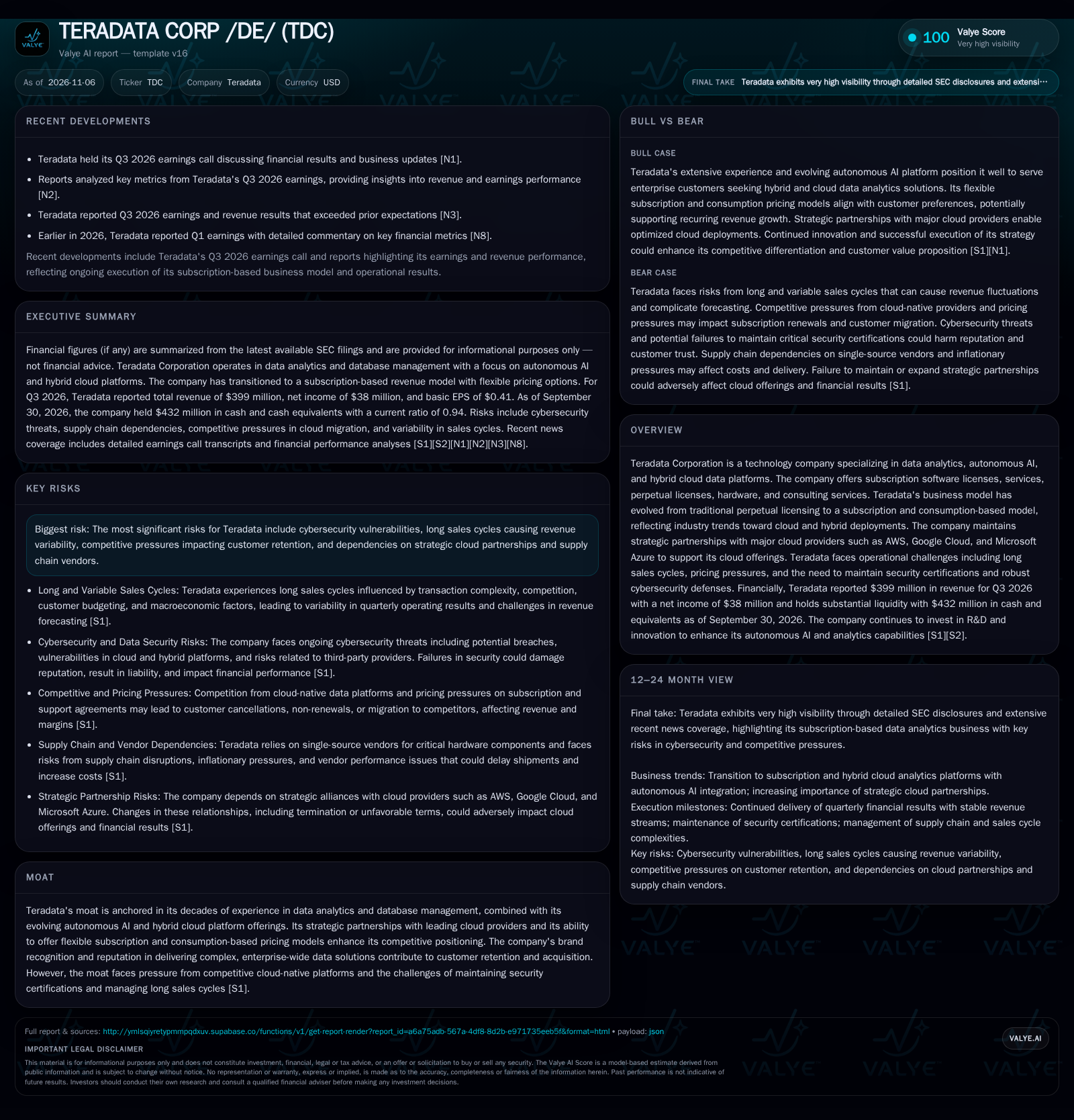
Teradata reported Q3 2026 revenue of $399 million, with $55 million from subscription software and $304 million from services. The company has transitioned to a subscription and flexible consumption pricing model, emphasizing hybrid cloud and AI-driven analytics. Despite recent earnings outperformance, Teradata faces persistent risks from long sales cycles, cloud-native competitors, cybersecurity threats, and supply chain dependencies [S2] [N1] [N2] [N3].
Teradata’s evolution into a hybrid cloud analytics and autonomous AI platform provider has reshaped both its commercial model and its risk profile. With subscription and consumption-based pricing now central, the company’s Q3 2026 results highlight momentum in services and recurring software revenue, but also expose the persistent complexity of enterprise sales cycles and intensifying competition from cloud-native rivals. As Teradata deepens its integration with major cloud providers and invests in AI-driven innovation, the central question is whether its hybrid approach can deliver durable margin growth while managing operational frictions and strategic dependencies.
Recent Earnings Highlight Subscription Growth and Changing Revenue Composition
For the three months ended September 30, 2026, Teradata reported total revenue of $399 million. Of this, subscription software licenses accounted for $55 million, while services contributed $304 million. Gross profit was $238 million, operating income reached $54 million, and net income was $38 million. Basic earnings per share stood at $0.41, diluted at $0.40 [S2].
The company’s balance sheet as of September 30, 2026, showed $432 million in cash and equivalents, current assets of $731 million, and current liabilities of $777 million, resulting in a current ratio of 0.94 and a cash ratio of 0.56 [S2]. This working capital profile underscores the importance of operational discipline, especially as Teradata invests in ongoing R&D and cloud partnerships.
Teradata’s transition from perpetual licensing to subscription and consumption-based pricing models is now reflected in its reported revenue streams, with a significant portion derived from recurring software and services contracts [S1] [S2]. This evolution drives greater revenue visibility but also exposes the company to renewal risk and competitive pricing pressures.
Economics of Subscription Models in Cloud-Based Analytics Services
Teradata’s shift to a subscription- and consumption-based revenue model fundamentally alters its revenue mix, cash flow profile, and customer engagement dynamics. Subscription and services revenues—now the majority of the top line—support higher revenue visibility and can smooth cyclicality relative to the legacy perpetual license model [S1] [S2]. However, this model typically involves lower upfront payments and requires robust renewal and expansion motions to sustain long-term growth.
Pricing is increasingly tied to customer consumption and usage in cloud or hybrid deployments, introducing both flexibility and variability. While this can align pricing with customer value and drive expansion within accounts, it also creates exposure to customer optimization and cost-cutting efforts, which can compress realized average revenue per user (ARPU) if customers scale back usage.
The hybrid cloud architecture requires continuous investment in R&D, integration, and security certifications—cost drivers that may be partly offset by operating leverage as cloud adoption scales. Consulting and managed services, though margin-dilutive compared to pure software, remain an integral part of the value proposition, especially for complex enterprise migrations and hybrid deployments.
The company reported cash and liquidity metrics for the period; these figures do not by themselves establish operating runway, investment capacity, financial flexibility, or financing capacity. [S2] The ability to generate and reinvest operating cash flow, rather than relying on external financing, will be a key determinant of strategic flexibility.
Balancing Hybrid Capabilities with Cloud-Native Market Entrants
Teradata’s core competitive proposition lies in its ability to deliver robust analytics across hybrid environments, leveraging longstanding expertise in data management, autonomous AI, and integration with major cloud providers. This hybrid positioning appeals to large enterprises with complex data needs and regulatory requirements that preclude full public-cloud adoption.
However, the rise of cloud-native data platforms—such as those offered by hyperscalers and specialized analytics vendors—intensifies pricing pressure and accelerates customer migration risk. These competitors often provide more seamless integration, aggressive pricing, and rapid feature development, challenging Teradata’s value proposition, particularly for net new workloads.
Strategic partnerships with AWS, Google Cloud, and Microsoft Azure are double-edged: they enable Teradata to extend its reach, but also create dependency and risk of disintermediation if cloud providers expand their own analytics offerings or alter partnership terms [S1].
Switching frictions for existing large enterprise customers remain material due to the complexity and cost of data migration, process reengineering, and regulatory compliance. However, these barriers are eroding as cloud-native tools mature and as enterprises increasingly prioritize cost efficiency and agility over legacy lock-in.
Enterprise Expansion Potential from Hybrid Cloud and AI Integration
The favorable scenario is anchored on Teradata successfully leveraging its hybrid platform and autonomous AI capabilities to deepen wallet share with existing enterprise customers and attract new accounts seeking flexible, multi-cloud analytics. If the company can demonstrate clear ROI from autonomous AI-driven workflow automation and analytics, it could command premium pricing and reduce churn.
Expansion of strategic partnerships—with deeper integration into AWS, Google Cloud, and Azure marketplaces—could accelerate customer acquisition and enable Teradata to participate in broader cloud migration tailwinds. Successful migration of on-premises customers to hybrid or cloud subscriptions would support recurring revenue growth and may drive operating leverage as cloud services scale.
Confirmation of this scenario would come from sustained growth in subscription ARR (if reported), improving gross margins, and evidence of large enterprise win-backs or expansions in competitive settings. Reduced sales cycle lengths and increased multi-year contract commitments would also signal improved commercial traction.
Incremental Gains Supported by Hybrid Cloud Advantages Amid Market Frictions
The most plausible path is that Teradata maintains modest growth as a hybrid analytics provider, with the cloud subscription model gradually overtaking legacy on-premises revenue. Services remain a large portion of revenue, reflecting the complexity of customer environments and the ongoing need for consulting and support.
Competitive pricing pressure and long sales cycles persist, limiting rapid margin expansion. Customer migration to cloud platforms is steady but accompanied by some churn and pricing renegotiation, especially as cloud-native competitors target existing accounts.
Base-case confirmation would include relatively stable or slightly growing subscription revenues, consistent gross margin performance, and continued reliance on large strategic accounts. Any step-change in customer adoption of autonomous AI features or a notable reduction in sales cycle duration would suggest positive momentum beyond this base trajectory.
Recurring Revenue Risks from Competitive and Partnership Developments
The adverse scenario involves accelerated customer migration to cloud-native competitors, resulting in subscription cancellations, non-renewals, and contraction of services revenue. If major cloud partners deprioritize Teradata integrations or introduce competing analytics offerings, the company’s hybrid advantage could erode rapidly.
Cybersecurity breaches or failures to maintain key certifications (such as ISO 27001 or FedRAMP) could undermine customer trust and trigger costly remediations, while persistent supply chain disruptions may drive up costs and delay critical platform deployments.
Evidence for this scenario would include sequential declines in subscription ARR or services revenue, loss of strategic accounts, adverse partnership announcements from hyperscalers, or material increases in customer churn. Prolonged sub-1.0 current ratios without clear cash flow improvement would also signal rising operational stress.
Teradata’s Cloud Analytics Progress and Market Positioning Factors
Progression in subscription annual recurring revenue (ARR)—if disclosed—would reveal the health and stickiness of the new business model.
Gross margin trends, especially in the software and cloud segment, would help gauge pricing power and the impact of competition.
Sales cycle duration and conversion rates: Any material reduction in average sales cycle length would suggest improved go-to-market efficiency.
Churn and renewal rates for cloud and hybrid subscriptions—if reported—would clarify customer retention risks.
Depth and breadth of cloud partnerships: Announcements of deeper integrations or expanded go-to-market with AWS, Google Cloud, or Azure would be positive signals.
Customer migration rates from on-premises to cloud/hybrid platforms, and any revenue dislocation during these transitions.
Cybersecurity incident disclosures or changes in certification status (e.g., ISO 27001, FedRAMP) would be critical to monitoring reputational and operational risk.
Working capital and free cash flow trends: Sustained improvement would indicate better operational discipline and strategic flexibility.
Disclaimer: This is research-only, informational analysis and not investment advice. It may include AI-generated interpretation and general industry context. Always verify important details using primary sources.

Comments