
Iris Acquisition Corp II: Execution Window Narrows as SPAC Pursues Freedom Metals Combination
With a letter of intent signed to form Freedom Metals Corporation, Iris Acquisition Corp II transitions from target search to deal execution. The company's globally experienced management team and generalist mandate offer flexibility, but the clock is ticking toward its mandated business combination deadline.
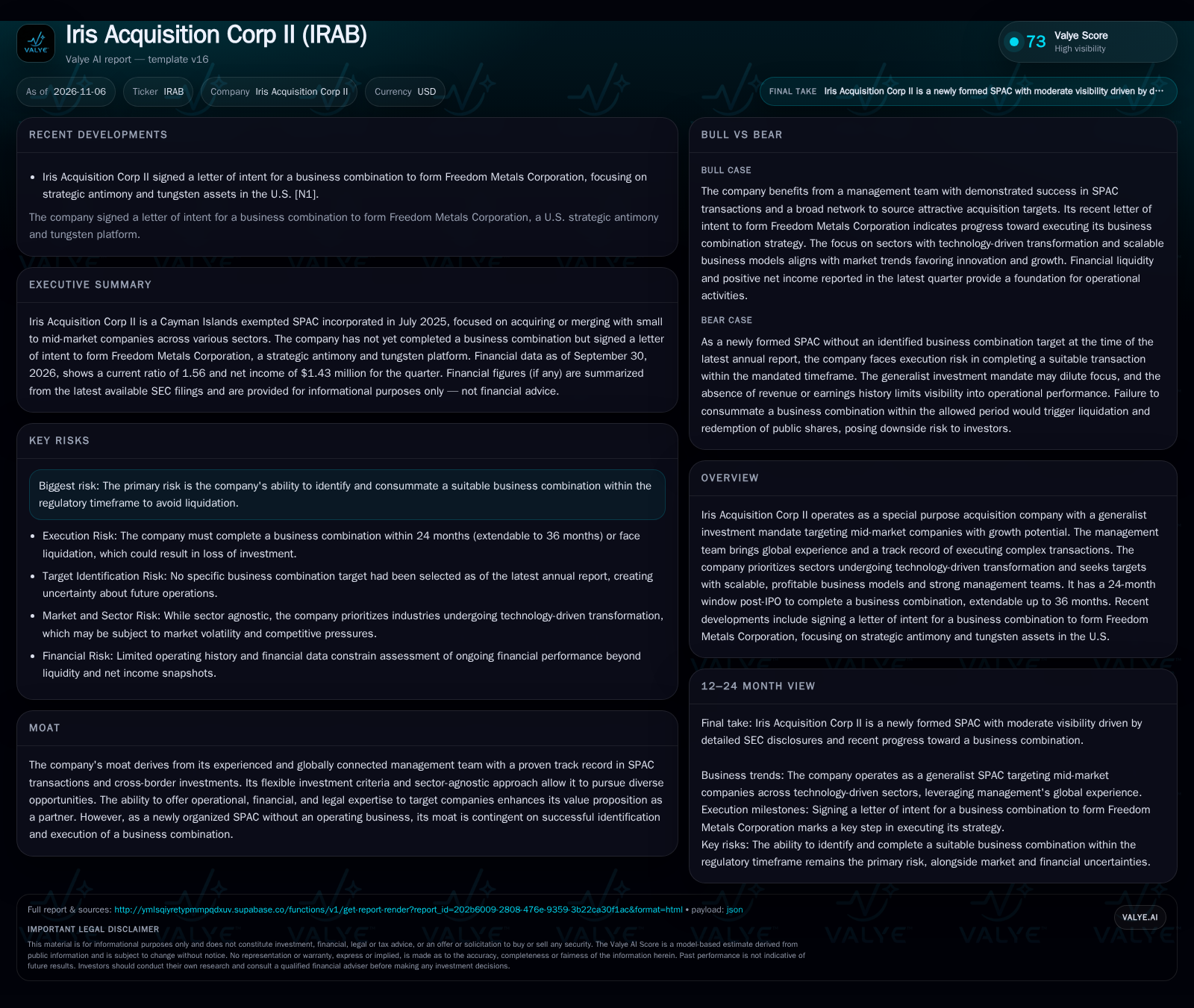
Iris Acquisition Corp II, a Cayman Islands SPAC, has signed a letter of intent for a business combination to create Freedom Metals Corporation, targeting U.S. antimony and tungsten assets. The company reported $574,063 in cash and $1.43 million in net income for the quarter ending September 30, 2026. With a flexible sector approach and a globally experienced management team, the primary risk now centers on executing the deal before the 24–36 month deadline or facing liquidation. The next phase will test the team's ability to convert intent into a value-accretive transaction. [S1] [S2] [N1]
Iris Acquisition Corp II, a recently formed SPAC, has reached a pivotal stage with the signing of a letter of intent to create Freedom Metals Corporation—a U.S.-focused platform for strategic antimony and tungsten assets. This development shifts the company from the search phase to the complex work of deal execution, with a regulatory clock ticking toward either a successful merger or mandatory liquidation. The management’s global track record and sector-agnostic mandate offer broad opportunity, but the true test will be converting this intent into a completed, value-creating transaction before the window closes.
Recent Deal Progress and Financial Position Define the Immediate Outlook
Iris Acquisition Corp II recently signed a letter of intent to form Freedom Metals Corporation, targeting U.S. antimony and tungsten assets—representing a shift from general target search to a concrete deal pathway. This is the company’s first public step toward fulfilling its core SPAC mandate. As of September 30, 2026, the company held $574,063 in cash and cash equivalents, with current liabilities of $416,476, resulting in a current ratio of 1.56 and a cash ratio of 1.38. Net income for the quarter was $1,430,836, but this figure reflects non-operating income; the company does not yet generate operating revenue. The SPAC faces a 24-month deadline from IPO (February 2026), extendable to 36 months, to consummate a business combination or return capital to shareholders. [S1] [S2] [N1]
SPAC Economics: Trust Account Structure and the Value Creation Challenge
SPACs like Iris Acquisition Corp II operate by raising capital through an IPO, placing proceeds (minus IPO costs and sponsor contributions) in a trust account, and using those funds to acquire or merge with a target company. The economics depend on identifying a business with growth potential and structuring a transaction that both unlocks value and survives post-merger public scrutiny. In this model, revenue is not generated until a combination occurs; interim income is typically limited to interest on trust assets. The $168.5 million raised at IPO (with additional private placement units) provides the capital base for acquisition but also creates dilution pressure from warrants, sponsor shares, and deferred underwriting fees. Operating leverage only materializes post-combination, depending on the economics of the chosen target. The main capital need is to identify a target that meets the 80% trust value threshold and can withstand redemptions if public shareholders opt out. If the Freedom Metals deal advances, the ultimate economics will hinge on the target’s asset quality, commodity exposure, and ability to generate sustainable cash flows as a public entity.
Global Networks Versus SPAC Market Saturation: Where Iris Acquisition Corp II Stands
The company’s competitive positioning rests on its globally diverse management team with prior SPAC execution experience, including cross-border dealmaking in private equity, technology, and real estate. This breadth may differentiate it in sourcing targets, particularly in sectors or geographies less saturated by U.S.-centric SPACs. However, the SPAC market remains crowded, with many vehicles competing for a shrinking pool of attractive targets—especially in the mid-market and tech-enabled segments. The generalist approach confers flexibility but also risks dilution of focus and investor uncertainty about sector specialization. The shift toward a strategic metals platform could provide thematic differentiation, as antimony and tungsten are critical minerals with rising geopolitical relevance. Still, ultimate differentiation will depend on the quality of the transaction, the post-merger business model, and the ability to attract long-term public market support. Peer competition includes other SPACs, private equity acquirers, and established industrial or mining companies seeking similar assets.
Executing the Freedom Metals Transaction: How a Successful Deal Could Unlock Value
The most favorable outcome for Iris Acquisition Corp II is the successful execution of the Freedom Metals Corporation combination, resulting in a public company with high-quality U.S. antimony and tungsten assets. If the target demonstrates scalable production, strong resource reserves, and access to differentiated end markets (e.g., defense, electronics), the transaction could capture market sentiment around supply chain security and critical minerals. Confirmation of this scenario would require completion of due diligence, definitive merger agreement signing, positive investor reception (low redemption rates), and evidence that the combined entity can achieve profitable operations and growth. Additional upside could come from post-merger capital markets access, strategic partnerships, or further asset roll-ups. Falsification would occur if the deal stalls, if material issues are uncovered in diligence, or if redemptions leave the post-merger entity undercapitalized.
From LOI to Merger: Most Likely Next Steps and What Would Validate Steady Progress
The most plausible path is that Iris Acquisition Corp II advances through due diligence and negotiations on the Freedom Metals transaction, with the process extending over several months as is typical for SPAC mergers. The deal may face hurdles, such as valuation disputes, regulatory review (especially for critical minerals), and potential shareholder redemptions. A successful outcome would be indicated by public announcement of a definitive agreement, S-4 filing, and completion of the shareholder vote with manageable redemptions—resulting in a newly listed operating company. If the deal falls through, the SPAC would need to quickly pivot to another target to avoid running out the regulatory clock. Confirmation of the base case would be sequential deal milestones; falsification would be repeated delays, loss of exclusivity, or withdrawal of the LOI.
Deal Failure or Regulatory Timed Out: How Investors Could Face Liquidation Risk
The adverse scenario is that the Freedom Metals deal does not progress—due to failed due diligence, regulatory barriers, or inability to agree on terms—and the company is unable to secure an alternative business combination within the mandated 24–36 month window. In this case, Iris Acquisition Corp II would be required to liquidate, returning trust account funds to public shareholders (minus permitted expenses), and sponsor/promote capital would be wiped out. Redemption risk is heightened if market sentiment turns against SPACs or the proposed target is viewed as risky or non-strategic. Confirmation would be deal termination, failure to announce a new target, or approaching the deadline with no viable alternative. Falsification would require either a new LOI or rapid progress on another transaction.
Milestones That Will Define the Success or Failure of the Iris Acquisition Corp II Thesis
Announcement of a definitive merger agreement for Freedom Metals Corporation, with disclosed transaction terms, would provide the first test of deal viability.
Filing of an S-4 or equivalent proxy/registration statement with the SEC, indicating regulatory progress and deal structure transparency.
Level of public shareholder redemptions at the merger vote—if disclosed—as high redemptions could impair post-merger capitalization.
Disclosure of the resource quality, production economics, and customer pipeline (if any) for the Freedom Metals platform, as these will drive post-merger valuation.
Any regulatory reviews or CFIUS notifications, given the strategic nature of U.S. antimony and tungsten assets.
Timeline and clarity on the SPAC’s remaining window to complete a merger before forced liquidation; a useful metric would be months remaining until the deadline.
Updates on management’s ability to source alternative targets if the current LOI fails, including any new LOIs or public statements on deal pipeline.
Disclaimer: This is research-only, informational analysis and not investment advice. It may include AI-generated interpretation and general industry context. Always verify important details using primary sources.

Comments