
Elanco Animal Health: Managing Generics, Regulatory Changes, and Manufacturing Scale in a Competitive Market
Recent regulatory approvals and manufacturing investments have positioned Elanco for growth, but the company faces intensifying generic competition, evolving regulatory headwinds, and the operational complexities of a global animal health business. The next phase will test its ability to defend key franchises, integrate acquisitions, and realize efficiencies from its expanded production footprint.
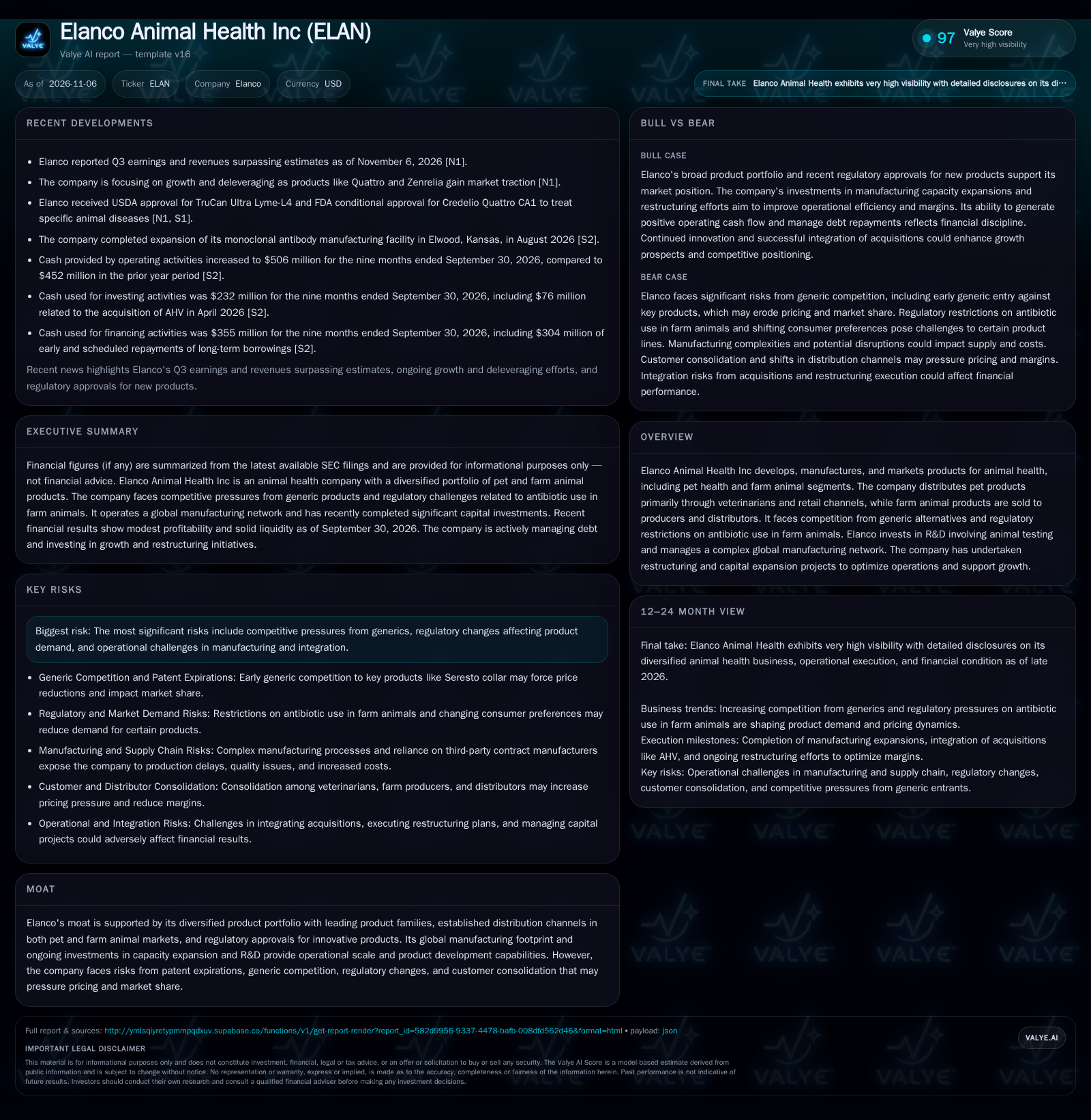
Elanco Animal Health’s Q3 2026 results beat expectations, bolstered by new product launches and operational restructuring, but the company now faces early generic competition to major products and regulatory pressures on farm animal segments. Successful integration of recent acquisitions and execution of manufacturing and R&D optimization will be critical as Elanco seeks to defend margins and drive growth in an increasingly competitive and regulated market. [N1] [S2]
Elanco Animal Health enters late 2026 at a strategic inflection point: strong recent financial performance and successful product launches are counterbalanced by growing generic competition to flagship franchises and tightening regulatory restrictions, particularly in farm animal segments. With a global manufacturing expansion just completed and further restructuring underway, Elanco’s ability to integrate new assets, defend its market positions, and adapt to changing industry dynamics will determine whether it can sustain growth and margin improvement in a rapidly evolving animal health landscape.
Recent Approvals, Operational Restructuring, and Early Generic Competition Define Elanco’s 2026 Backdrop
Elanco reported Q3 2026 net income of $18 million and operating cash flow of $506 million for the first nine months of the year, up from $452 million in the same period last year, indicating improved operational performance. The company reported a current ratio of 2.09 for the period. [S2] [S2]
On the product front, Elanco secured regulatory approvals for new offerings such as TruCan Ultra Lyme-L4 and Credelio Quattro CA1, expanding its innovation pipeline. [N1] [S1] However, early generic competition to the Seresto collar in the U.S. (beginning January 2026) threatens a key franchise and could impact both pricing and market share. [S2]
The company completed a major expansion of its monoclonal antibody manufacturing facility in Elwood, Kansas, in August 2026, and is in the midst of a restructuring plan involving site closures, headcount reduction, and R&D footprint optimization. [S2] These moves are designed to support margin expansion but add integration and execution risk.
How Elanco’s Product and Channel Mix Shape Its Economic Model
Elanco’s revenue base is anchored by its top five product families, which collectively accounted for approximately 38% of total revenue in 2025, with the Advantage portfolio alone representing about 10%. [S2] This concentration creates both scale economies and vulnerability, particularly as the Seresto collar—a significant contributor—now faces early generic entry, which could accelerate price erosion and volume loss.
The company’s economics depend on a mix of higher-margin pet health products (primarily distributed through veterinarians and retailers) and generally lower-margin farm animal products, which are exposed to regulatory restrictions and volatile demand driven by disease outbreaks and changing consumer preferences. Regulatory bans on antibiotics in farm animals, as seen recently in the EU and Vietnam, directly reduce addressable markets for legacy farm animal therapeutics.
Elanco’s cost structure reflects both fixed and variable components: substantial investments in global manufacturing (16 sites plus ~140 third-party contract manufacturers) create operating leverage when volumes are strong, but also expose the company to potential underutilization and margin pressure if demand falters. [S2] Recent capital expenditures—including the Elwood facility and the AHV acquisition—add to fixed costs, increasing the importance of successful integration and volume ramp-up to defend margins.
Restructuring charges ($155 million in 2025 with more expected in 2026) indicate a focus on cost containment and portfolio optimization, but also bring near-term disruption and potential execution risk. [S2]
Defending Share Amid Generics, Regulation, and Shifting Distribution Channels
Elanco competes in a global animal health industry characterized by innovation-driven branded products, but increasingly challenged by generic entrants, especially as patents expire. Early U.S. generic competition to Seresto marks a critical test: if generics can rapidly capture share, Elanco’s pricing power and revenue predictability may weaken, especially in the pet health segment.
Customer consolidation among veterinarians, distributors, and farm producers is amplifying buyer leverage, which could further compress margins. Additionally, the rise of e-commerce and telemedicine is altering the pet health purchasing landscape, potentially bypassing traditional veterinary and retail channels on which Elanco has historically relied. This shift could disrupt established distributor relationships and challenge legacy channel economics.
On the innovation front, recent FDA and USDA approvals (e.g., TruCan Ultra Lyme-L4, Credelio Quattro CA1, Zenrelia, Befrena) demonstrate continued R&D productivity. However, regulatory scrutiny of animal testing, evolving veterinary practices, and activist pressure could slow product development or raise costs over time.
Operationally, Elanco’s global scale—spanning proprietary manufacturing and extensive outsourcing—offers cost advantages and flexibility, but also creates exposure to quality, supply chain, and integration risks, especially as the company executes on its restructuring and capital expansion plans.
Innovation and Execution Unlock Margin Expansion and Defensible Growth
A favorable outcome for Elanco would see its recent product launches (Zenrelia, Credelio Quattro, TruCan Ultra Lyme-L4, Befrena) gaining rapid market traction, offsetting generic-driven declines in legacy franchises such as Seresto. If new products capture share in both established and new markets, the company could sustain or grow revenue even as older products face price pressure.
Successful integration of the AHV acquisition and the ramp-up of the Elwood monoclonal antibody facility could drive manufacturing efficiencies and support higher-margin biologic product lines. If restructuring yields targeted cost savings and operational streamlining, Elanco may realize meaningful margin expansion.
Confirmation of this scenario would include continued outperformance on operating cash flow, evidence of sustained or growing share for new products, and margin improvement despite generic headwinds. Regulatory approvals in additional geographies for recent pipeline assets would further validate the growth thesis.
Balancing Growth from New Products Against Erosion in Legacy Franchises
The most plausible trajectory is that Elanco experiences a mixed environment: new product launches contribute incremental growth and support pricing, but are partially offset by declining sales and margin pressure in legacy products facing generic competition and regulatory headwinds.
Restructuring initiatives and manufacturing investments yield moderate efficiency gains, but integration complexity and customer consolidation limit the extent of margin improvement. Farm animal segment growth remains challenged by regulatory restrictions on antibiotics and volatile demand, while the pet health business must adapt to evolving customer purchasing behavior and increased channel competition.
Evidence supporting this scenario would be incremental improvement in margins and operating cash flow, but with revenue growth moderating and product mix shifting away from older franchises. If disclosed, stable or slightly declining market share in top product families would be consistent with this outcome. Failure to achieve full integration benefits or to offset generic losses with new product growth would tilt the scenario toward the downside.
Accelerating Generic Erosion and Regulatory Shocks Undermine Profitability
In a more adverse scenario, generic competitors rapidly capture share from Seresto and potentially other key franchises, forcing significant price reductions and volume losses in Elanco’s highest-margin products. If regulatory pressures intensify—such as broader bans on antibiotics or additional activist-driven constraints on animal testing—Elanco could face further contraction in its farm animal business and higher R&D costs.
Manufacturing and integration challenges (e.g., underutilized new capacity, quality issues, or delayed synergies from acquisitions) could compound cost pressures, eroding margins and straining the balance sheet. Customer consolidation and the rise of alternative channels (e-commerce, telemedicine) might accelerate pricing pressure and disrupt legacy distribution economics before Elanco can adapt its go-to-market strategy.
Confirmation of this downside would be a sharp drop in revenue or margins from flagship products, negative operating leverage as fixed costs remain high, and warning signs such as inventory build-ups, channel destocking, or missed synergy targets. Higher restructuring or integration charges without corresponding financial improvement would further support the adverse case.
Milestones That Will Determine Whether Elanco Can Sustain Its Competitive Position
Market share and realized pricing for the Seresto collar in the U.S. pet health segment, especially as generics enter (if disclosed), will be a direct test of Elanco’s ability to defend core franchises.
Revenue growth and adoption rates for recently launched products such as Zenrelia, Credelio Quattro, TruCan Ultra Lyme-L4, and Befrena—segmented by geography and channel where possible—would help gauge the success of the innovation pipeline.
Progress on manufacturing efficiency and capacity utilization at the Elwood monoclonal antibody facility, including any disclosed cost savings or operating leverage, will indicate whether the capital investment is translating into financial benefit.
Integration milestones and financial contributions from the AHV acquisition, including realized synergies and revenue expansion, would be important for assessing acquisition execution.
Gross margin trends and restructuring cost realization, including the impact of site closures and workforce reductions, will signal whether operational streamlining is delivering sustainable margin improvement.
Exposure to regulatory changes—such as new or expanded bans on antibiotic use in farm animals—and any related impacts on product sales should be closely tracked.
Shifts in channel mix for pet health products, including the proportion sold via e-commerce and telemedicine versus traditional veterinary and retail distributors, would help test Elanco’s adaptability to changing purchasing behavior.
If disclosed, customer concentration metrics and the degree of pricing pressure in negotiations with veterinary groups, distributors, and large farm producers would further clarify the evolving bargaining dynamics.
Disclaimer: This is research-only, informational analysis and not investment advice. It may include AI-generated interpretation and general industry context. Always verify important details using primary sources.

Comments