
Under Armour’s Margin Recovery Efforts Face Test as Revenue Growth Stalls and Brand Repositioning Takes Priority
Despite near break-even results and a reported liquidity position, Under Armour’s push for margin improvement and brand transformation collides with persistent revenue softness and intensifying sector competition. The question is whether international gains and operational discipline can offset challenges in core markets and restore sustainable growth.
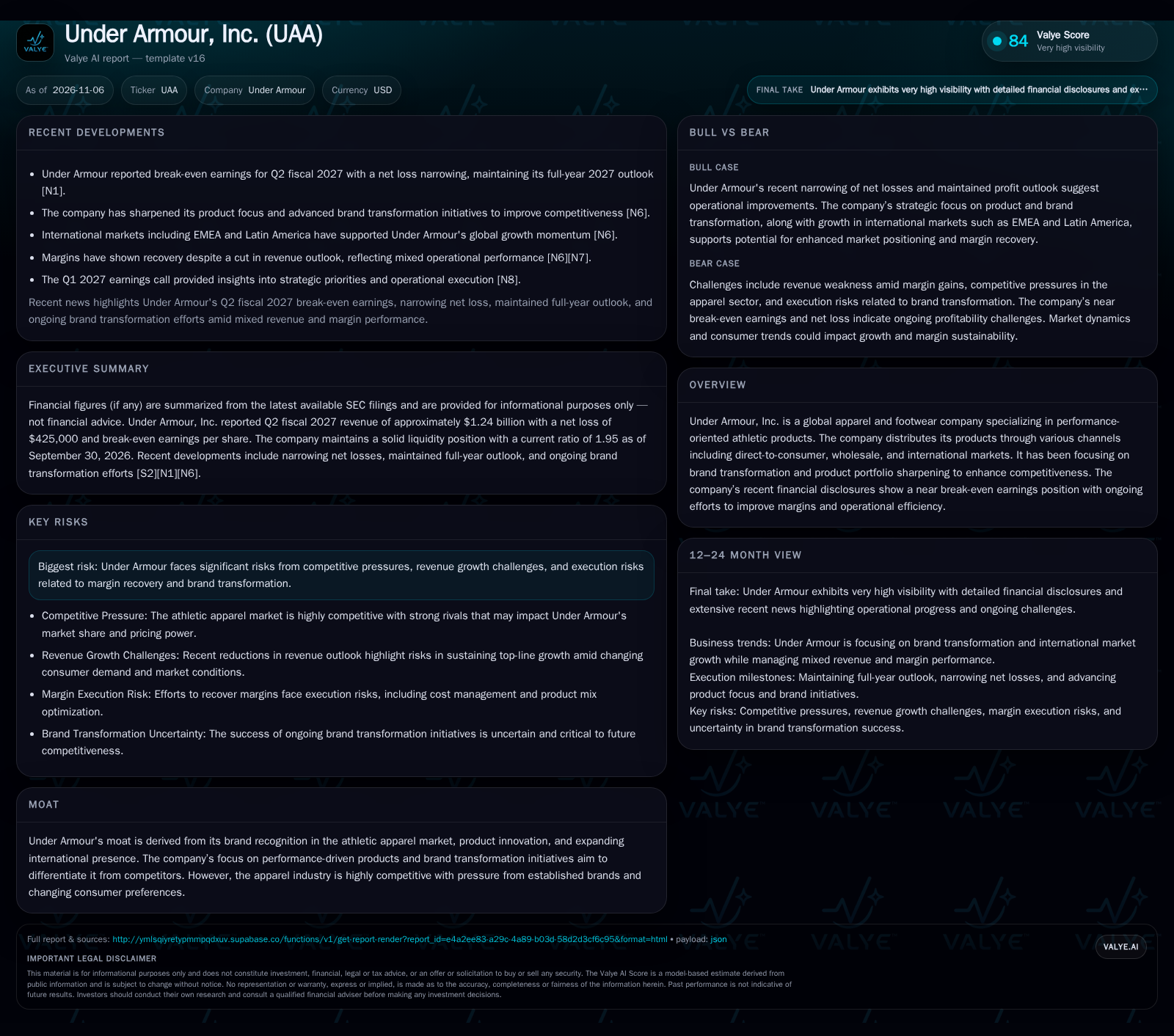
Under Armour reported Q2 fiscal 2027 revenue of $1.24 billion and a net loss of $425,000, marking a near break-even quarter amid ongoing efforts to sharpen its product focus and advance brand transformation. While reported liquidity position, margin recovery is being achieved in the context of a reduced revenue outlook and persistent competitive pressures. International markets provide growth support, but execution risks and uncertainty around transformation success remain central to the company’s outlook. [S2] [N1] [N6] [N7]
Under Armour, Inc. stands at a critical juncture as it seeks to reassert its brand relevance and restore profitability in the crowded athletic apparel market. The company’s Q2 fiscal 2027 results showed $1.24 billion in revenue and a near break-even bottom line, underscoring the tension between operational discipline and top-line weakness. With a sharpened focus on product and brand transformation, Under Armour is betting on international markets and margin recovery to offset challenges in North America and persistent competitive threats. The next phase will test whether operational improvements and a revamped brand proposition can translate into sustainable growth or if structural headwinds will continue to constrain progress. [S2] [N1] [N6] [N7]
Margin Gains Offset by Revenue Weakness: The Current State of Play
Under Armour reported Q2 fiscal 2027 revenue of $1.24 billion and a net loss of $425,000, resulting in break-even earnings per share for the quarter. This outcome reflects a company at an inflection point—able to stabilize its bottom line but struggling to reignite top-line growth. As of September 30, 2026, Under Armour’s liquidity position included $284.55 million in cash, current assets of $2.24 billion, and current liabilities of $1.15 billion, yielding a current ratio of 1.95. While these figures suggest balance-sheet stability, they do not, by themselves, resolve ongoing profitability and growth concerns. The company has also reduced its revenue outlook but maintained its profit outlook, signaling that margin recovery is being prioritized amid challenging demand conditions. [S2] [N1] [N6] [N7]
How Under Armour’s Economic Model Is Evolving
Under Armour’s business economics hinge on the interplay between revenue growth, gross margin management, and the costs associated with brand transformation. Historically, the company’s model has been characterized by a mix of wholesale and direct-to-consumer (DTC) channels, with wholesale generating scale but often carrying lower margins, and DTC offering higher margins but requiring greater investment in brand, technology, and customer experience. Recent focus on product sharpening suggests an attempt to shift the sales mix toward higher-margin, differentiated offerings—potentially leaning further into DTC and premium segments.
Margin recovery efforts likely involve a combination of cost discipline, product mix optimization, and supply-chain efficiency. However, these gains are occurring against a backdrop of revenue contraction, which limits the ability to leverage fixed costs and realize operating leverage at scale. The apparel sector’s promotional intensity also means that margin gains can be fragile if inventory builds or demand softens. If the transformation succeeds in repositioning the brand, Under Armour could see improved pricing power and customer loyalty; if not, it may remain locked in a low-growth, margin-compression cycle.
Brand Perception and the Challenge of Differentiation
Under Armour operates in an intensely competitive landscape dominated by global athletic brands and an expanding field of direct-to-consumer specialists. While the company has historically relied on performance-driven product innovation and strong brand recognition, its differentiation has eroded in recent years due to shifting consumer tastes, fashion-driven cycles, and aggressive moves by both established giants and nimble upstarts.
International markets—particularly EMEA and Latin America—have become essential to sustaining growth, but these regions carry their own risks, including local competition and economic volatility. The company’s efforts to sharpen product focus and drive brand transformation are intended to reclaim differentiation, but the apparel sector’s low switching costs and high promotional activity make this a difficult task. The success of these initiatives will depend on how effectively Under Armour can communicate its value proposition, drive consumer engagement, and resist the commoditization pressures that have weighed on mid-tier athletic brands.
If Brand Transformation Takes Hold, Margin Expansion Could Follow
A favorable outcome for Under Armour would see its brand transformation initiatives resonating with consumers, leading to renewed demand for core performance products and successful expansion in international markets. If product innovation and marketing investments drive higher full-price sell-through, the company could realize improved gross margins and a healthier channel mix, with DTC and premium offerings representing a larger share of sales. Operational discipline and supply-chain efficiency would further support margin gains, while international momentum could offset North American pressures.
Evidence confirming this scenario would include sustained gross margin expansion, positive same-store sales growth in DTC channels (if disclosed), increased sell-through rates of new product lines, and market share gains in EMEA and Latin America. Commentary from management or retail partners indicating improved brand perception and pricing power would further bolster the case. Conversely, a lack of traction in new product launches or continued promotional activity would challenge the plausibility of this upside.
Operational Discipline Maintains Stability, But Structural Challenges Persist
The most plausible outcome is that Under Armour maintains operational stability through ongoing cost control and incremental margin improvement, but revenue growth remains muted, especially in North America. International sales may provide a partial offset, but are unlikely to fully compensate for domestic headwinds. The company continues to invest in brand and product initiatives, but the competitive environment and consumer behavior limit the pace of recovery.
This scenario would be confirmed by continued break-even or low-single-digit net income results, stable or modestly improving gross margins, and flat to slightly declining revenue trends. Management guidance that emphasizes margin discipline over aggressive growth would be consistent with a base case in which Under Armour remains a viable but structurally challenged player in the athletic apparel market.
Brand Efforts Stall and Revenue Slippage Accelerates
In a negative scenario, Under Armour’s brand transformation fails to gain traction, resulting in persistent or worsening revenue declines and renewed margin pressure. Competitive intensity could force the company into deeper promotional activity, eroding any recent margin gains. Inventory management challenges may re-emerge, requiring markdowns or leading to working-capital stress. International markets might also falter if macroeconomic or local competitive conditions deteriorate.
This outcome would be reflected in shrinking gross margins, widening net losses, inventory build-ups, and negative trends in cash flow. Guidance cuts or management commentary highlighting weak consumer response and ongoing competitive headwinds would further support the downside case.
What Will Determine Whether Under Armour’s Turnaround Succeeds?
Gross margin trends: Sustained improvement would signal successful product mix and operational discipline; deterioration would suggest renewed pricing or inventory pressure.
Revenue growth rates by region (if disclosed): Acceleration in EMEA and Latin America could offset North American weakness; declines would signal broader demand issues.
Direct-to-consumer and e-commerce penetration (if disclosed): Higher DTC mix would indicate progress toward higher-margin, brand-led sales.
Inventory levels and turnover: Efficient inventory management is crucial to avoiding markdowns and preserving margins.
Sell-through rates of new product launches (if disclosed): Success here would validate product focus and innovation strategy.
Management commentary on brand perception and consumer engagement: Positive signals would support the transformation thesis.
Guidance updates on revenue and profit outlook: Upward revisions would indicate strengthening fundamentals, while further cuts would raise red flags.
Disclaimer: This is research-only, informational analysis and not investment advice. It may include AI-generated interpretation and general industry context. Always verify important details using primary sources.

Comments