
Farmers National Banc: Dividend Strength, Regional Scale, and Sustaining Margins in a Changing Banking Environment
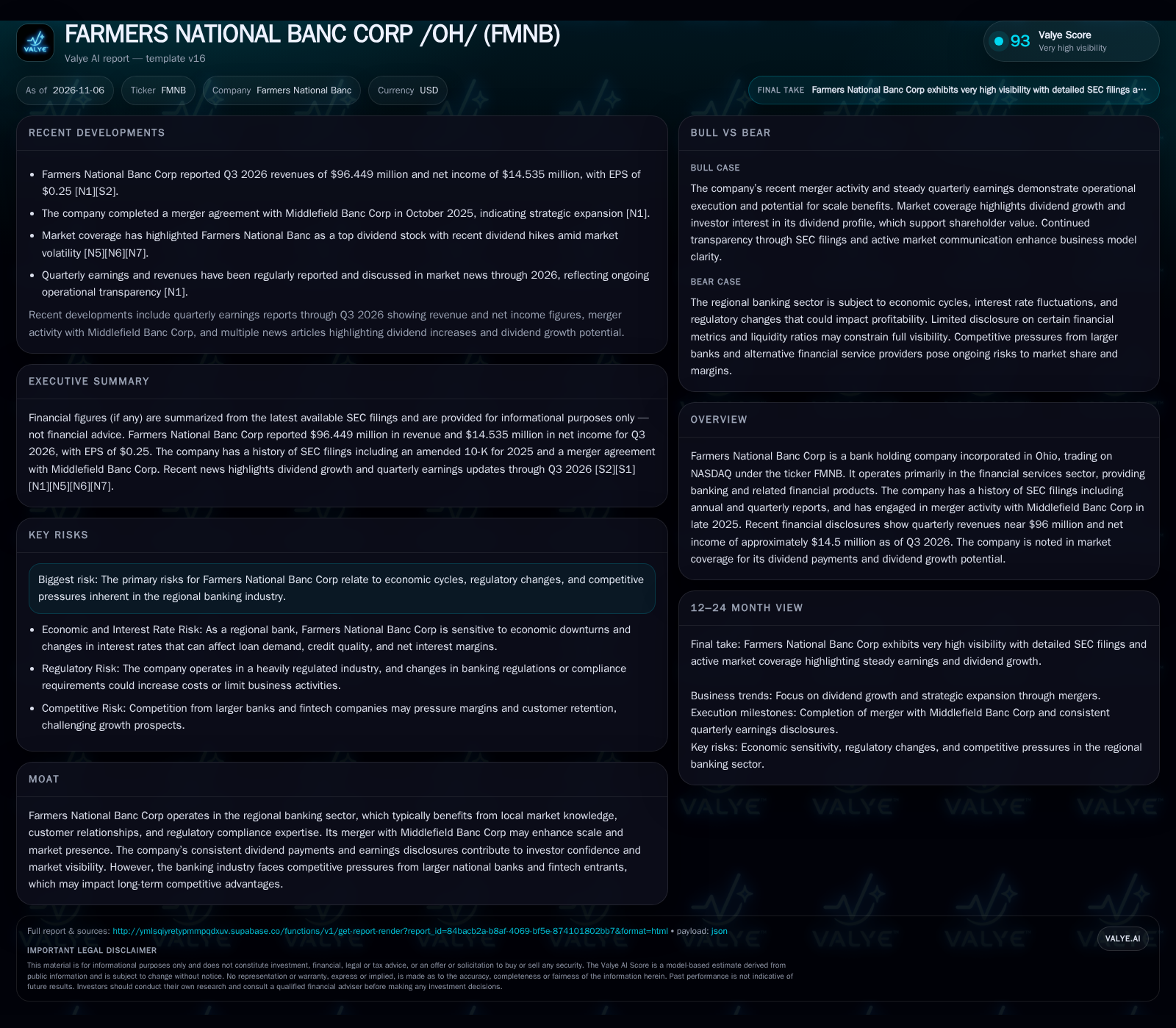
Farmers National Banc Corp reported Q3 2026 revenues of $96.4M and net income of $14.5M, with $0.25 EPS, underscoring stable earnings and a robust dividend profile.
Farmers National Banc Corp reported Q3 2026 revenues of $96.4M and net income of $14.5M, with $0.25 EPS, underscoring stable earnings and a robust dividend profile. However, as a regional bank, it remains exposed to interest rate volatility, regulatory risk, and heightened competition from both large banks and fintechs, making future margin and growth less certain. The thesis hinges on whether scale, local relationships, and dividend discipline can offset sector-wide pressures and a lack of granular liquidity disclosure. [S2] [N7]
Farmers National Banc Corp, a Canfield, Ohio-based regional bank holding company, delivered solid third-quarter 2026 results, reporting revenues just above $96 million and net income of $14.5 million. Yet, beneath the surface, the realities of regional banking—exposure to interest rate cycles, regulatory uncertainty, and increasing competition from both larger financial institutions and fintech disruptors—pose strategic questions about the durability of Farmers National Banc’s margins and growth prospects. The company’s future will likely be shaped by its ability to balance stable shareholder returns with the evolving demands of a changing banking landscape. [S2] [N7]
Recent Results Highlight Stability but Leave Open Questions on Resilience
Farmers National Banc Corp reported $96.449 million in revenue and $14.535 million in net income for the third quarter ended September 30, 2026, with basic and diluted earnings per share of $0.25. These outcomes reflect continued operational profitability and underscore the company’s positioning as a consistent performer within the regional banking sector. The market has noted Farmers National Banc’s dividend payouts and recent dividend hikes, reinforcing its appeal to income-focused investors. However, the most recent liquidity figure available is from 2013, limiting visibility into the company’s current cash and liquidity position. This absence of up-to-date liquidity data makes it difficult to assess the company’s short-term potential financial flexibility and ability to absorb shocks or capitalize on opportunities. [S2] [N7]
How Farmers National Banc Earns and Allocates: Spreads, Scale, and Dividend Discipline
As a regional bank holding company, Farmers National Banc Corp’s core economic engine is net interest income—primarily the spread between interest earned on loans and securities and interest paid on deposits and other funding sources. Fee income from ancillary banking services may contribute, but interest spread remains the largest driver. The fixed cost base includes branch operations, regulatory compliance, and technology infrastructure, while funding costs and loan loss provisions can fluctuate significantly with macroeconomic conditions. Operating leverage is attainable through loan book growth and scale—either organically or via mergers—but is constrained by the need to maintain credit quality and regulatory capital.
Dividend payments are a prominent feature of the company’s capital allocation, with recent hikes drawing positive market attention. The sustainability of these dividends depends on maintaining stable or growing earnings and prudent credit risk management. The company reported cash and liquidity metrics for the period; these figures do not by themselves establish operating runway, investment capacity, financial flexibility, or financing capacity. If the company can maintain credit quality and manage funding costs effectively, its model could generate attractive risk-adjusted returns; however, rising deposit costs and potential declines in loan demand during adverse cycles could erode profitability.
Local Relationships Versus Scale: Navigating a Crowded Banking Field
Farmers National Banc operates in a highly competitive regional banking landscape, contending with larger national banks, other regional peers, and increasingly, digital-first financial platforms. The company’s main competitive advantages likely stem from local market knowledge, long-standing customer relationships, and a reputation for reliable service—attributes that can support retention and cross-selling, particularly in less urban markets where national players may lack reach.
However, the sector is experiencing margin compression due to rising deposit costs, regulatory compliance burdens, and the encroachment of fintech and direct digital lenders. Larger banks enjoy cost advantages in technology and compliance, while fintechs can offer convenience and innovative products that appeal to digitally savvy customers. Farmers National Banc’s ability to defend and grow its share may hinge on leveraging local presence, selectively expanding through M&A, and adopting digital capabilities without sacrificing service quality. If the company cannot keep pace with technology or faces disproportionate compliance costs, its competitive position could erode over time.
Dividend Growth and Strategic Expansion Drive Shareholder Value
A favorable scenario for Farmers National Banc sees the company leveraging its stable earnings base and strong dividend profile to attract and retain both customers and investors. If management continues to execute on prudent loan underwriting and cost discipline, while selectively pursuing accretive M&A in adjacent markets, the company could achieve operating scale and greater pricing power.
Additional disclosure of liquidity and capital ratios would also bolster confidence in the company’s ability to weather economic downturns and maintain its payout. Conversely, a scenario where dividend growth is achieved at the expense of capital adequacy or credit quality would call this outcome into question.
Earnings Consistency Amid Sector Headwinds Sets Expectations
The most plausible near-term trajectory for Farmers National Banc is continued operational stability, with revenues and net income tracking recent levels, supported by a conservative loan portfolio and disciplined cost management. Dividend payments likely remain a core part of the shareholder value proposition, but further growth may be limited by sector-wide pressures—including rising deposit costs, regulatory compliance expenses, and moderate loan demand.
This scenario would be confirmed by flat to modestly growing quarterly earnings, stable or cautiously rising dividends, and no significant deterioration in loan quality metrics (if disclosed). If the company is able to maintain its current market share and avoid credit losses, it could continue to deliver steady—if unspectacular—returns. However, any material uptick in credit costs, deposit outflows, or regulatory burdens would be early signs that the baseline is at risk.
Margin Compression, Credit Losses, and Regulatory Costs Threaten Stability
An adverse scenario for Farmers National Banc would involve a combination of rising funding costs, declining net interest margins, and increased credit losses—potentially triggered by a regional economic downturn or an unfavorable interest rate environment.
Additional downside risks include heightened regulatory scrutiny or new compliance requirements that disproportionately impact smaller regional banks, as well as accelerated share loss to digital-first competitors. Confirmation of this scenario would be seen in declining quarterly revenues and net income, a reduction or suspension of the dividend, and any public disclosure of loan portfolio stress or capital ratio deterioration. If the company is unable to raise capital or shore up liquidity in response, the risk to shareholder value would escalate.
Milestones and Metrics That Will Shape the Dividend and Growth Thesis
The company reported profitability for the period. [S2]
Disclosure and trajectory of liquidity and capital adequacy ratios: More recent data would clarify the company’s ability to absorb shocks and fund growth (if disclosed).
Loan portfolio quality metrics, such as non-performing assets or charge-offs: Early indicators of emerging credit risk in the current economic environment (if disclosed).
Deposit growth or retention trends: Critical for funding stability, especially as competition for deposits intensifies (if disclosed).
Evidence of successful M&A integration or organic market share gains: Would signal effective execution of any expansion strategy (if disclosed).
Regulatory developments or compliance cost disclosures: Shifts in the regulatory landscape could materially impact cost structure and strategic flexibility.
Disclaimer: This is research-only, informational analysis and not investment advice. It may include AI-generated interpretation and general industry context. Always verify important details using primary sources.

Comments