
Immunocore: Can Kimmtrak’s Rare Cancer Focus Drive Sustainable Growth Beyond 2026?
Immunocore’s drive to expand Kimmtrak’s label and capitalize on rare oncology markets has fueled revenue growth and clinical momentum, but persistent net losses and sector-specific headwinds keep the long-term profit trajectory in question.
Immunocore Holdings plc has built its near-term prospects around Kimmtrak, a rare-cancer therapy that is both expanding its clinical reach and delivering double-digit revenue growth. However, Immunocore remains loss-making, and its future depends on successful clinical expansion, regulatory navigation, and the ability to translate scientific advances into durable commercial wins amid a high-risk sector.
Immunocore Holdings plc stands at a crossroads familiar to innovation-driven biopharmaceutical companies: a flagship oncology product (Kimmtrak) that is delivering tangible revenue growth and clinical development milestones, paired with the realities of ongoing net losses and sector-specific risks. The company’s reported liquidity position and recent progress in label expansion studies set the stage for potential upside, but the path to sustainable profitability—and broader commercial success—remains highly contingent on clinical, regulatory, and market developments over the next 12–24 months.
Recent Milestones and Financial Position Define Immunocore’s Present
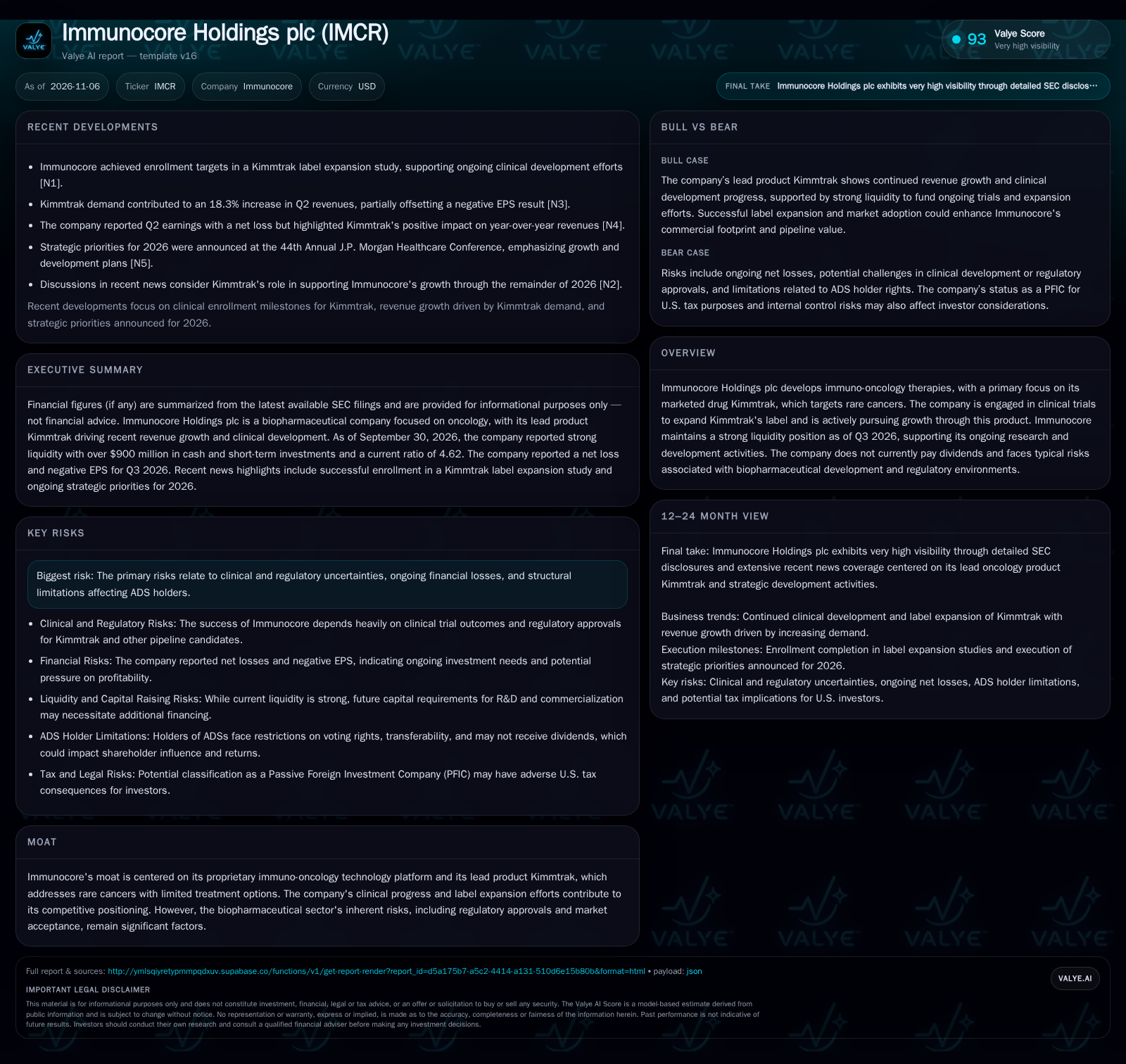
Immunocore’s Q2 2026 revenues grew 18.3% year-over-year, primarily due to demand for its rare-cancer drug Kimmtrak [N3]. The company has met enrollment targets for a Kimmtrak label expansion clinical trial, underscoring progress in broadening the drug’s addressable market [N1]. Despite these advances, Immunocore reported a net loss of $14.2 million in Q3 2026 and negative EPS of -$0.28 per share [S2]. As of September 30, 2026, the balance sheet showed over $900 million in liquid assets (cash and short-term investments), with a current ratio of 4.62 and cash ratio of 3.93, reflecting reported liquidity position [S2]. For investors, returns are expected to be realized through capital appreciation, as the company does not anticipate paying dividends in the foreseeable future [S1].
How Revenue Flows: Rare Disease Pricing, R&D Spend, and the Path to Scale
Immunocore’s economics are anchored to the commercial performance of Kimmtrak, a therapy targeting rare cancers—a segment often characterized by high pricing power but limited patient populations. Rare disease drugs typically command premium prices due to the lack of alternatives and the high unmet need, but the total addressable market is inherently constrained. As a result, top-line growth is highly dependent on successful label expansions or new indications, which can increase eligible patient pools and extend commercial life.
The company’s substantial R&D outlays reflect the capital-intensive nature of biopharma: ongoing clinical trials, regulatory submissions, and post-market studies all require sustained investment. While Immunocore’s fixed costs (infrastructure, core R&D teams) are significant, variable costs per patient are often modest once a therapy is approved, creating the potential for operating leverage if new indications can be commercialized without proportionally higher expenses.
However, persistent net losses indicate that Kimmtrak’s current revenue base is not yet sufficient to cover the aggregate cost structure, and future profitability depends on scaling revenues faster than operating costs—a common challenge for single-product biopharma companies. The company reported cash and liquidity metrics for the period; these figures do not by themselves establish operating runway, investment capacity, financial flexibility, or financing capacity.
A critical consideration in Immunocore’s economic model is the balance between upfront R&D investments and the timing of revenue realization. Given the protracted development cycles typical in oncology, the lag between clinical trial initiation and commercial returns can extend several years, intensifying liquidity demands. This dynamic underscores the importance of milestone-driven financing strategies and the potential need for external capital infusions if clinical progress or market uptake deviates from expectations. Furthermore, the company’s ability to manage its fixed versus variable cost structure will influence how quickly incremental revenues from new indications translate into improved operating margins.
Evaluating Moat and Market Dynamics in Rare Oncology
Immunocore’s competitive position rests on its proprietary immuno-oncology technology and first-mover advantage in a rare cancer niche. Kimmtrak’s focus on a disease with few treatment options creates a defensible initial market, and successful label expansions could deepen this moat. In rare oncology, barriers to entry often include complex development pathways, regulatory exclusivity (such as orphan drug status), and physician familiarity with a novel mechanism.
However, the landscape is not static. Larger pharmaceutical firms and emerging biotechs are continuously advancing their own immunotherapies, and technology substitution—from next-generation cell therapies to bispecific antibodies—could erode Kimmtrak’s differentiation over time. Additionally, payer scrutiny on rare-disease drug pricing is increasing globally, which could impact reimbursement and limit the ability to sustain premium pricing.
The company’s competitive risk is amplified by its reliance on a single marketed product. Without a broad portfolio or strong pipeline visibility, Immunocore is more vulnerable to clinical setbacks, new entrants, or shifting treatment paradigms than diversified peers.
The durability of Immunocore’s competitive moat also hinges on its capacity to innovate beyond Kimmtrak’s initial mechanism of action. As immuno-oncology rapidly evolves, competitors deploying next-generation modalities—such as engineered cell therapies with enhanced persistence or bispecific constructs with improved targeting—could challenge Kimmtrak’s clinical relevance. Immunocore’s pipeline diversification and ability to integrate emerging scientific advances into its platform will be pivotal in maintaining differentiation. Additionally, strategic partnerships or licensing agreements may serve as mechanisms to augment technological capabilities and mitigate risks associated with a narrow product focus.
Label Expansion and Market Adoption Create Self-Sustaining Growth
In an upside scenario, Immunocore successfully secures regulatory approval for Kimmtrak in additional indications, expanding the eligible patient pool and driving further revenue growth. If the ongoing label expansion study yields positive outcomes and is followed by swift regulatory acceptance, the company could begin to realize operating leverage as incremental sales are achieved with relatively modest increases in cost. Sustained clinical success would also bolster physician confidence and payer willingness to reimburse, supporting market adoption in both current and new territories.
Confirmation of this scenario would come from: (1) positive pivotal trial results and clear regulatory timelines for new indications; (2) sequential acceleration in quarterly revenues attributable to expanded use cases; (3) narrowing net losses or movement toward operating breakeven; and (4) evidence of pipeline productivity, with new drug candidates advancing beyond early-stage trials.
Incremental Growth Balanced by Persistent Investment and Sector Headwinds
The most plausible trajectory sees Immunocore continuing to grow Kimmtrak revenues at a moderate pace as it penetrates the rare cancer market and executes on label expansion. Revenue growth may be partially offset by rising competition, payer pushback on pricing, and the natural limits of a rare-disease patient base.
This scenario would be confirmed if Immunocore delivers steady—if unspectacular—top-line growth, maintains or increases R&D spend, and demonstrates progress in clinical milestones without yet achieving profitability. Headwinds such as regulatory delays, modest uptake in new indications, or pricing pressure would keep margins under pressure, but do not derail the company’s strategic path.
Clinical or Regulatory Setbacks Undermine the Kimmtrak Growth Engine
In a negative scenario, Immunocore faces adverse clinical trial results or regulatory setbacks that delay or prevent Kimmtrak’s label expansion. Without new indications or significant increases in market penetration, revenue growth stalls while the cost base remains elevated, leading to widening losses and potential pressure to raise additional capital. Increased competition from alternative therapies or unexpected safety signals could further erode market share and pricing power.
Evidence of this scenario would include: (1) negative or inconclusive trial outcomes; (2) regulatory rejections or prolonged delays; (3) flat or declining revenues despite ongoing spend; and (4) announcements of cost-cutting, restructuring, or external financing efforts in response to deteriorating fundamentals.
Milestones That Could Shift the Immunocore Thesis in 2027 and Beyond
Quarterly Kimmtrak revenue growth rates and their attribution to new indications or geographies.
Status and results of ongoing and upcoming pivotal trials for Kimmtrak label expansion.
Timeline and outcomes for regulatory submissions and decisions in key markets.
Progression of pipeline assets beyond Kimmtrak, if disclosed, including clinical-stage milestones.
Gross margin trends and evidence of operating leverage as revenues scale.
Cash burn rate relative to R&D and commercialization outlays, and its impact on projected runway.
Competitive landscape evolution—specifically, new therapy launches in Kimmtrak’s indication space.
Any material changes to ADS holder rights, tax status (PFIC classification), or capital allocation policy.
Disclaimer: This is research-only, informational analysis and not investment advice. It may include AI-generated interpretation and general industry context. Always verify important details using primary sources.

Comments