
Precision and Scale: Mettler Toledo’s Diversification and Service Strategy Shape Financial Outcomes
Mettler Toledo’s latest results highlight robust growth in laboratory and industrial segments, underpinned by a globally diversified customer base and a high-margin mix of products and services. Yet, exposure to trade disruptions and geopolitical volatility remains a persistent risk, testing the durability of its competitive advantages and the scalability of its service-driven business model.
Mettler Toledo delivered 6% year-over-year sales growth in Q3 2026, with strong contributions from laboratory and industrial products across all major regions. Its business is defined by high gross margins, a global footprint, and a recurring service component, but ongoing tariff uncertainty and geopolitical risks could challenge future momentum. The company’s broad product suite and direct customer relationships support resilience, though margin sustainability and end-market demand remain key variables. [S2]
Mettler Toledo’s Q3 2026 results underscore the strength of its global business model: revenue rose 6% year-over-year, powered by gains in both laboratory and industrial products. The company’s high gross margins and balanced geographic exposure reflect the value of its premium, diversified product suite and recurring service offerings. However, macroeconomic turbulence—including tariffs and geopolitical conflict—remains a headwind. The interplay between resilient core demand, margin management, and external shocks will likely determine how much of this momentum is sustainable into 2027 and beyond. [S2]
Mettler Toledo’s Recent Results Showcase Growth and Resilience
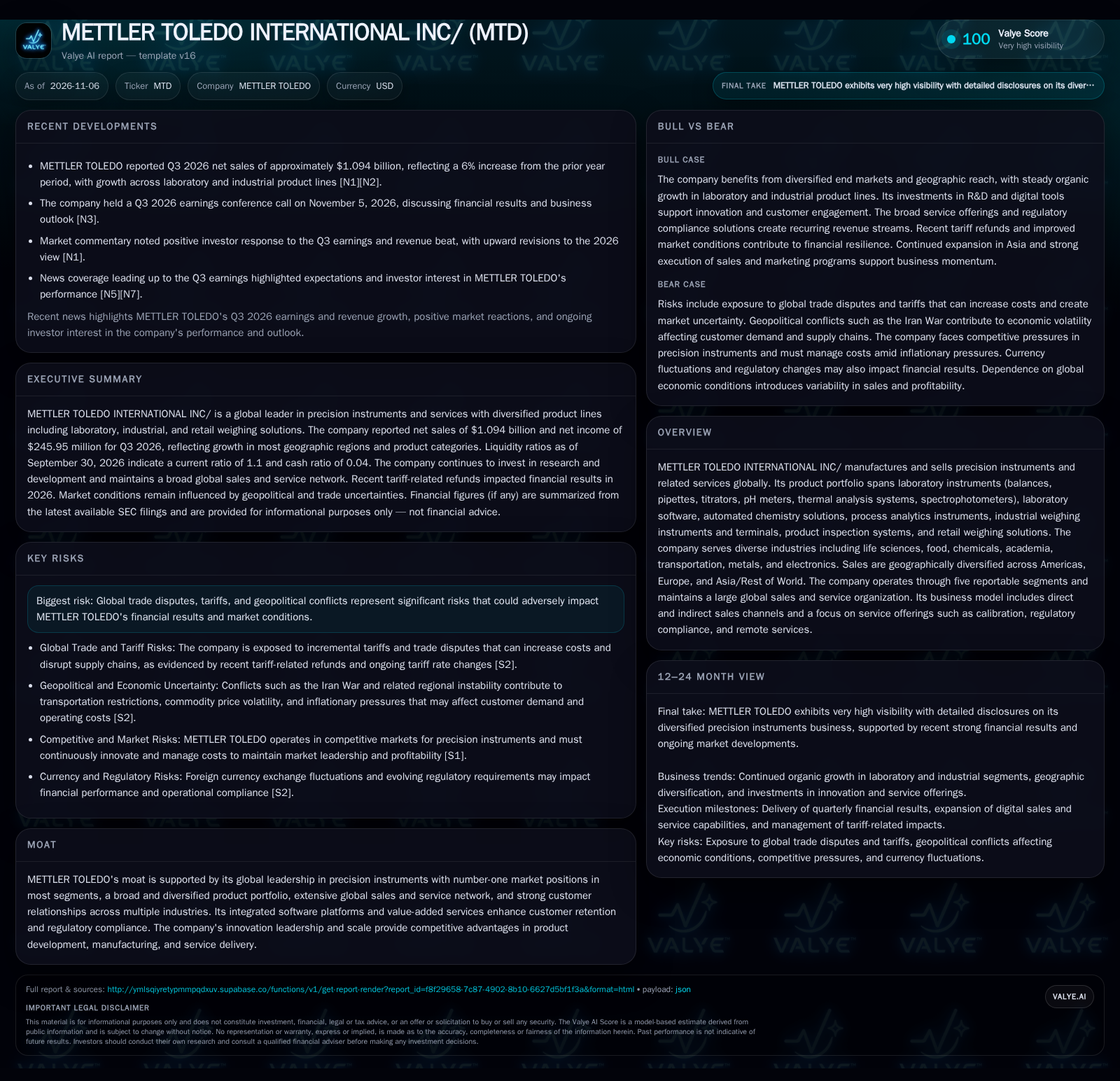
Mettler Toledo reported net sales of $1.094 billion for Q3 2026, representing a 6% increase over the prior year period. This growth was broad-based, with laboratory products and services accounting for about 55% of net sales (up 6% in USD) and industrial products and services at 40% (up 8% in USD). Organic local-currency sales growth for the first nine months of 2026 was 4%, excluding acquisitions and tariff refunds. The company’s gross profit margin remained robust at nearly 60%, while net income for Q3 reached $245.95 million. These figures reflect both underlying demand for precision instruments and the company’s ability to maintain pricing and margin discipline amid macro uncertainty. [S2]
Geographically, the company’s sales are well balanced—42% from the Americas, 29% from Europe, and 29% from Asia and other countries in 2025. No single customer represented more than 1% of total net sales, indicating a highly diversified revenue base. However, the company also noted a one-time $52 million benefit from tariff-related refunds, partially offset by $28 million in customer refunds, highlighting the ongoing impact of trade disputes. [S1] [S2]
Monetizing Precision: Exploring Margins, Services, and Scale at Mettler Toledo
Mettler Toledo’s core economic engine is its blend of high-value instruments and recurring service revenues. Laboratory and industrial products are typically sold at premium price points, justified by accuracy, regulatory compliance, and integration with specialized software (such as LabX). Gross margins near 60% reflect both the value-add of proprietary technology and the stickiness of aftermarket services like calibration, regulatory support, and remote diagnostics. Service contracts not only provide recurring revenue but also embed the company deeper into customer workflows, potentially reducing switching and price sensitivity over time.
On the cost side, research and development (R&D) expenses are about 4.9% of net sales, supporting ongoing product innovation. Selling, general, and administrative (SG&A) expenses are approximately 24.4% of net sales, with a significant portion likely tied to the direct sales and global service footprint. The company reported cash and liquidity metrics for the period; these figures do not by themselves establish operating runway, investment capacity, financial flexibility, or financing capacity. Significant upside in operating leverage could emerge if sales growth outpaces SG&A expansion, but macro shocks could quickly erode this advantage if demand falters or costs spike. [S2]
Maintaining Market Leadership in a Fragmented, High-Value Sector
Mettler Toledo holds global number-one market positions in most of its business lines, enabled by a broad portfolio, recognized brand, and an extensive service network. Its competitive edge stems from a combination of technical innovation, multi-industry reach, and a direct sales/service model for sophisticated products. The company’s integrated software platforms and regulatory expertise further differentiate its offerings, particularly for customers in life sciences, food, and regulated industries where compliance and data integrity are critical.
However, the precision instrument market remains competitive, with specialized and lower-cost rivals targeting niche or price-sensitive segments. Substitution risk from automation, digital sensors, and lower-cost alternatives exists, especially in commoditized or emerging market applications. Mettler Toledo’s reliance on innovation and service quality, rather than price, means that maintaining leadership requires constant investment and vigilance. Its global footprint and deep customer relationships provide switching friction, but these advantages could erode if competitors narrow the technology or service gap.
Margin and Revenue Gains Possible Through Innovation and Service Growth
If Mettler Toledo successfully leverages its R&D investments to launch new high-value instruments and expand its digital and remote service offerings, it could accelerate both top-line growth and margin expansion. Upside could also come from deeper penetration in fast-growing Asian markets, where Q3 2026 sales rose 14% in local currency, and from converting more customers to service contracts and integrated software solutions.
Confirmation of this scenario would involve sustained organic sales growth above 5%, steady or rising gross margins, and evidence of increased service and software mix in reported revenues. Additional upside indicators would include expansion of direct sales in emerging markets and increased R&D productivity (e.g., new product launches or software platform adoption rates). Evidence that would falsify this scenario includes a slowdown in innovation cadence, margin compression from pricing pressure, or stalled growth in key regions. [S2]
Diversification Supports Growth Amid Margin Pressure from External Factors
The most plausible trajectory is for Mettler Toledo to continue delivering mid-single-digit organic growth, supported by broad end-market exposure, a diversified geographic footprint, and incremental innovation in both products and services. Gross margins are likely to remain robust, given the company’s premium positioning and service revenue mix, but may fluctuate within a narrow band due to currency volatility, input cost pressures, or competitive discounting.
Risks from tariffs and geopolitical disruptions could intermittently affect both revenues and costs, but the company’s lack of customer concentration and broad industry reach should mitigate the worst-case impacts. Confirmation of this scenario would include continued organic sales growth in the 3-5% range, stable gross margins near 60%, and no material deterioration in regional or product-line performance. Evidence that would challenge this scenario includes a sharp slowdown in one or more regions, significant margin erosion, or unexpected declines in service contract renewals. [S2]
Geopolitical and Trade Risks Pose Challenges to Margins and Demand
A worsening of global trade disputes, escalation of geopolitical conflicts (such as the Iran War), or new tariffs could disrupt Mettler Toledo’s supply chains, inflate input costs, and dampen customer demand—especially in export-dependent regions. In this scenario, gross margins could compress as the company absorbs higher costs or is forced to discount to maintain volumes. Delays or reductions in capital spending by industrial or academic customers could further pressure revenues, especially if global economic conditions deteriorate.
Confirmation would come from declining sales in affected regions, margin compression below historical norms, rising inventory or receivables, and increased volatility in financial results. A lack of new service contracts or a slowdown in software adoption would also signal weakening competitive position. Conversely, rapid recovery in trade conditions or effective cost pass-through would falsify the downside thesis. [S2]
Factors Influencing the Strength of Mettler Toledo’s Premium Position
Organic local-currency sales growth by segment and region—especially in Asia, where recent growth has outpaced other geographies—would help test the company’s ability to capture emerging market opportunities. [S2]
Gross profit margin trends, with a focus on the impact of input costs, pricing discipline, and service/software mix, would provide early signals of margin resilience or vulnerability. [S2]
The proportion of revenue from recurring services and software, if disclosed, would clarify the extent of embedded customer relationships and switching costs.
R&D efficiency metrics such as new product launch cadence, software adoption rates, or patent filings would indicate the sustainability of innovation-driven differentiation.
Customer retention rates or service contract renewal rates, if disclosed, would help test the strength of customer switching frictions.
Regional sales performance in the face of new tariff or geopolitical disruptions would reveal the company’s capacity to withstand external shocks.
Updates on direct versus indirect channel sales mix would illuminate whether the company is expanding its value-added approach or facing commoditization pressures.
Disclaimer: This is research-only, informational analysis and not investment advice. It may include AI-generated interpretation and general industry context. Always verify important details using primary sources.

Comments