
Citizens & Northern: Profitability, Dividend Continuity, and Navigating Sector Uncertainties
Citizens & Northern Corp demonstrates solid recent profitability and ongoing shareholder returns, but like all regional banks, must continuously manage credit, interest rate, and regulatory risks. The company’s ability to maintain earnings momentum and dividend payouts amid sector headwinds will shape its forward trajectory.
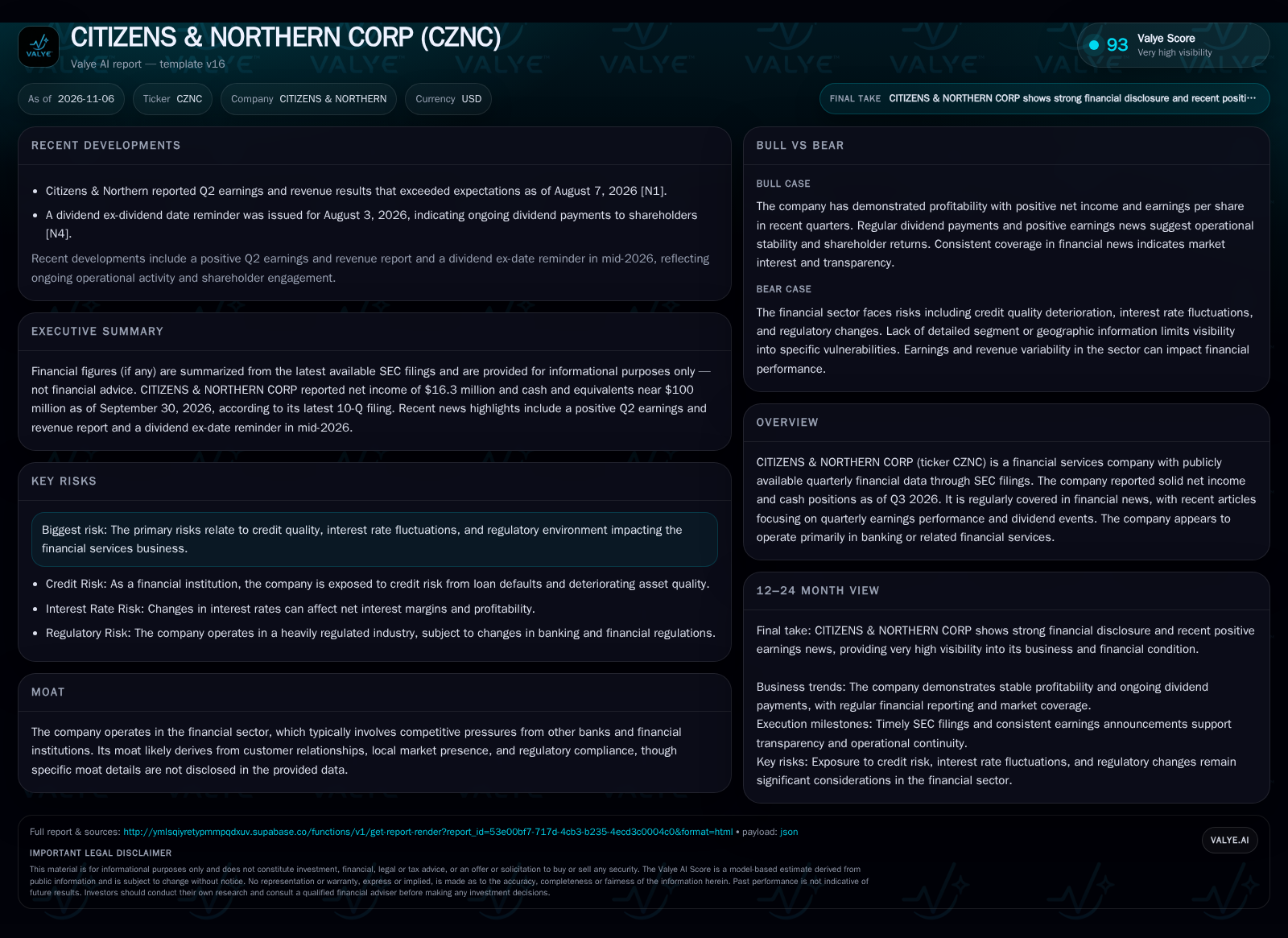
Citizens & Northern Corp reported Q3 2026 net income of $16.3 million and maintained nearly $100 million in cash and equivalents, reflecting operational strength and liquidity. Its future resilience will depend on how it navigates credit quality, interest rate volatility, and regulatory changes, with a watchful eye on earnings consistency, asset quality, and capital deployment strategy. [S2] [N1] [N4]
Citizens & Northern Corp enters late 2026 with solid financial footing, reporting robust net income and a substantial cash position. The company outperformed Q2 expectations and maintained its dividend program, signaling operational stability and a commitment to shareholder returns. However, as a regional financial institution, Citizens & Northern remains exposed to evolving credit conditions, interest rate trends, and regulatory dynamics that could challenge its earnings resilience and capital allocation decisions in the coming quarters.
Recent Results Underscore Earnings Strength and Shareholder Focus
As of September 30, 2026, Citizens & Northern reported net income of $16.3 million for the quarter, translating to basic earnings per share of $0.92 and diluted EPS of $1.72. The company’s cash and cash equivalents totaled nearly $100 million [S2]. The cited source reports dividend-related activity; that disclosure alone does not establish dividend-policy continuity, management confidence, or a material constraint on capital flexibility. [N1] [N4] These facts highlight both operational profitability and a track record of returning capital to shareholders, setting a baseline of financial strength amid a volatile sector environment.
How Citizens & Northern Generates Value: Spread, Scale, and Dividend Discipline
Like most regional banks, Citizens & Northern’s core earnings are likely driven by net interest income—the spread between yields on loans and the cost of funding (primarily customer deposits). Fee-based revenue may provide incremental upside, but interest margin remains the pivotal driver of profitability. The company’s ability to generate $16.3 million in quarterly net income suggests a well-managed balance sheet and disciplined cost structure [S2].
Operating leverage for a bank of this scale typically depends on growing loans and deposits faster than fixed costs, while maintaining strict credit risk controls. The cited source reports dividend-related activity; that disclosure alone does not establish dividend-policy continuity, management confidence, or a material constraint on capital flexibility. The company reported cash and liquidity metrics for the period; these figures do not by themselves establish operating runway, investment capacity, financial flexibility, or financing capacity. Capital needs are ongoing, as regulatory requirements and growth ambitions may demand retention of earnings or periodic capital raises depending on risk-weighted asset expansion.
Furthermore, the sustainability of Citizens & Northern’s net interest margin depends significantly on the composition and repricing dynamics of its loan and deposit portfolios. If the bank holds a substantial proportion of fixed-rate loans funded by variable-rate deposits, rising interest rates could enhance margins temporarily, but prolonged rate volatility might compress spreads if deposit costs adjust faster than loan yields. Conversely, a loan portfolio heavily weighted toward adjustable-rate instruments could provide more immediate repricing benefits but may expose the bank to borrower credit stress in a rising rate environment. Thus, the interplay between asset-liability management and macroeconomic interest rate trends is critical to maintaining earnings stability.
Capital allocation decisions also play a pivotal role in value creation. Citizens & Northern must balance dividend payouts with reinvestment in technology, branch infrastructure, and credit risk mitigation. The cited source reports dividend-related activity; that disclosure alone does not establish dividend-policy continuity, management confidence, or a material constraint on capital flexibility. The cited source reports dividend-related activity; that disclosure alone does not establish dividend-policy continuity, management confidence, or a material constraint on capital flexibility. Therefore, a nuanced understanding of how the bank prioritizes capital deployment amid competing demands would help clarify its potential financial flexibility and growth trajectory.
Customer Loyalty, Local Knowledge, and the Battle for Deposits
Citizens & Northern operates in a fiercely competitive landscape, where regional banks contend with national banks, credit unions, and fintech entrants. The primary sources of advantage are likely customer relationships, local market expertise, and a reputation for service reliability. However, these advantages are under constant pressure from digital banking platforms, rising customer expectations for seamless digital experiences, and aggressive deposit pricing by larger or online-focused competitors.
Switching costs in banking are modest for basic deposit relationships but can be higher for business customers or those with bundled lending, wealth management, or other advisory services. Regulatory compliance and community ties can reinforce barriers to entry, but the threat of substitution from digital-first banks and non-bank lenders is real. Without explicit evidence of unique technology or product differentiation, Citizens & Northern’s moat appears to rest on execution, customer trust, and prudent risk management rather than structural competitive insulation.
Earnings Momentum and Asset Quality Drive Premium Valuation Potential
If Citizens & Northern continues to post positive earnings surprises, as seen in Q2 2026 [N1], while maintaining high asset quality and disciplined expense management, the company could be rewarded with a premium valuation and the flexibility to increase dividends or pursue selective growth opportunities. This scenario would likely be confirmed by sustained net interest margin expansion, low non-performing asset ratios (if disclosed), and further beats on consensus earnings expectations.
Additional upside could come from prudent lending growth in core markets, successful adoption of digital banking services that enhance customer stickiness, or opportunistic M&A that expands the company’s footprint without diluting returns. A key falsification would be rising loan losses, margin compression, or evidence that recent earnings outperformance was unsustainable or driven by non-recurring items.
In addition to lending growth and digital adoption, operational efficiency improvements could materially enhance profitability. If Citizens & Northern successfully leverages technology to automate back-office functions, streamline compliance processes, and optimize branch networks, it could reduce expense ratios and improve return on assets. Such efficiency gains would be particularly valuable in a low to moderate loan growth environment, allowing the bank to maintain or expand net income despite margin pressures. Monitoring efficiency ratio trends and technology investment outcomes would therefore provide insight into the sustainability of earnings momentum.
Moreover, diversification of fee income streams beyond traditional lending and deposit services could contribute incremental earnings resilience. Expanding wealth management, insurance brokerage, or specialized advisory services can generate non-interest income less sensitive to interest rate cycles and credit conditions. However, successful diversification requires investment in talent and systems, as well as effective cross-selling capabilities. The degree to which Citizens & Northern can cultivate these ancillary revenue sources without compromising core banking relationships would influence its ability to weather sector headwinds and enhance shareholder returns over time.
Stable Performance Amid Sector Headwinds Remains Most Likely
The most plausible outcome is that Citizens & Northern maintains stable profitability, modest loan growth, and regular dividend payments, while managing through sector-specific challenges such as fluctuating interest rates and regulatory compliance costs. This would be confirmed by continued quarterly net income in line with recent results, maintenance of cash reserves near current levels, and no material deterioration in asset quality (if disclosed).
In this scenario, the company neither dramatically outperforms nor underperforms its peer group, but instead delivers consistent, if unspectacular, returns. Evidence against this base case would be a sudden spike in credit losses, a material decline in net interest margin, or a regulatory event that forces a strategic or capital allocation rethink.
Adverse Credit Cycle or Margin Compression Could Pressure Earnings and Capital
If economic conditions deteriorate—triggering higher loan defaults or declining collateral values—Citizens & Northern could face rising credit costs and shrinking profitability. In parallel, a sharp or prolonged decline in net interest margins (for example, due to aggressive deposit pricing or unfavorable yield curve shifts) would erode core earnings power. Regulatory changes could further tighten capital or liquidity requirements, constraining dividend capacity or forcing balance-sheet deleveraging.
This scenario would be confirmed by a drop in quarterly net income, cuts or suspensions to dividend payments, and/or a reduction in reported cash and equivalents. Early warning signs may include a rise in non-performing loans, higher loan loss provisions, or a reversal of recent earnings momentum.
Tracking Earnings Quality, Risk Exposure, and Strategic Flexibility at Citizens & Northern
Quarterly net income and EPS trends: Sustained or growing profitability would support the base and upside scenarios. A sudden decline may signal emerging risks. [S2]
Net interest margin (if disclosed): Compression would indicate pressure from funding costs or loan yield declines.
Asset quality metrics—including non-performing asset ratios and loan loss provisions (if disclosed): Deterioration would be an early warning of credit stress.
Loan and deposit growth rates: Strong growth, especially on the lending side, could signal market share gains but also increase risk exposure.
Regulatory or compliance developments: New requirements or enforcement actions could impact capital, costs, or growth strategy.
Disclaimer: This is research-only, informational analysis and not investment advice. It may include AI-generated interpretation and general industry context. Always verify important details using primary sources.

Comments