
Eastern Bankshares at a Crossroads: Profitability, M&A Dynamics, and the Future of Regional Banking
Eastern Bankshares, Inc. posts robust Q3 earnings and maintains a sizable short-term investment portfolio, but faces a rapidly consolidating regional banking landscape.
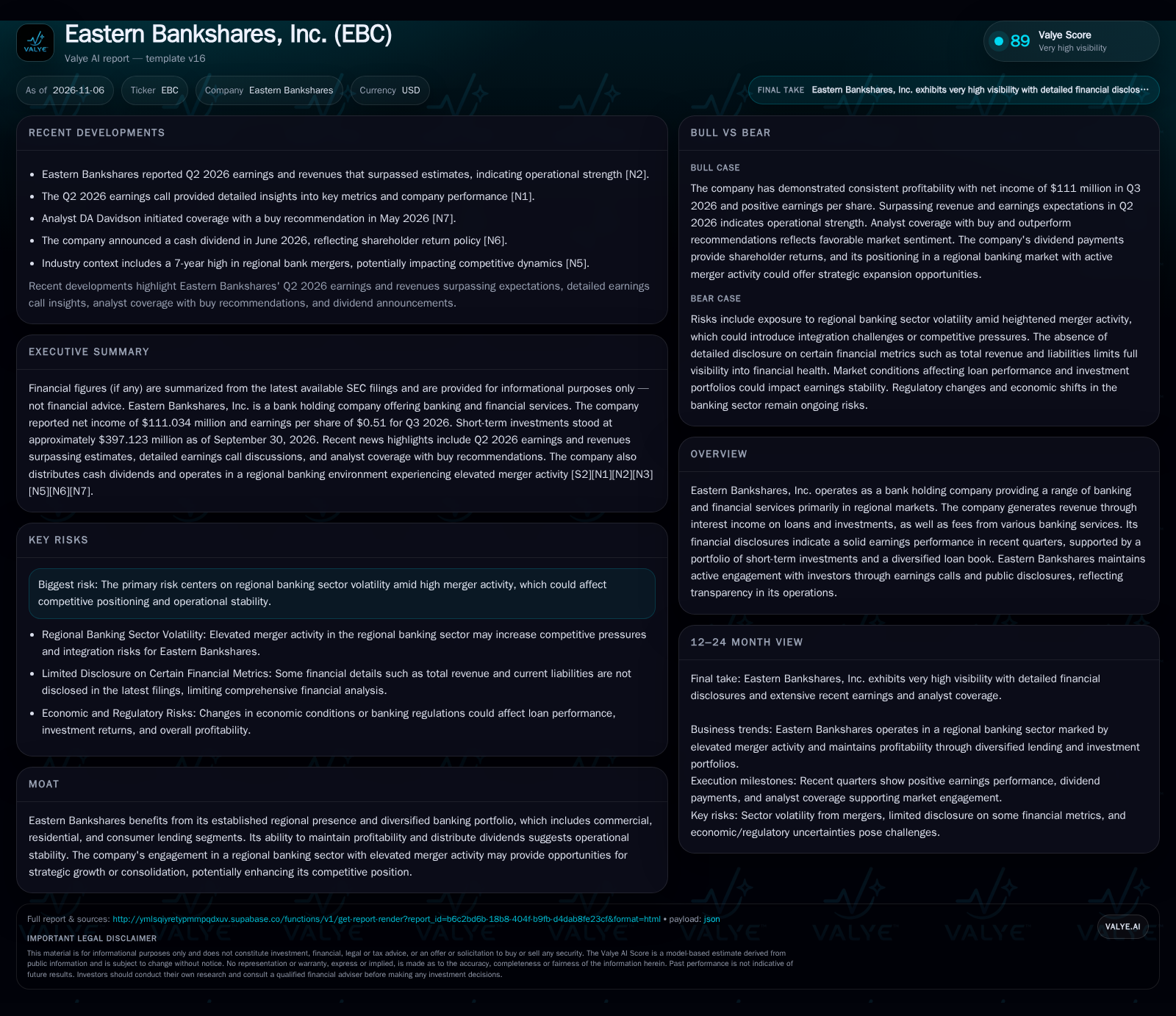
Eastern Bankshares reported $111 million in Q3 2026 net income and continues to pay dividends, signaling operational strength and shareholder engagement. Its $397 million in short-term investments adds potential financial flexibility. However, the company operates in a regional banking sector marked by heightened merger activity, which could reshape competitive dynamics. The interplay of earnings resilience, capital allocation, and sector consolidation will define its trajectory over the next 12–24 months. [S2] [N1] [N2] [N6] [N7]
Yet the company operates in an environment where consolidation and competitive realignment are accelerating, raising questions about its future strategy and resilience. Whether Eastern can leverage its financial stability to pursue accretive growth or must fend off heightened competitive threats will shape its value proposition for shareholders.
Recent Earnings, Investment Position, and Sector Backdrop: What’s Changed for Eastern Bankshares
Eastern Bankshares reported net income of $111.034 million for Q3 2026, with both basic and diluted earnings per share at $0.51. This performance signals ongoing profitability and operational consistency. The company’s short-term investments totaled $397.123 million as of September 30, 2026, providing liquidity and potential flexibility for deployment. Eastern continues to pay cash dividends, as noted in June 2026, maintaining a visible shareholder return policy. Meanwhile, the regional banking environment is marked by high merger activity, which could reshape competitive positioning and open doors for strategic moves or create new integration risks. [S2] [N6]
How Eastern Bankshares Makes Money: Revenue Streams and Margin Dynamics
Eastern Bankshares generates revenue primarily through interest income on loans—ranging from commercial to residential and consumer lending—as well as from investment securities and fee-based banking services. The core profitability is typically driven by the net interest margin (NIM), which depends on the spread between interest earned on assets and paid on deposits and borrowings. While Q3 earnings show strong bottom-line results, the actual sustainability of this performance depends on loan growth, credit quality, deposit costs, and the ability to manage funding in a changing rate environment.
A material short-term investment portfolio provides flexibility but also exposes the company to reinvestment risk if rates decline. Operating leverage in regional banks can be significant: as loan volumes and fee income increase, fixed costs (such as branch operations, compliance, and technology) are spread over a larger base, boosting margins. However, rising deposit costs, loan losses, or regulatory costs can quickly erode this leverage. If Eastern participates in sector M&A—either as acquirer or target—capital needs, integration costs, and dilution risks could reset the earnings trajectory. The cited source reports dividend-related activity; that disclosure alone does not establish dividend-policy continuity, management confidence, or a material constraint on capital flexibility.
In addition to traditional interest income, fee-based services such as wealth management, payment processing, and treasury services increasingly contribute to Eastern Bankshares' revenue diversification. These non-interest income streams can provide a buffer against margin compression during periods of rising funding costs or economic downturns. However, their growth depends on client acquisition and retention, as well as competitive pricing and technological capability. Moreover, the sensitivity of net interest margin to interest rate cycles requires careful asset-liability management. For instance, a rising rate environment could enhance margin if loan repricing outpaces deposit cost increases, but if deposit costs rise faster or loan demand softens, margins could compress. Therefore, the interplay between interest rate trends and the bank’s loan and deposit mix is critical to sustaining profitability.
Regional Consolidation and Competitive Pressures: Where Does Eastern Stand?
Eastern Bankshares’ established presence and diversified loan portfolio provide a degree of stability and customer loyalty. However, the regional banking sector is undergoing rapid consolidation, with peers merging to achieve scale, diversify risk, and absorb rising compliance and technology costs. Larger banks and non-bank financial intermediaries present ongoing threats, offering digital platforms, broader product sets, and potentially lower-cost funding.
Eastern’s ability to maintain or grow market share will depend on its customer retention, relationship banking strengths, and capacity to deliver digital and advisory services. Mergers among competitors could compress margins or force Eastern to pursue its own strategic combinations. At the same time, consolidation may open opportunities to acquire distressed or subscale competitors at attractive valuations, provided Eastern’s capital position and integration capabilities are sufficient. The question is whether the company can use its current profitability and liquidity to play offense, or if it will be pushed into defensive maneuvers by sector dynamics.
Eastern Bankshares’ competitive positioning also hinges on its ability to invest in digital transformation initiatives. As larger competitors leverage scale to deploy advanced analytics, automation, and customer-facing technologies, regional banks must balance the cost of innovation with the necessity to meet evolving customer expectations. Failure to keep pace technologically risks customer attrition, especially among younger demographics who prioritize seamless digital experiences. Conversely, targeted technology investments can enhance operational efficiency, reduce compliance costs, and enable more personalized services, strengthening customer relationships. Additionally, the bank’s regional focus may offer advantages in local market knowledge and relationship banking, but this must be leveraged effectively against the threat of national players expanding into regional markets through digital channels.
Leveraging Financial Strength for Strategic Expansion: The Growth Pathway
A bullish scenario sees Eastern Bankshares deploying its sizable short-term investments and earnings momentum to capitalize on sector consolidation. The company could pursue accretive acquisitions of smaller banks, expanding its footprint, diversifying its loan book, and gaining operating scale.
This outcome would be confirmed by announcements of targeted acquisitions, sustained outperformance in earnings—especially if NIM and loan growth outpace peers—and evidence that cost synergies or revenue enhancements are being realized post-transaction. Analyst upgrades and positive market reaction to acquisition news would further support the scenario. Conversely, failure to identify attractive targets, or unsuccessful integration efforts, would quickly falsify this thesis.
Should Eastern Bankshares pursue strategic expansion, its success will depend not only on identifying attractive acquisition targets but also on executing integrations that preserve cultural alignment and operational synergies. The bank’s ability to integrate technology platforms, unify risk management frameworks, and retain key talent from acquired institutions will be essential to realizing cost savings and revenue enhancements. Moreover, accretive acquisitions could enable better negotiation power with vendors and improved capital efficiency, further supporting profitability. However, this path requires disciplined capital allocation and clear strategic rationale to avoid overpaying or diluting shareholder value. If Eastern can demonstrate a track record of successful integrations and sustained margin improvement post-acquisition, it may also enhance investor confidence and access to capital markets for future growth initiatives.
Sustaining Core Profitability Amid Sector Flux: The Most Plausible Outcome
The most likely outcome for Eastern Bankshares is steady, if unspectacular, continuation of current trends: maintaining profitability through a balanced loan portfolio and prudent investment management, while navigating competitive and regulatory headwinds. The company may avoid large-scale acquisitions, focusing instead on organic growth, incremental digital upgrades, and risk management.
Modest growth in fee income and gradual improvement in efficiency ratios would further support the base case. Any abrupt shifts in earnings quality, asset mix, or capital allocation would challenge this narrative.
Earnings Pressure from M&A Disruption or Market Shocks
The principal risk is that Eastern Bankshares is adversely affected by sector consolidation—either forced into a defensive merger or losing market share to larger, more technologically advanced competitors. Integration missteps in any acquisition could lead to elevated costs, customer attrition, or credit losses. Additionally, a sudden deterioration in economic conditions or regulatory shocks could impair loan performance, compress margins, and threaten dividend sustainability.
Confirmation of this scenario would come from negative earnings surprises, dividend cuts, rising non-performing assets, or regulatory interventions. Announcements of rushed or dilutive M&A deals, or evidence of significant customer outflows, would also signal downside realization.
Milestones That Will Define Eastern Bankshares’ Trajectory in a Consolidating Sector
Sustained net income growth and stability in quarterly EPS—especially relative to regional peers—would help assess operating momentum.
Trends in net interest margin (NIM) and loan growth, if disclosed, are essential for evaluating core banking profitability.
Updates on short-term investment deployment or changes in the composition of the investment portfolio would signal capital allocation priorities.
Announcements of mergers, acquisitions, or divestitures—including terms, integration plans, and expected synergies—would be pivotal.
Credit quality metrics such as non-performing assets and loan loss provisions, if disclosed, would indicate balance sheet strength.
Changes in analyst ratings, target prices, or coverage breadth could signal shifting market perceptions.
Evidence of digital banking initiatives or technology investments, if provided, would show adaptation to changing customer expectations.
Disclaimer: This is research-only, informational analysis and not investment advice. It may include AI-generated interpretation and general industry context. Always verify important details using primary sources.

Comments