
Magnolia Bancorp: Navigating Concentration, Profitability Pressures, and Local Mortgage Dynamics
Magnolia Bancorp’s specialized focus on fixed-rate residential mortgages in select Louisiana parishes offers operational clarity but brings pronounced concentration and profitability risks. With recent net losses and limited diversification, the company’s future hinges on managing credit quality, expanding its value proposition, and competing against larger, tech-enabled rivals.
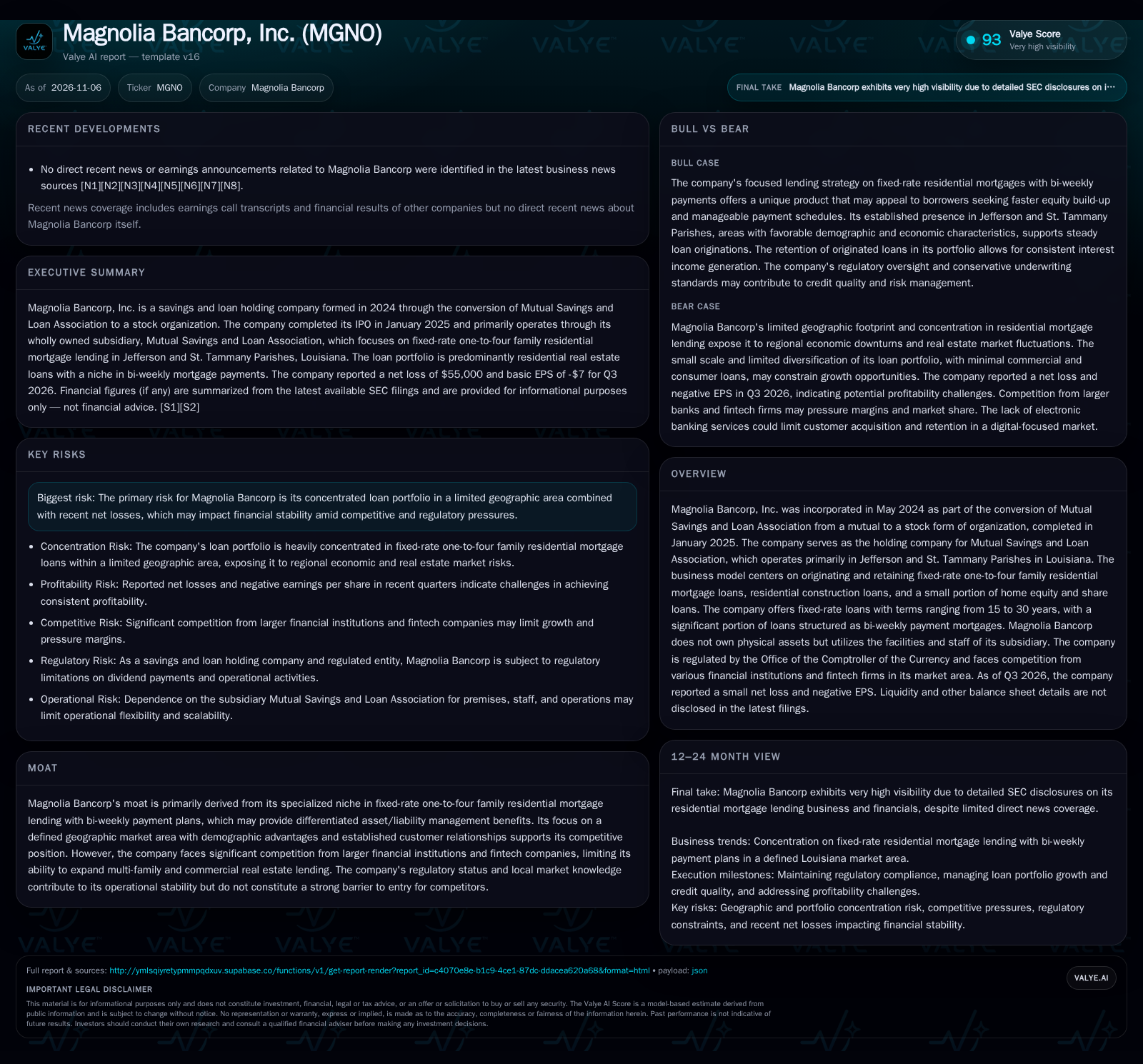
Magnolia Bancorp, newly public after converting from mutual form, centers its lending on fixed-rate residential mortgages in two Louisiana parishes. Recent net losses and a narrowly concentrated loan book underscore both the clarity and risks of its model. The company’s ability to improve profitability, manage geographic exposure, and adapt to intensifying competition will be the core levers for future value creation or erosion. [S1] [S2]
Magnolia Bancorp, a recent entrant to the public markets following its 2025 conversion from mutual form, exemplifies the strengths and vulnerabilities of a niche-focused, community-oriented lender. Its strategy—anchored in fixed-rate residential mortgages within a tight Louisiana footprint—offers operational simplicity and potential credit discipline. However, this clarity comes at the cost of outsized exposure to local economic swings, limited revenue diversification, and recent net losses. As digital competitors and larger banks intensify their presence, Magnolia’s ability to defend margins, build scale, and restore profitability will be decisive for its long-term trajectory.
Recent Conversion, Focused Lending, and Profitability Set the Stage
Magnolia Bancorp was created in May 2024 during Mutual Savings and Loan Association’s shift from mutual to stock form, with the IPO closing in January 2025 and raising $8.3 million in gross proceeds. The company’s loan portfolio is dominantly—97.8%—composed of fixed-rate one-to-four family residential mortgages, totaling about $30 million at year-end 2025. Despite this focused approach, Magnolia reported a net loss of $55,000 and basic EPS of -$7 for Q3 2026. The company reported cash and liquidity metrics for the period; these figures do not by themselves establish operating runway, investment capacity, financial flexibility, or financing capacity. These facts underscore the company’s clarity of mission but also highlight its exposure to profitability and concentration risks. [S1] [S2]
How Magnolia’s Lending Model Drives Revenue and Cost Structure
The company’s revenue model is built on interest income from retained, fixed-rate residential mortgages, with bi-weekly payment structures that accelerate principal repayment and may reduce credit risk over time. Because Magnolia retains these loans on its balance sheet rather than selling them, its net interest margin (NIM) is the primary lever for profitability. However, this approach also increases exposure to local real estate cycles and interest rate mismatches, especially in a rising rate environment where funding costs could outpace yields on fixed-rate assets.
Magnolia’s cost base is likely lean, as it does not own property and shares staff and infrastructure with its subsidiary, but as a small institution, it lacks the scale economies of larger banks. Fixed operational costs—regulatory compliance, staffing, and IT—are spread over a modest asset base, limiting operating leverage. The company’s capital needs are relatively low for growth but high for resilience, as even small credit losses or margin compression can materially impact reported earnings.
Competing in a Crowded Local Market—Strengths and Limitations
Magnolia’s competitive position is anchored in its deep local knowledge and specialization in fixed-rate residential mortgages, particularly with bi-weekly payment plans that may appeal to certain borrowers. This niche focus can foster strong customer relationships and lower credit risk, as underwriting is tailored to familiar markets.
However, the company faces intense competition from a wide range of financial institutions—large national banks, regional banks, credit unions, and fintechs. These rivals often offer broader product suites, greater digital convenience, and more competitive pricing. Magnolia’s lack of commercial, multi-family, or substantive consumer lending further limits cross-selling and customer retention opportunities, while the absence of electronic banking services could hinder new customer acquisition, especially among younger or more tech-savvy demographics.
Barriers to entry in residential lending are moderate, as regulatory compliance and local reputation matter but do not insulate against well-capitalized or technologically advanced entrants. Over time, the company’s ability to differentiate on service, speed, or unique product features will be tested as digital mortgage origination platforms and larger banks continue to encroach on community bank territory. [S1]
Profit Recovery and Niche Expansion Could Unlock Value
A favorable scenario for Magnolia would involve a rebound in profitability, driven by stable or improving net interest margins, low credit losses, and steady loan demand within its target markets. If the company can leverage its bi-weekly mortgage product to attract a loyal base of prime borrowers, it could maintain high credit quality and reduce delinquencies, supporting both asset quality and earnings.
Incremental expansion into adjacent lending segments—such as home equity lines or select commercial real estate, if risk-managed—could diversify revenue and reduce concentration risk. Implementing digital banking capabilities, even at a basic level, would also help attract and retain a broader customer base. Confirmation of this scenario would come from a return to sustained profitability, disclosure of improved NIM and asset quality metrics, and evidence of new product or digital service adoption.
Falsification would be clear if net losses persist, loan growth stagnates, or credit quality deteriorates, indicating the niche model is insufficient to support earnings in the current competitive and rate environment. [S1] [S2]
Incremental Growth Amid Persistent Margin and Scale Constraints
The most plausible near-term outcome is that Magnolia continues to operate as a focused, modestly growing local lender with fluctuating but generally thin profitability. Loan origination volumes may track local housing activity and interest rate trends, with credit quality remaining acceptable barring a sharp regional downturn.
Net interest margins are likely to remain under pressure given the competitive landscape and the fixed-rate structure of the portfolio, while operating costs could creep upward as regulatory and technology requirements rise. The company’s lack of portfolio diversification will continue to expose it to local economic cycles, and without significant digital investments, customer acquisition and retention could gradually erode.
Confirmation of this scenario would include relatively stable loan balances, modest swings in quarterly earnings (positive or negative), and limited change in product or geographic scope. A shift outside these parameters—either a move to sustained profitability or a material deterioration in credit or margin—would challenge the base case. [S1] [S2]
Regional Weakness or Competitive Displacement Triggers Further Losses
Adverse outcomes for Magnolia could materialize through a combination of local economic stress (such as rising unemployment or falling home values in Jefferson and St. Tammany Parishes) and intensifying competition from digital-first lenders or regional banks. In this scenario, loan demand could contract, credit losses could rise, and net interest margins could compress further if funding costs increase but asset yields remain locked.
A lack of liquidity or capital flexibility—given the undisclosed balance sheet details—could compound the situation, forcing the company to curtail lending or take defensive actions that further erode earnings power. Regulatory scrutiny may increase if losses persist, limiting strategic options or dividend capacity.
Evidence supporting this scenario would include rising non-performing loans, further net losses, shrinking loan balances, or a loss of market share to tech-enabled rivals. If Magnolia can maintain asset quality and stem losses, the downside could be mitigated, but the risk is amplified by the company’s concentrated model. [S1] [S2]
Factors Shaping Magnolia’s Value Proposition and Risk Profile Going Forward
Quarterly net income and EPS trends—sustained improvement, continued losses, or volatility would help gauge earnings power and viability. [S2]
Net interest margin (NIM) evolution—if disclosed, changes would indicate the company’s ability to manage funding costs versus asset yields.
Loan growth or contraction—particularly in one-to-four family mortgages; stagnation or shrinkage could signal competitive or demand pressure. [S1]
Credit quality metrics—such as non-performing loans or charge-offs, if disclosed, would provide visibility into risk management and potential losses.
Any disclosure or rollout of digital banking capabilities—would signal strategic adaptation and potential for customer base expansion.
Changes in local housing or employment data in Jefferson and St. Tammany Parishes—external indicators of loan demand and credit risk.
Expansion into adjacent loan products or new geographies—any such moves would test the scalability and adaptability of Magnolia’s model.
Disclaimer: This is research-only, informational analysis and not investment advice. It may include AI-generated interpretation and general industry context. Always verify important details using primary sources.

Comments