
Assured Guaranty: Regulatory Barriers, Earnings Volatility, and the Realities of Capital Deployment
Assured Guaranty’s unique position as a cross-jurisdictional financial guaranty insurer brings structural advantages and persistent frictions. Regulatory capital restrictions, volatile mark-to-market accounting, and dependency on third-party data shape both its earnings profile and shareholder return potential.
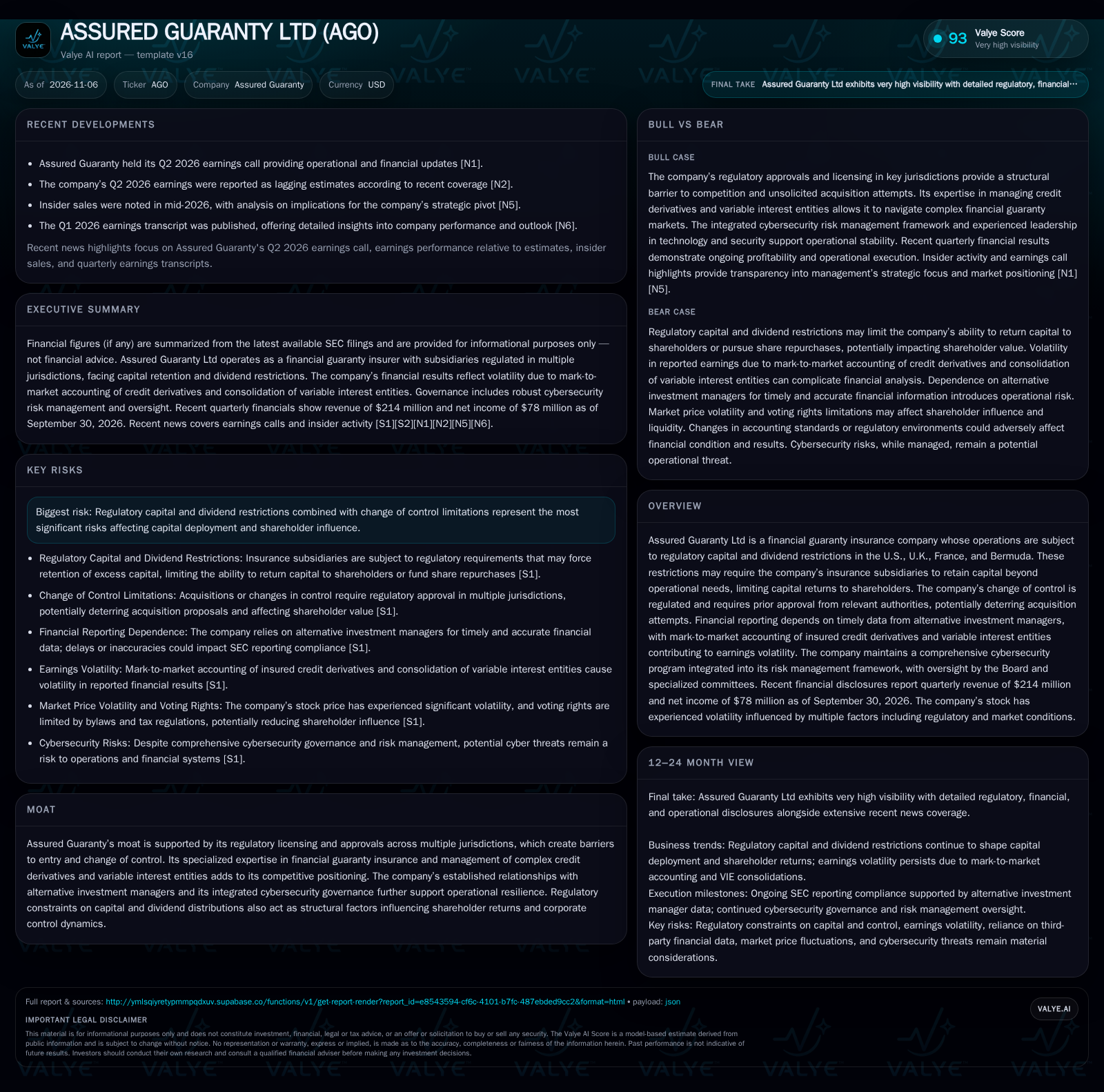
Assured Guaranty reported $214 million in revenue and $78 million in net income for the latest quarter, but its ability to return capital to shareholders is constrained by regulatory capital retention requirements. Volatility in reported results stems from mark-to-market accounting and variable interest entity consolidation. The company’s moat is rooted in multi-jurisdictional regulatory barriers and technical expertise, but earnings volatility and capital deployment limitations remain central investor concerns. [S2]
Assured Guaranty occupies a distinct niche as a financial guaranty insurer, operating at the intersection of complex regulatory environments and evolving credit markets. Its reported quarterly net income of $78 million on $214 million in revenue reflects underlying profitability, but headline figures obscure a more nuanced reality: regulatory capital restrictions limit capital returns, and volatile mark-to-market accounting introduces significant earnings noise. The company’s competitive advantage is anchored in its regulatory approvals and technical sophistication, yet its structural constraints and dependencies on third-party data create persistent friction points for investors seeking clarity on long-term value creation. The question for Assured Guaranty is not only how it manages risk, but how—and when—it can translate operational strength into tangible shareholder rewards. [S1] [S2]
Recent Financials Highlight Profitability, but Regulatory and Accounting Headwinds Remain
Assured Guaranty reported $214 million in revenue and $78 million in net income for the quarter ended September 30, 2026. While these figures demonstrate continued profitability, the headline earnings are shaped by two persistent headwinds: regulatory capital retention requirements and mark-to-market accounting volatility. Insurance subsidiaries are required to hold capital in excess of operational needs, directly limiting the company’s ability to return capital via dividends or buybacks. In addition, the company’s earnings are subject to swings from the mark-to-market treatment of insured credit derivatives and the consolidation of variable interest entities (VIEs), complicating both forecasting and valuation. [S1] [S2]
The company also reported $768 million in short-term investments as of March 31, 2026, providing a degree of potential financial flexibility but not directly resolving the capital deployment constraints imposed by regulators. Recent news coverage has highlighted both earnings misses and insider sales, reinforcing market sensitivity to operational updates and strategic pivots. [N1] [N2] [N5]
How Financial Guaranty Insurance Economics Drive Both Margin and Volatility
Assured Guaranty’s core business model revolves around the underwriting of financial guaranty insurance, primarily for municipal bonds and structured finance instruments. Revenue is generated through upfront and ongoing insurance premiums, which are priced based on the perceived credit risk of the underlying obligations and the company’s ability to absorb potential losses. Investment income on the substantial float—premiums collected and not yet paid out as claims—represents a significant earnings lever, particularly in a higher interest rate environment.
However, the economics are complicated by the need to hold regulatory capital well in excess of actuarial loss expectations. This creates a structural drag on return on equity, as capital cannot be fully redeployed or returned to shareholders. Further, the use of mark-to-market accounting for insured credit derivatives and the consolidation of VIEs introduces earnings volatility that is not necessarily reflective of underlying claims experience or core operating performance. This can obscure true run-rate profitability and make cost of capital higher, as investors demand a premium for uncertainty.
Variable expenses are largely tied to claims, loss adjustment, and reinsurance costs, while fixed costs are dominated by regulatory compliance, technology, and risk management infrastructure. Operating leverage can improve as new business is written on the existing platform, but capital and regulatory constraints limit the company’s ability to scale aggressively or optimize its capital structure without regulatory approval.
Regulatory Barriers and Technical Expertise as Double-Edged Swords
Assured Guaranty’s most durable competitive advantage is its regulatory licensing and approvals across the U.S., U.K., France, and Bermuda. These barriers make it difficult for new entrants to compete at scale or for potential acquirers to effect a change of control without lengthy, uncertain regulatory processes. The company’s technical expertise in evaluating complex structured finance and municipal risks, alongside its experience managing VIEs and derivative exposures, further differentiates it from generic insurers.
However, these same regulatory and technical hurdles can act as constraints. The obligation to retain excess capital reduces flexibility and can lead to suboptimal capital allocation compared to non-regulated peers or alternative asset managers. In addition, the company is reliant on timely and accurate data from alternative investment managers for SEC reporting, introducing operational risk if data quality or timeliness deteriorates.
Peer competition comes primarily from other specialized financial guarantors and, to a lesser extent, from large multiline insurers with credit risk capabilities. The broader threat is from disintermediation via capital markets innovation—such as direct municipal bond insurance alternatives or structured finance vehicles that bypass traditional guarantors.
Unlocking Capital and Reducing Earnings Volatility Could Drive Rerating
The most favorable scenario for Assured Guaranty would involve a combination of regulatory relaxation and improved transparency around underlying earnings power. If regulators allow subsidiaries to operate with lower capital buffers—perhaps due to improved macroeconomic conditions or demonstrated risk management—then more capital could be returned to shareholders through dividends or buybacks, directly enhancing equity value.
Additionally, if the company successfully reduces earnings volatility—either through refined accounting practices, more stable VIE structures, or a shift in business mix toward less mark-to-market-sensitive products—investors may assign a higher multiple to reported earnings. Confirmation of this scenario would include regulatory approvals for larger capital distributions, a declining trend in earnings volatility quarter-over-quarter, and management commentary highlighting progress made in smoothing reported results.
Structural Constraints Persist, but Core Profitability Endures
The most plausible outcome is that Assured Guaranty continues to generate stable, if somewhat volatile, core profits while regulatory capital constraints and mark-to-market accounting remain persistent features of its business model. Shareholder returns are likely to be moderate, driven by periodic dividends and opportunistic buybacks when regulatory conditions allow, but are unlikely to approach those of less-regulated financial peers.
Quarterly earnings will continue to fluctuate, not always tracking underlying claims experience, making it challenging for investors to distinguish between true operational performance and accounting-driven volatility. The company’s regulatory moat and technical expertise should allow it to defend existing market share, but not to materially accelerate growth without a change in the external environment.
Evidence for this scenario would include ongoing profitability with regular but modest capital returns, continued references in earnings calls to regulatory capital management, and a lack of significant change in reported earnings volatility.
Sustained Regulatory Drag and Data Dependencies Weigh on Value Creation
The adverse scenario centers on a combination of stricter regulatory capital requirements, adverse changes in accounting standards, or operational missteps with third-party data providers. If regulators increase required capital buffers or slow approvals for distributions, more capital could be trapped at subsidiary levels, further limiting shareholder returns and depressing the company’s valuation.
Additional downside could come from increased volatility in mark-to-market earnings, especially in a period of market stress, or from a deterioration in the quality and timeliness of data provided by alternative investment managers. If SEC reporting is delayed or inaccurate due to these dependencies, investor confidence could be undermined and cost of capital could rise.
This scenario would be confirmed by announcements of increased capital requirements, reductions or suspensions of dividends/buybacks, reporting delays or restatements tied to data issues, or a material cybersecurity incident impacting operations or financial reporting.
Milestones That Will Shape Assured Guaranty’s Ability to Deliver Shareholder Value
Changes in regulatory capital requirements or explicit regulatory approvals/disapprovals for capital distributions at the subsidiary or group level.
Reported trends in quarterly earnings volatility, particularly the magnitude and drivers of mark-to-market swings and VIE consolidation impacts.
Disclosure of dividend and share buyback activity, including management commentary on the sustainability of such returns if disclosed.
Material changes in the company’s relationship with alternative investment managers, especially any reported operational or reporting disruptions.
Evidence of successful new business written at attractive risk-adjusted spreads, or conversely, increased competitive pressure on premium pricing.
SEC reporting timeliness and the absence or presence of restatements or late filings attributed to data dependencies.
Cybersecurity incident disclosures or board-level commentary on evolving risk management priorities.
Disclaimer: This is research-only, informational analysis and not investment advice. It may include AI-generated interpretation and general industry context. Always verify important details using primary sources.

Comments