
Kingstone’s Next Act: Niche Underwriting, New York Dislocation, and the Challenge of Regional Expansion
Kingstone Companies leverages disciplined underwriting and strong producer relationships to capitalize on upheaval in New York’s personal lines insurance market. As it eyes ambitious growth through geographic expansion and technology-driven efficiency, the company faces execution risks, catastrophe exposure, and an evolving competitive landscape.
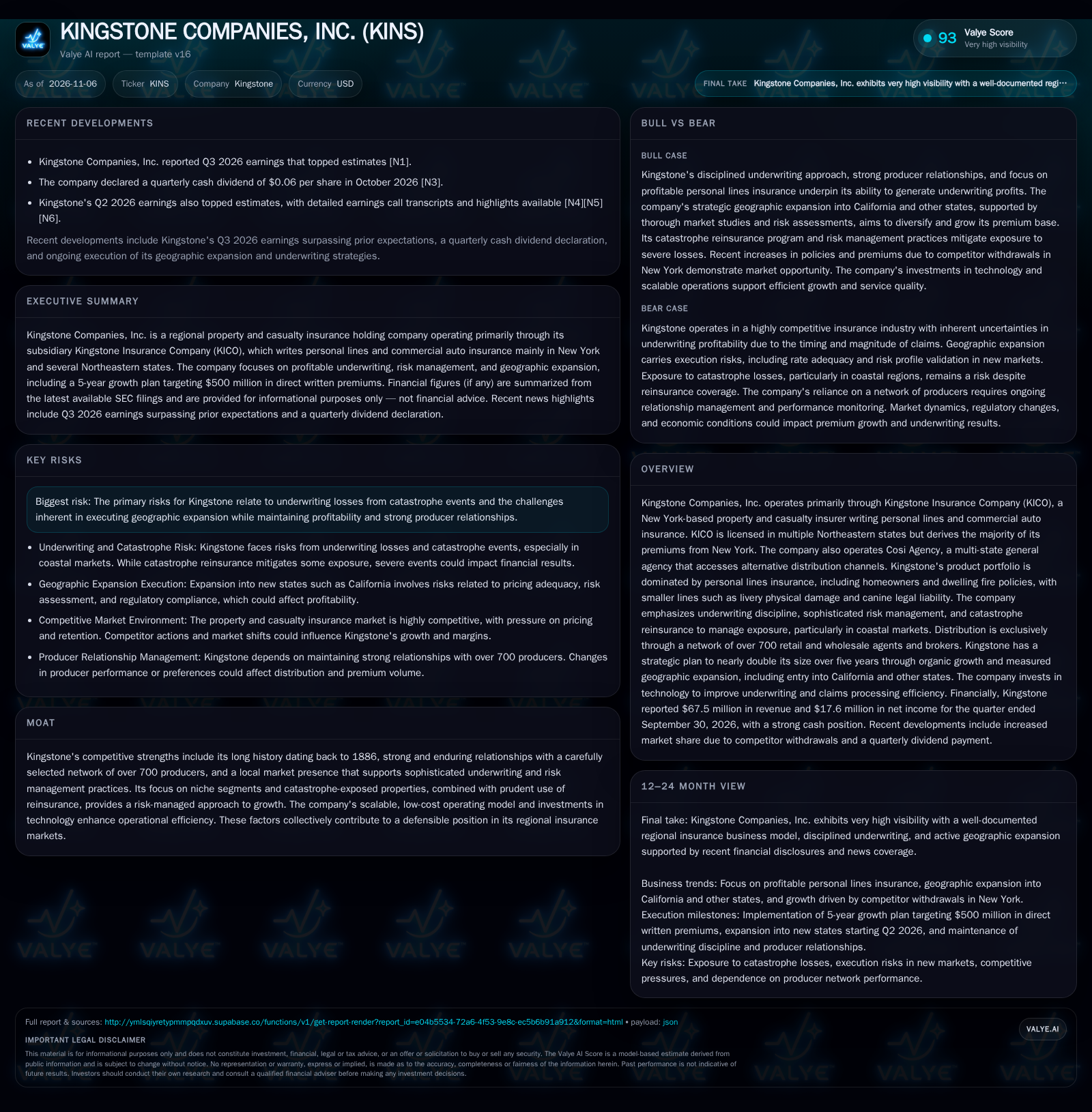
Kingstone Companies, Inc. is a regional property and casualty insurer with a core focus on personal lines in New York. Recent competitor withdrawals have fueled double-digit premium growth, while the company pursues a five-year plan for geographic expansion and increased scale. Profitability and risk management remain central as Kingstone balances opportunities from market dislocation against the complexities of entering new states and managing catastrophe exposure. Q3 2026 results exceeded expectations, and a quarterly dividend underscores current financial stability. Key questions center on the sustainability of recent growth and the company’s ability to replicate its model beyond its home market. [S1] [S2] [N1] [N3]
Kingstone Companies, Inc. stands at a pivotal juncture in its evolution as a regional property and casualty insurer. Recent upheaval in New York’s personal lines insurance market, marked by competitor withdrawals, has propelled significant premium growth and allowed Kingstone to consolidate its position in its core geography. With a disciplined underwriting approach and scalable operations, the company now sets its sights on ambitious geographic expansion, starting with California and additional Northeastern states. The central question is whether Kingstone can sustain its profitable underwriting and operational efficiency as it ventures into less familiar markets, all while managing catastrophe risk and navigating a fragmented, highly competitive industry landscape. [S1] [S2]
Premium Growth and Market Dislocation Reshape Kingstone’s Landscape
Kingstone’s recent operating environment has been defined by a sharp increase in premium volumes and policy counts, catalyzed by the withdrawal of competitors from the New York personal lines market. In 2025, gross written premiums surged 14.8% to $277.8 million, with 98% sourced from New York policies. This growth was not the result of broad diversification, but rather a deepening of the company’s core business in its home market. The momentum continued into 2026, as evidenced by Q3 revenue of $67.54 million and net income of $17.58 million, both exceeding analyst expectations. The company’s declared $0.06 quarterly dividend further signals near-term financial stability. However, this concentration leaves Kingstone exposed to local regulatory, competitive, and catastrophe risk, even as it prepares for geographic expansion beginning with California in 2026. [S1] [S2] [N1] [N3]
How Underwriting Discipline and Scale Shape Kingstone’s Profit Model
Kingstone’s revenue model is anchored in the economics of personal lines insurance: collecting premiums upfront and managing claims and expenses to generate underwriting profits and investment income. With 94.7% of gross written premiums in 2025 derived from homeowners, dwelling fire, and related products, underwriting discipline is critical. The company relies on sophisticated pricing, risk scoring, and property inspections to manage loss ratios—particularly vital in catastrophe-prone coastal regions. Variable costs are largely claims-driven, while fixed costs (technology, compliance, producer management) can benefit from scale. The company’s investments in digital platforms and workflow automation are designed to support efficient growth without proportionate increases in overhead. Capital needs are dictated by regulatory requirements and reinsurance costs, especially as Kingstone seeks to expand into new, potentially higher-risk geographies. Operating leverage may improve if premium growth outpaces expense growth, but large claims events or pricing missteps could quickly erode margins.
Defensible Niche or Vulnerable to Disruption? Kingstone’s Position Among Regional Insurers
Kingstone’s core advantages lie in its longstanding producer relationships and deep underwriting expertise in New York’s personal lines market. Its distribution model—over 700 carefully selected agents and brokers—creates localized market knowledge and potential stickiness, but also exposes the company to shifts in producer allegiance or performance. The company’s focus on niche segments, including catastrophe-exposed properties, can be a source of both pricing power and elevated risk. While large national carriers may be less willing to absorb volatility in these segments, Kingstone’s willingness to underwrite them—backed by catastrophe reinsurance—can enable premium growth. However, geographic expansion introduces new competitors, regulatory regimes, and customer preferences. In California and other target states, Kingstone will face established regional and national insurers, insurtech entrants leveraging data and automation, and the ongoing threat of adverse selection without granular local knowledge. Its moat depends on replicating its risk selection and producer network advantages outside its home turf.
What If Kingstone Successfully Exports Its Model? Catalysts for Outperformance
The bull scenario hinges on Kingstone’s ability to leverage its underwriting expertise, technology investments, and producer network to profitably scale in new markets. If the company’s expansion into California and additional states delivers premium growth without a spike in loss ratios or expense creep, Kingstone could approach its five-year $500 million direct written premium goal. Sustained market dislocation—such as further competitor withdrawals in the Northeast—could provide additional tailwinds. Confirmation would come from continued above-peer premium growth, stable or improving combined ratios in new geographies, and evidence that the company can maintain or expand margins as it scales. If disclosed, rising renewal rates and low new-market loss ratios would further validate the thesis.
Sustaining Profitable Growth Amid New Risks and Higher Stakes
The most plausible outcome is that Kingstone achieves moderate premium growth, primarily from its New York base, while cautiously ramping up operations in new states. Expense ratios may edge upward as the company invests in compliance, producer recruitment, and local market studies for geographic expansion. Loss ratios could fluctuate, especially in the early phase of entering unfamiliar territories, but catastrophe reinsurance should provide a buffer against outsized events. The company’s scalable operations and technology investments likely keep administrative costs in check, but the risk of adverse selection or regulatory missteps in new markets remains. Evidence supporting this scenario would include steady premium growth, stable combined ratios, and no major negative surprises in quarterly claims or regulatory developments. A useful metric would be the premium mix shift toward new states over time, if disclosed.
When Expansion Backfires: Adverse Selection, Catastrophe Losses, and Margin Compression
The bear case centers on Kingstone’s possible inability to replicate its underwriting and distribution strengths beyond New York. If new market entries lead to inadequate pricing, poor risk selection, or regulatory missteps, loss ratios could spike and erode profitability. A severe catastrophe event in the company’s heavy New York portfolio could simultaneously pressure capital and disrupt growth plans. Producer attrition or underperformance could further constrain premium growth, while entrenched competitors and insurtechs may outcompete Kingstone on price or digital convenience. Confirming evidence would include a sharp deterioration in combined or loss ratios, unexpected reserve strengthening, regulatory penalties, or a material slowdown in premium growth—especially if accompanied by negative earnings surprises or a cut in the dividend.
Tracking Kingstone’s Ability to Scale Its Model and Manage Risk
Monitor the premium mix by geography—specifically, the proportion of direct written premiums originating outside New York as expansion progresses. If disclosed, this would indicate execution on the geographic diversification strategy.
Track the combined ratio and loss ratio trends, both overall and segmented by new versus legacy markets. Deterioration in these metrics would signal underwriting or pricing challenges.
Observe quarterly premium growth rates, especially as competitor withdrawals normalize. A slowdown could indicate saturation or increased competition.
Watch for changes in catastrophe reinsurance costs and program structure, as these may foreshadow higher risk or capital requirements.
Monitor producer retention, recruitment, and performance metrics, if disclosed. Shifts here could impact distribution capacity and premium volume.
Follow regulatory developments in both New York and new target states, particularly any actions affecting rate adequacy or capital requirements.
Assess dividend continuity and management commentary on capital allocation. A cut or suspension could indicate unexpected stress or prioritization of capital for risk absorption.
If available, review technology adoption or workflow efficiency metrics, as these underpin the company’s scalable low-cost model.
Disclaimer: This is research-only, informational analysis and not investment advice. It may include AI-generated interpretation and general industry context. Always verify important details using primary sources.

Comments