
Agentix Corp.’s Exclusive IP Licensing: Building a Clinical Pipeline Under Financial Pressure
Agentix Corp. is betting on exclusive licensing deals with leading research institutions to seed its clinical development ambitions. Yet with no reported revenue, persistent net losses, and liabilities outpacing assets, the company’s ability to bridge the gap between early-stage science and commercial viability faces immediate tests.
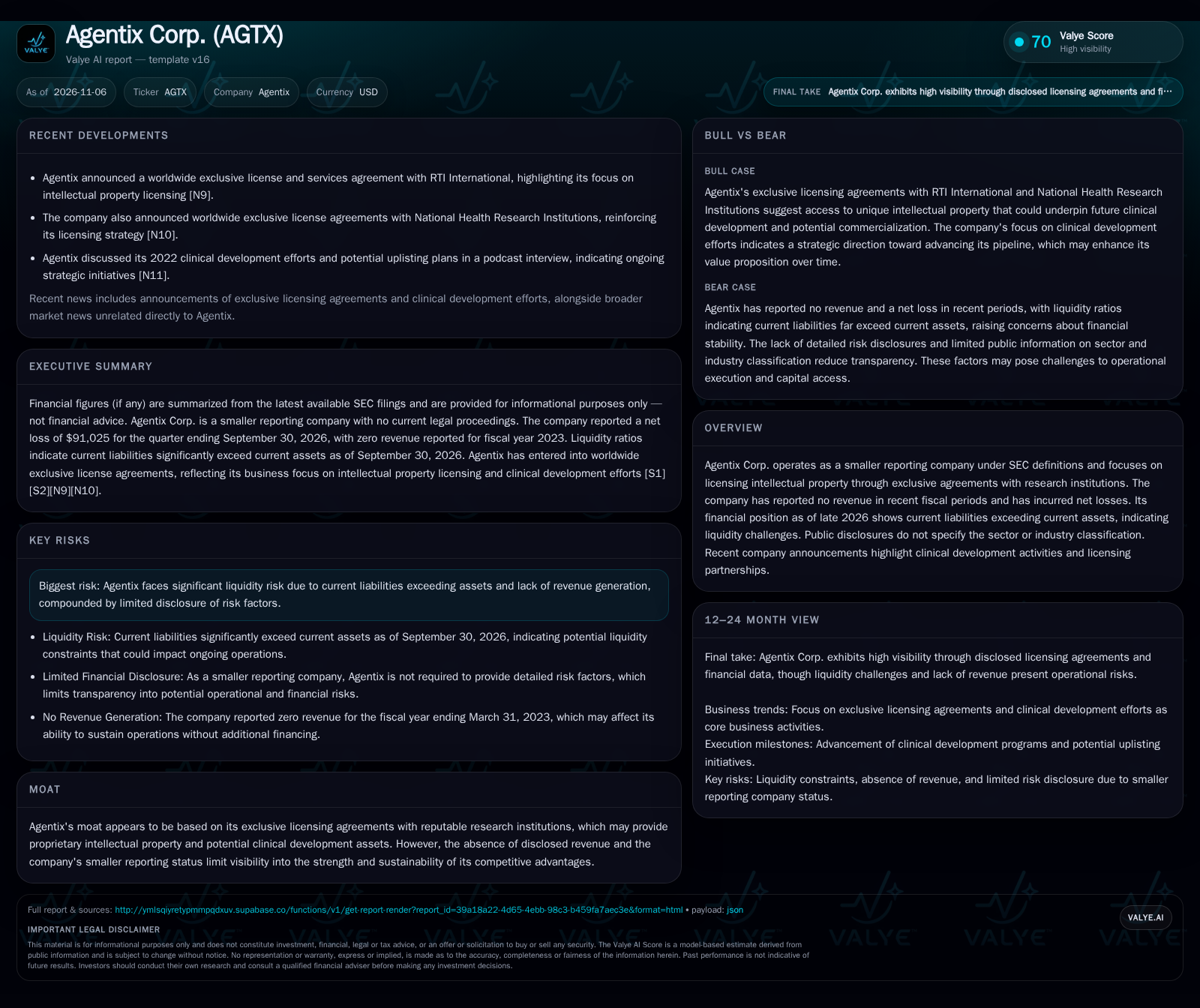
Agentix Corp. has secured exclusive global licenses from major research institutions, aiming to build value through clinical development. However, the company reported no revenue for fiscal 2023, continues to post net losses, and faces a pronounced liquidity shortfall as of September 2026. The path ahead hinges on successful pipeline advancement and access to new capital, with operational execution and transparency as key watchpoints. [S1] [S2]
Agentix Corp. exemplifies the high-risk, high-potential profile of early-stage biotech ventures leveraging exclusive intellectual property from top-tier research institutions. As Agentix pursues clinical milestones and strategic options like uplisting, the company’s fate will likely be determined by its ability to secure additional funding, deliver credible development progress, and demonstrate that its licensed assets can translate into commercial value.
Current Financial Strains and Persistent Losses Shape Agentix’s Position
The company reported cash and liquidity metrics for the period; these figures do not by themselves establish operating runway, investment capacity, financial flexibility, or financing capacity. [S2] The company posted a net loss of $91,025 for the most recent quarter and reported no revenue for the fiscal year ending March 31, 2023. [S1] [S2] These facts underscore two immediate issues: the need for near-term financing to sustain operations, and the absence of any commercial income stream to offset ongoing expenses. In this context, Agentix’s exclusive licensing agreements with research institutions represent its primary asset and the foundation for its stated clinical development ambitions.
Evaluating Revenue Potential and Cost Dynamics in an IP-Licensing Model
Agentix’s economics are currently shaped by two features: exclusive IP licensing and early-stage R&D cost structure. The company’s model involves acquiring global rights to promising therapeutic candidates from research institutions, with the expectation that these assets can be advanced through preclinical and clinical development. Revenue generation, if achieved, would plausibly come from one of three channels: milestone payments and royalties via out-licensing to larger pharma partners, direct commercialization (should Agentix retain rights through late-stage trials and approval), or a trade sale based on pipeline value.
The cost side is dominated by R&D outlays, licensing fees, and general administrative expenses. Until clinical assets reach proof-of-concept or out-licensing triggers, expenses are likely to outpace any near-term income. Fixed operating costs are likely small compared to larger biotech peers, but variable expenses can spike with trial initiations or new licensing deals. Given the lack of revenue and negative liquidity ratios, Agentix’s economics are currently dependent on access to external capital—whether through equity offerings, convertible debt, or strategic partnerships.
The absence of revenue and the company’s smaller reporting status mean that Agentix must carefully manage cash burn and secure timely financing to avoid operational disruption. The company’s future economic upside is levered to the value and advancement of its licensed pipeline, but its capital needs are acute and ongoing.
Assessing the Competitive Edge of Agentix’s Exclusive Licensing Rights
Agentix’s competitive thesis rests on exclusive, worldwide rights to intellectual property from leading research institutions, including recent deals with National Health Research Institutions. In theory, such agreements can provide access to differentiated clinical assets that are otherwise unavailable to competitors, at least for the duration of exclusivity. The strength of this position depends on the novelty, patent life, and clinical promise of the underlying assets.
However, the broader biotech licensing market is intensely competitive, with numerous early-stage companies vying for similar assets and larger pharma firms sometimes bypassing intermediaries. Without disclosed details about the specific therapeutic areas, stage of development, or competitive landscape of Agentix’s pipeline, it is unclear whether its portfolio offers true differentiation or faces near-term obsolescence. Moreover, Agentix’s limited financial resources could constrain its ability to advance assets rapidly, potentially leading to loss of exclusivity or missed market windows.
In this context, Agentix’s competitive position is more a function of its execution speed and capital access than of IP alone. The company could be vulnerable to better-funded rivals or shifting priorities at its licensing partners.
Converting Licensed IP Into Clinical Progress and Strategic Opportunities
A favorable scenario for Agentix would see successful advancement of one or more licensed assets into clinical trials with compelling early data, triggering either lucrative out-licensing deals or setting the stage for direct commercialization. If the company’s pipeline includes assets addressing high-unmet-need indications with clear mechanistic rationale and strong preclinical support, Agentix could attract interest from larger partners or investors—unlocking milestone payments, upfront licensing fees, or additional capital.
The company’s stated focus on clinical development and uplisting suggests a desire to increase visibility and credibility, which could further support capital-raising or partnership efforts. Confirmation of this scenario would come from announced clinical trial initiations, positive data readouts, or disclosed licensing/partnership transactions that generate non-dilutive funding.
Falsification would occur if Agentix fails to initiate trials, is unable to secure new financing, or if its assets prove non-competitive in their respective indications. The near-term dependency on funding means that upside is only plausible if operational and financial execution are tightly aligned.
Operating Under Cash Constraints While Pursuing a Strategic Turning Point
Absent transformative clinical or commercial milestones, Agentix’s most plausible trajectory is one of tight cash management, incremental pipeline progress, and ongoing pursuit of new capital. The company may prioritize advancing one lead asset to a value-inflection point—such as Phase 1/2 clinical data—while deferring or shelving less promising programs. Interim financing could come from small equity raises or bridge loans, but these may be dilutive and uncertain in a weak capital market.
In this scenario, Agentix’s progress is slow and marked by frequent funding needs, with operational risks elevated by the liquidity gap. Confirmation would come from continued net losses, small-scale capital raises, and incremental clinical updates without major partnership or revenue events. If Agentix can maintain enough momentum to reach a credible proof-of-concept, it could eventually pivot to a more favorable strategic position; if not, prolonged underfunding could erode the value of its IP portfolio.
Risks of Cash Shortfalls and Asset Losses Endangering Company Viability
The adverse scenario is defined by Agentix’s inability to secure new funding before liabilities come due, forcing the company to curtail operations, delay or abandon clinical programs, or even face insolvency. In this world, the combination of zero revenue, ongoing net losses, and a stark liquidity mismatch becomes existential.
Asset attrition may occur if exclusivity lapses due to missed milestones or inability to fund required development, or if research partners terminate agreements. The absence of detailed risk disclosures compounds uncertainty about the timing and magnitude of these risks. Confirmation would come from missed payments, public disclosures of program halts, or adverse going-concern language in filings. Falsification would require evidence of new, substantial funding or transformative licensing deals that materially improve Agentix’s financial outlook.
Key Milestones Influencing Agentix Corp.’s Future Direction
Announced initiation of clinical trials for any licensed asset, including specific indication and phase.
Disclosure of out-licensing or partnership agreements with upfront or milestone payments that generate non-dilutive cash.
Any SEC filing or press release indicating successful completion of a financing round or capital raise, and the terms thereof.
Updates on the company’s uplisting process, which could affect capital market access and liquidity.
If disclosed, burn rate projections and runway estimates post-financing events would help test sustainability.
Amendments to licensing agreements—such as revised milestones, extended exclusivity, or asset returns—would signal shifts in IP value.
Public statements or filings regarding changes to management, board composition, or strategic direction.
Disclaimer: This is research-only, informational analysis and not investment advice. It may include AI-generated interpretation and general industry context. Always verify important details using primary sources.

Comments