
Peapack-Gladstone’s Private Banking Play: Expanding Wealth Management and Navigating Regional Competition
With over $13 billion in wealth assets under management and a flagship New York City presence, Peapack-Gladstone is doubling down on relationship-driven banking. The challenge: balancing high-touch service, technology investment, and competitive headwinds from bigger institutions and digital disruptors.
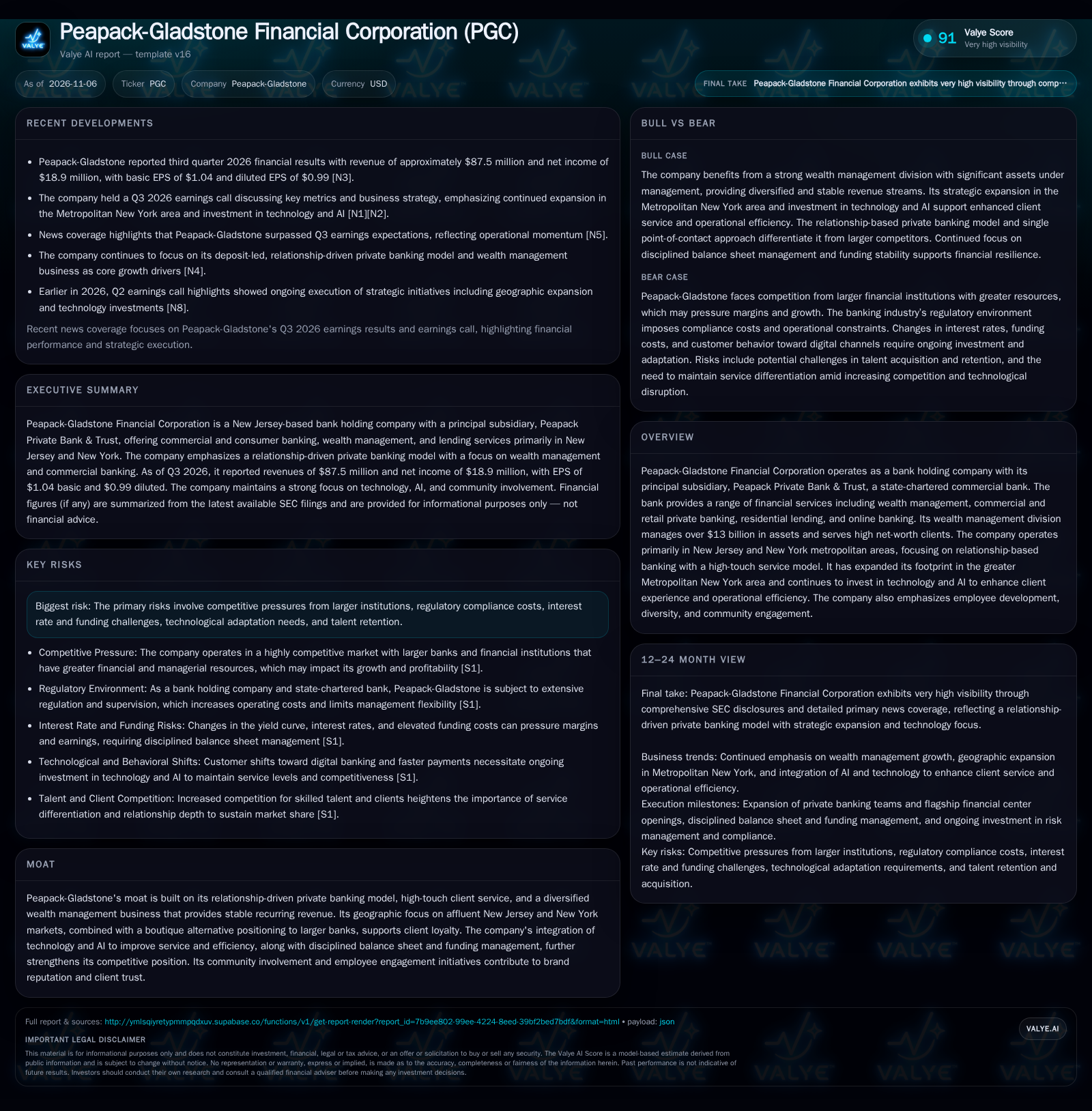
Peapack-Gladstone Financial Corporation is advancing its boutique private banking and wealth management model, recently surpassing Q3 2026 earnings expectations. The company is investing in technology and AI while expanding into the New York metropolitan market. It faces margin pressures and regulatory costs as it seeks to differentiate through personalized service and disciplined growth. Key watchpoints include deposit growth, wealth management inflows, technology adoption, and resilience against larger competitors.
Peapack-Gladstone Financial Corporation is executing a deliberate strategy to grow its wealth management and private banking businesses in the competitive New Jersey and New York metropolitan region. The company’s latest financials show resilience, with Q3 2026 results surpassing expectations as it expands its geographic footprint and invests in technology and AI to elevate client experience. However, with larger banks and fintechs encroaching on its affluent markets, the company must prove that its high-touch, relationship-first model can deliver sustainable growth and defend margins in an evolving financial landscape.
Recent Performance Highlights Expansion and Wealth Management Scale
Peapack-Gladstone reported Q3 2026 revenue of $87.5 million and net income of $18.9 million, with basic earnings per share at $1.04 and diluted EPS at $0.99 [S2]. The company’s wealth management arm closed 2025 with $13.1 billion in assets under management, underscoring its importance as a core, fee-based revenue driver [S1]. Notably, the company opened a flagship financial center in New York City in April 2025, deepening its presence in affluent markets [S1]. These developments matter because they signal continued operational momentum, diversification beyond traditional lending, and a focus on capturing high-value clients in a region where competition is intense and client loyalty is hard-won.
Revenue Mix, Fee Streams, and the Leverage Challenge
Peapack-Gladstone’s business model combines traditional net interest income from commercial and retail banking with fee-based revenue from wealth management. The wealth management division, with $13.1 billion AUM, likely provides a more stable and recurring revenue stream than the rate-sensitive lending business, helping to partially insulate earnings from interest rate volatility. Fee income from wealth and trust services often carries higher margins and lower capital requirements than lending, but scaling AUM in a fragmented, competitive market requires continuous investment in talent and technology.
On the lending side, the bank offers a full suite of products—working capital lines, term loans, commercial and multifamily mortgages, and asset-based financing—alongside residential and consumer banking. This product breadth allows for cross-selling and deepening client relationships, but also exposes the company to credit and funding risks, especially if commercial real estate or small business credit quality deteriorates.
Operating leverage is plausible if the company can grow AUM and core deposits faster than expense growth, particularly through technology and process efficiency. However, the boutique private banking model is labor-intensive, and sustaining high-touch service while expanding may constrain margin gains. Technology investments—especially in AI and digital client interfaces—could improve scalability, but require upfront capital and ongoing adaptation to client expectations.
How Boutique Positioning Interacts with Larger Banks and Digital Disruptors
Peapack-Gladstone competes in one of the most saturated banking corridors in the U.S., facing national banks, regional players, credit unions, and fintechs. Its relationship-driven, single-point-of-contact approach aims to differentiate it from the transactional, often impersonal service of larger banks. The focus on affluent New Jersey and New York markets—where client needs are complex and loyalty is often tied to service quality—may enable the company to defend share against commoditized offerings.
However, larger banks bring scale advantages in technology, product range, and compliance infrastructure, while fintechs increasingly target HNWIs with digital-first solutions and lower fees. The company’s ongoing technology and AI investments are necessary to remain relevant, but the question is whether these will be enough to offset the brand and resource advantages of its bigger rivals.
Switching costs in private banking and wealth management can be high due to relationship depth and complexity, but are not insurmountable if service falters or digital offerings lag. Retention of top talent—often the linchpin of client loyalty in boutique banking—remains a persistent vulnerability.
What Success Looks Like: Deepening Relationships and Scalable Growth
A favorable outcome would see Peapack-Gladstone leveraging its New York flagship and expanded private banking teams to accelerate high-net-worth client acquisition, driving both AUM and core relationship deposit growth. If technology and AI investments successfully enhance the client experience and back-office efficiency, the bank could achieve operating leverage—growing revenue faster than expenses while maintaining its high-touch service standard.
Confirmation of this scenario would come from sustained double-digit AUM growth, expanding fee income as a share of total revenue, and evidence of improving efficiency ratios without service erosion. Additional indicators would be market share gains in targeted affluent zip codes and high retention rates among both clients and key relationship managers. Stronger deposit growth relative to peers, particularly in a rising-rate environment, would reinforce the deposit-led model’s credibility.
Balancing Expansion and Margin Pressures in a Competitive Market
The most plausible trajectory is one where Peapack-Gladstone maintains steady, if unspectacular, growth in both wealth management and core banking, with periodic margin pressures as it invests in technology and expands into new markets. Fee income from wealth management may continue to buffer volatility in net interest income, but competitive pricing and rising compliance costs could constrain profitability.
Moderate AUM growth, stable deposit levels, and incremental gains in New York and New Jersey would characterize this path, with efficiency ratios remaining flat or improving only modestly. Falsification would come from flat or declining AUM, loss of major private bankers, or failure to demonstrate meaningful operating leverage despite technology spend.
Margin Compression and Talent Loss: The Double Bind
An adverse scenario would materialize if larger banks and digital entrants erode Peapack-Gladstone’s client base, leading to stagnant or declining AUM and core deposits. Talent poaching—by competitors offering higher compensation or more advanced digital platforms—could further undermine the relationship-driven model, triggering client attrition and compressing fee income.
Margin pressure could intensify if funding costs rise and the company is unable to reprice loans or attract low-cost deposits. Regulatory or compliance missteps, especially as the company scales into New York, might drive up non-interest expenses. Evidence of this scenario would include declining wealth management inflows, rising attrition among top private bankers, deteriorating efficiency ratios, or a spike in credit losses.
Milestones That Will Validate or Challenge Peapack-Gladstone’s Relationship-Banking Thesis
Net new assets under management in wealth management—especially growth rates versus regional and national competitors—would help test the durability of the fee-based revenue stream.
Core relationship deposit growth, particularly in new markets like New York City, would provide evidence of client acquisition and the effectiveness of the deposit-led model.
Efficiency ratio trends: Improvements would indicate successful scaling and technology leverage, while deterioration could signal rising costs or operational inefficiencies.
Retention rates of key private bankers and wealth advisors, if disclosed, would be a leading indicator of client stickiness and future asset flows.
Market share gains or losses in targeted affluent zip codes in New Jersey and New York would reveal competitive positioning.
The share of fee income (primarily wealth management and trust fees) as a percentage of total revenue would signal progress in diversifying away from net interest income.
Adoption rates and client satisfaction scores for new digital and AI-enabled services, if disclosed, would clarify the impact of technology investments.
Non-performing asset or loan metrics, particularly in commercial and multifamily lending, would highlight underlying credit risks as the company grows.
Disclaimer: This is research-only, informational analysis and not investment advice. It may include AI-generated interpretation and general industry context. Always verify important details using primary sources.

Comments