
German American Bancorp: Regional Banking Expansion Tests the Limits of Scale and Compliance
German American Bancorp’s acquisition-driven growth and diversified banking model have increased its regional scale, but the approach now faces new regulatory thresholds, integration complexity, and intensified competition from larger banks and fintechs.
German American Bancorp has expanded its footprint in the Midwest through the acquisition of Heartland BancCorp, driving its consolidated assets closer to the $10 billion mark—a level that would trigger more stringent regulatory oversight. While Q3 2026 results show solid profitability, the company must now navigate heightened compliance costs, integration challenges, and the persistent threat from tech-enabled competitors. The bank’s ability to balance growth with efficiency, regulatory adaptation, and customer retention will determine its long-term trajectory. [S1] [S2]
German American Bancorp has grown into a leading regional player in Indiana, Kentucky, and Ohio by layering traditional banking, wealth management, and recent acquisition scale. Its Q3 2026 financials reflect steady profitability, but the company is now on the cusp of a crucial transition: as its asset base nears $10 billion, it faces not only the operational demands of a larger footprint but also a step-up in regulatory scrutiny. The question is whether its community focus and diversified service lines can offset increased compliance costs and the rising tide of tech-enabled competition.
Recent Acquisition and Asset Growth Set the Stage for a New Regulatory Era
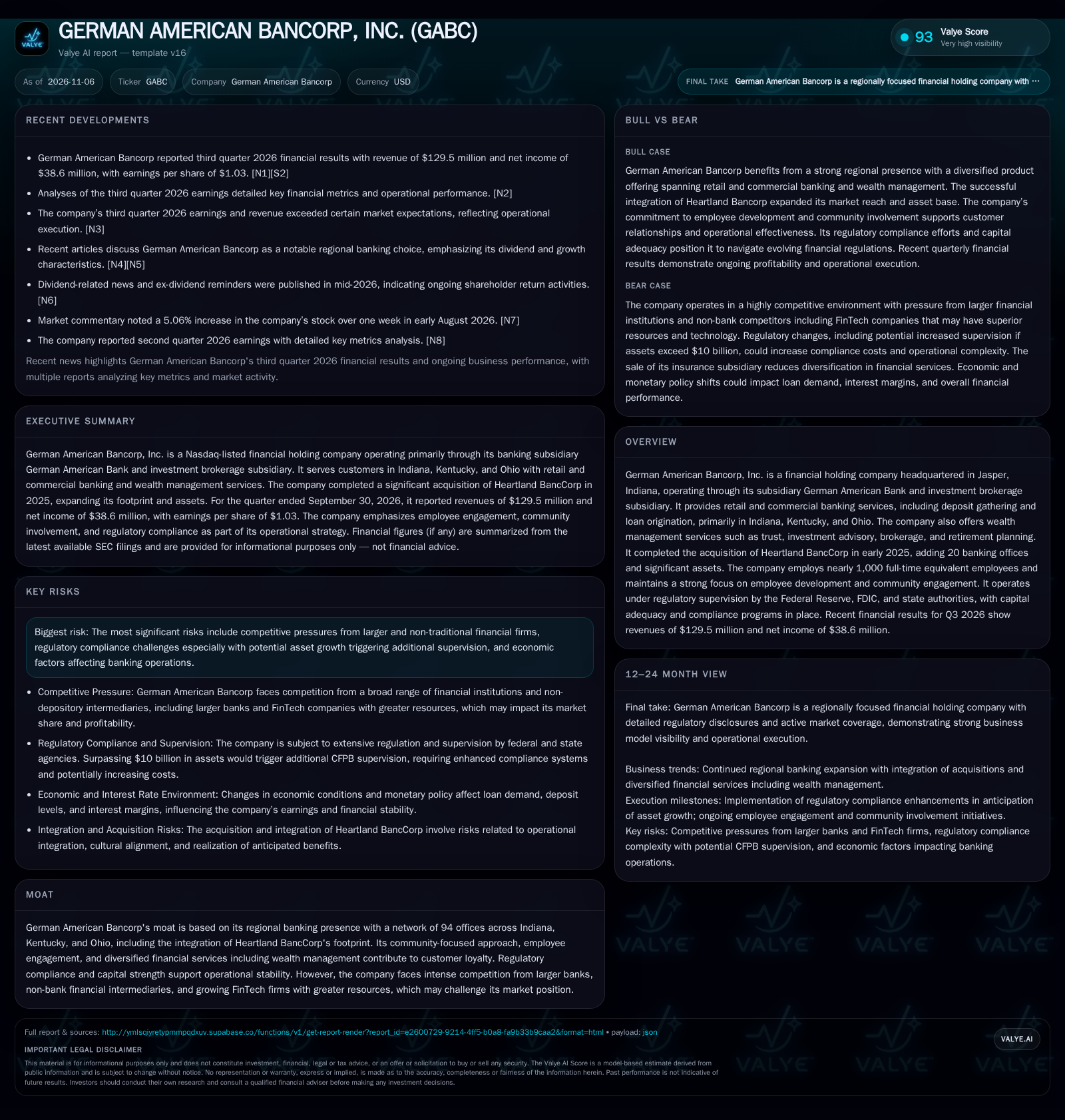
The February 2025 acquisition of Heartland BancCorp brought 20 new banking offices and approximately $1.94 billion in assets into German American Bancorp’s network, significantly increasing its scale in the Midwest. As of Q3 2026, the company reported revenue of $129.5 million and net income of $38.6 million, continuing its track record of profitability. With consolidated assets approaching $10 billion, German American Bancorp is preparing for the possibility of additional Consumer Financial Protection Bureau (CFPB) supervision, which will require more complex compliance systems and internal controls. The sale of its insurance subsidiary in mid-2024 has narrowed its non-banking operations, but the company continues to leverage its wealth management and brokerage offerings to diversify revenue. [S1] [S2]
How Scale, Mix, and Regulatory Costs Shape Financial Performance
German American Bancorp’s core economics are driven by traditional community banking activities: deposit gathering, loan origination, and fee-based wealth management. The Heartland BancCorp acquisition has increased both the deposit base and loan book, which can improve operating leverage if integration is efficient and if the company can sustain low funding costs relative to loan yields. However, as asset thresholds are crossed, regulatory costs and compliance investments typically rise non-linearly. For example, surpassing $10 billion in assets will subject the company to CFPB oversight and likely additional Dodd-Frank Act requirements, increasing fixed costs and potentially compressing margins.
Revenue mix is shifting: the 2024 divestiture of the insurance arm removes a recurring, albeit likely lower-margin, income stream, but the company retains fee-based wealth management and brokerage services. Margins in these areas may be higher than traditional lending but are sensitive to market volatility and client retention. The bank’s ability to manage funding costs, credit quality, and cross-sell higher-margin services will be critical for sustaining profitability as regulatory and technology expenses rise.
The interplay between scale economies and regulatory cost escalation creates a complex dynamic for German American Bancorp’s financial performance. While larger asset bases can spread fixed costs over a broader revenue stream, the step-up in compliance requirements often introduces new fixed and variable expenses that may not scale linearly. The bank’s ability to optimize operational processes, including leveraging automation in compliance workflows and enhancing data analytics for credit underwriting, will be critical to preserving margins. Furthermore, the sensitivity of fee-based wealth management revenues to market conditions introduces variability that must be managed through diversified product offerings and client segmentation strategies.
Community Focus Versus the Digital Scale of National and Fintech Rivals
German American Bancorp’s network of 94 offices provides a strong local presence and customer familiarity across Indiana, Kentucky, and Ohio. Its community banking approach, employee engagement, and regional branding (including the Heartland Bank name in Columbus and Greater Cincinnati) help retain customers wary of impersonal national banks. However, the company faces intense competition from larger regional and national banks with greater resources, as well as fintechs able to deliver digital-first offerings at lower cost and with greater product flexibility.
The competitive threat from fintechs is particularly acute in deposit gathering, consumer lending, and small business services, where technology-driven convenience and speed can erode traditional relationship advantages. Larger banks may also benefit from scale-driven cost efficiencies and superior compliance infrastructure, which will become more relevant as German American Bancorp crosses new regulatory thresholds. The company’s differentiated wealth management and advisory services offer some insulation, but customer acquisition and retention costs could rise if digital competitors accelerate their push into the Midwest.
German American Bancorp’s community banking model benefits from strong personal relationships and localized decision-making, which can be a competitive advantage in customer trust and retention. However, as digital channels become increasingly central to customer engagement, the bank must strategically invest in digital transformation initiatives to remain relevant. This includes developing user-friendly mobile platforms, integrating data-driven personalization, and enhancing cybersecurity measures to meet customer expectations and regulatory demands. Failure to keep pace with technological advancements could result in customer attrition to fintechs and larger banks that offer seamless, digitally native experiences.
If Integration and Compliance Investments Deliver Synergies, Margin Expansion Is Possible
A favorable outcome would see German American Bancorp successfully integrate Heartland BancCorp, realizing cost and revenue synergies through branch consolidation, technology adoption, and cross-selling of wealth management services to the expanded customer base. If the company can implement CFPB-mandated compliance systems efficiently—leveraging technology and process redesign to contain incremental costs—then operating leverage could improve as asset and deposit growth drive higher absolute revenue.
Supporting evidence would include rising noninterest income per customer, stable or improving efficiency ratios, and robust loan/deposit growth without a commensurate rise in nonperforming assets or compliance expenses. Confirmation would also come from market share gains in core regions and positive customer satisfaction or retention metrics post-integration.
Growth Brings Higher Costs and Complexity, With Returns Moderated by Competition
The most likely path is that German American Bancorp continues to grow moderately, but with incremental compliance and technology costs offsetting some of the scale benefits from the Heartland acquisition. The company may experience margin pressure as it invests in CFPB-level compliance, faces more aggressive digital competition, and absorbs the full impact of insurance business divestiture on noninterest income.
Evidence for this scenario would be steady but not accelerating revenue growth, stable (but not improving) efficiency ratios, and manageable increases in compliance and operating expenses. Loan and deposit growth may track regional economic trends rather than outpace them, while returns on equity and assets remain within historical norms for regional banks facing similar regulatory transitions.
Integration Stumbles or Regulatory Costs Outpace Revenue Gains
A more adverse scenario could unfold if German American Bancorp struggles to fully integrate Heartland BancCorp, resulting in customer attrition, higher-than-expected operating costs, or credit quality issues within the acquired loan portfolio. If the company underestimates the complexity or cost of meeting CFPB requirements, regulatory compliance could become a drag on profitability, eroding the benefits of scale.
This scenario would be confirmed by a spike in noninterest expenses, a deterioration in efficiency or return metrics, or a rise in nonperforming loans and customer churn post-acquisition. Inability to offset lost insurance income with higher-margin wealth management or brokerage revenue would further pressure earnings, while digital competitors could accelerate share loss if the bank’s technology investments lag.
What Will Determine German American Bancorp’s Post-Acquisition Trajectory?
Trends in efficiency ratio and noninterest expense, especially as compliance and integration costs become more visible.
Revenue and client growth in wealth management and brokerage, which would help offset the loss of insurance operations.
Deposit and loan growth rates in newly acquired Heartland BancCorp branches versus legacy branches.
Asset quality metrics, including nonperforming loans and charge-offs, particularly in the expanded loan portfolio post-acquisition.
Implementation progress and cost of CFPB-related compliance investments if and when the $10 billion asset threshold is crossed.
Market share changes in core Midwest regions, especially against fintech entrants and larger bank competitors.
Customer retention rates and satisfaction levels post-integration, if disclosed.
Ability to sustain or improve return on assets and equity as the company scales and absorbs regulatory complexity.
Disclaimer: This is research-only, informational analysis and not investment advice. It may include AI-generated interpretation and general industry context. Always verify important details using primary sources.

Comments