
United Bankshares After Piedmont: Regional Scale, Integration Leverage, and Banking’s Structural Crossroads
United Bankshares’ recent Piedmont Bancorp acquisition and consistent earnings highlight the bank’s quest for regional dominance, but competition, digital disruption, and regulatory shifts pose evolving challenges. The company’s operational resilience hinges on integrating its expanded footprint, extracting scale benefits, and navigating the transition from branch-centric to hybrid banking models.
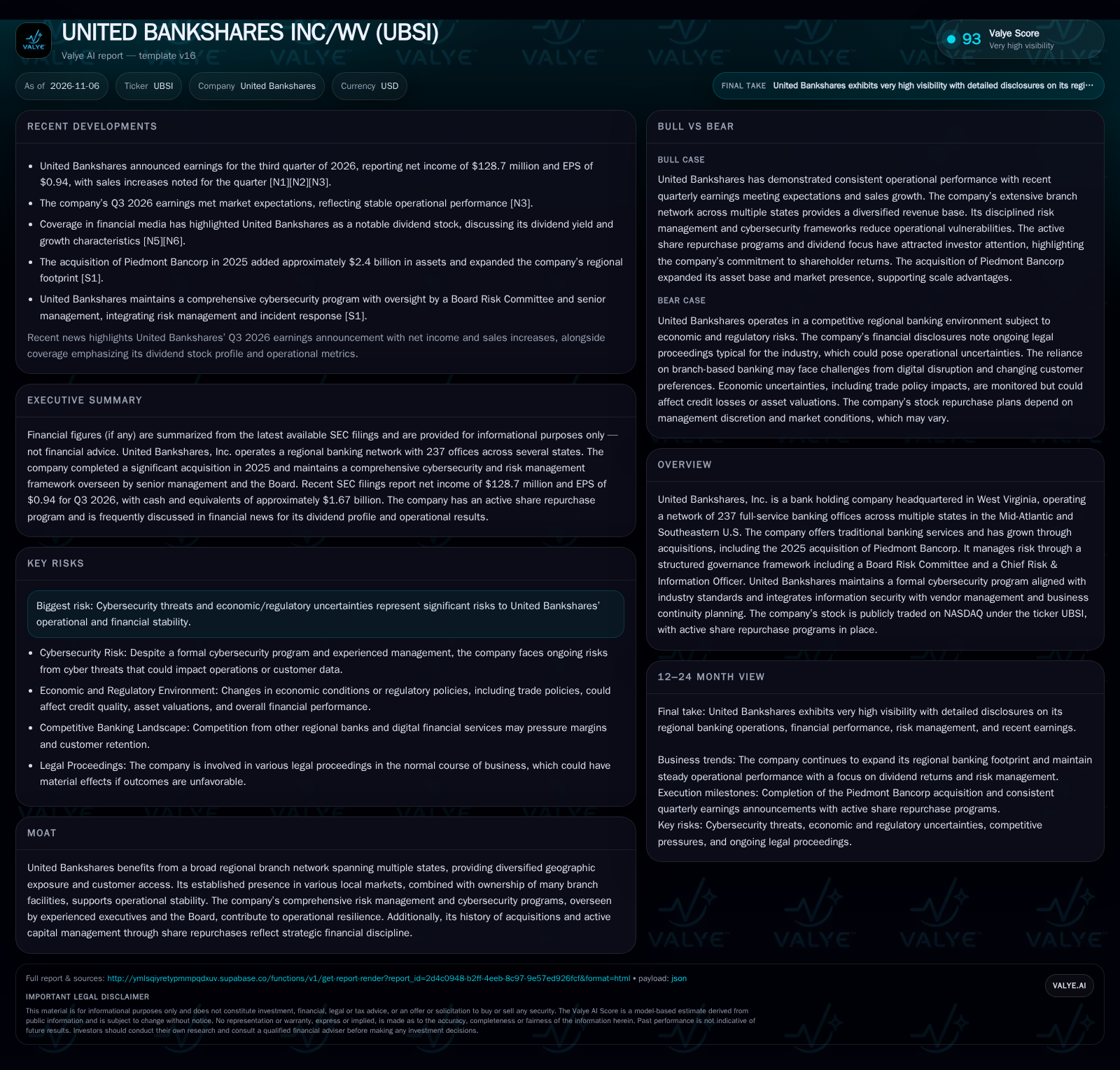
United Bankshares now operates a 237-branch network spanning the Mid-Atlantic and Southeast, following its $2.4 billion asset acquisition of Piedmont Bancorp in 2025. Q3 2026 earnings met expectations, and the company maintains $1.67 billion in cash and equivalents. The thesis now revolves around integration efficiency, margin management in a competitive environment, and adaptation to digital banking trends [S1] [S2] [N3].
United Bankshares, Inc. stands at a pivotal juncture after its acquisition of Piedmont Bancorp, which brought a significant boost to its asset base and expanded its regional banking footprint. The company’s Q3 2026 results signal operational steadiness, but the real challenge—and opportunity—lies in how United leverages its scale, integrates Piedmont’s operations, and adapts to structural pressures reshaping the regional banking sector. As competition intensifies and digital disruption accelerates, United’s future will be defined by its ability to extract value from its enlarged network, manage risk, and evolve its business model beyond the branch.
Piedmont Acquisition and Earnings Consistency Reshape United’s Platform
United Bankshares’ acquisition of Piedmont Bancorp in January 2025 added approximately $2.4 billion in assets and $2.1 billion in loans, cementing its presence in the Southeast and materially expanding its balance sheet [S1]. This deal not only broadened the company’s geographic footprint but also increased the scale at which it can operate, a critical advantage for regional banks facing margin pressure and rising compliance costs.
The company reported cash and liquidity metrics for the period; these figures do not by themselves establish operating runway, investment capacity, financial flexibility, or financing capacity. [S2] [N3]
The company’s active share repurchase program, which saw over 1.3 million shares repurchased in late 2025, underscores management’s focus on capital return and shareholder value [S1].
Branch Scale, Loan Mix, and Integration: The Economic Engine Under the Hood
United Bankshares’ core revenue streams stem from net interest income, fees on deposit and lending products, and ancillary services typical for regional banks. The Piedmont acquisition substantially increased the company’s loan book, which could enhance net interest margin if United can optimize funding costs and maintain credit quality. However, integration costs and potential loan portfolio overlap may offset some near-term gains.
Branch ownership versus leasing affects the company’s fixed versus variable cost structure. Owning a significant portion of branches in some states provides long-term stability and shields the bank from certain inflationary pressures, but also reduces flexibility if branch rationalization becomes necessary. Variable costs include personnel, compliance, technology, and risk management investments, especially as digital banking adoption grows.
Operating leverage could improve if United successfully consolidates back-office functions and harmonizes technology platforms post-acquisition. The challenge is to realize synergies without disrupting customer relationships or incurring excessive restructuring charges.
Capital needs remain moderate for a regional bank of this size, with cash and equivalents of $1.67 billion as of Q3 2026 [S2], and the ability to include certain subordinated notes and capital securities as Tier 2 capital. However, persistent regulatory scrutiny and evolving capital rules could increase requirements over time.
Regional Reach Versus Digital Disruption: Where United Stands
United Bankshares’ competitive position is rooted in its 237-branch network spanning seven states, offering diversified exposure to multiple local economies [S1]. This footprint gives the bank access to a broad deposit base and the ability to cross-sell products to a wide array of customers.
However, the regional banking landscape is intensely competitive, with peer banks, credit unions, and digital-first challengers all vying for market share. While United’s scale and established local relationships provide some switching friction, the risk is that customers increasingly opt for digital-only providers, eroding branch-driven advantages and pressuring fee and interest income.
Differentiation may depend on the company’s ability to deliver seamless digital experiences while leveraging in-market relationships—especially in markets newly acquired from Piedmont. If United can integrate digital offerings with high-touch service, it could defend its customer base against fintech and megabank encroachment. Conversely, slow adaptation could see the bank outflanked by nimbler competitors.
Synergy Realization and Digital Transition Drive Outperformance
The most favorable scenario for United Bankshares involves successful integration of Piedmont Bancorp yielding cost synergies, improved operating leverage, and enhanced cross-sell opportunities. If management can harmonize loan portfolios, eliminate redundant back-office functions, and leverage shared technology investments, margins could expand even as market competition intensifies.
Additionally, if United accelerates digital transformation—rolling out competitive mobile and online banking solutions, and integrating these with branch-based relationship management—it could retain and even grow its customer base, capturing younger demographics and improving cost-to-income ratios.
Evidence that would confirm this scenario includes sustained or rising net interest margin, declining efficiency ratio, positive operating leverage, and stable or improving deposit/share growth in both legacy and acquired markets. Accelerated digital adoption metrics, if disclosed, would further support the case.
Integration Progress Offsets Competitive Pressures—But Structural Headwinds Persist
The most plausible outcome is that United Bankshares achieves moderate integration benefits from the Piedmont acquisition—enough to stabilize earnings and defend regional market share, but not enough to materially outpace peers. Branch rationalization and technology investments may keep cost growth in check, while steady credit quality supports predictable net interest income.
However, ongoing competitive and regulatory pressures, combined with gradual migration of customers to digital channels, are likely to cap margin expansion. The company may need to continuously invest in compliance, cybersecurity, and digital capabilities just to maintain its position.
Confirmation of this scenario would come from stable quarterly earnings, a broadly unchanged efficiency ratio, and deposit/share trends in line with regional peers. Falsification would be signaled by integration delays, unexpected credit losses from the acquired loan book, or a marked deterioration in operating leverage.
Integration Stumbles and Digital Lag Threaten Franchise Value
A less favorable causal chain would see United struggle with Piedmont integration—manifesting as operational disruptions, customer attrition in overlapping markets, and higher-than-expected restructuring or credit costs. If the bank fails to harmonize systems and cultures, anticipated synergies could evaporate, while regulatory scrutiny may intensify due to legacy risk exposure.
Simultaneously, if United is slow to upgrade its digital banking platforms, it risks accelerated deposit outflows to digital-native competitors or larger banks with superior technology. This could compress net interest margins, raise funding costs, and force the company to compete more aggressively on price, eroding profitability.
Signs of this scenario would include a rising efficiency ratio, declining net interest margin, negative deposit/share trends, or an uptick in non-performing assets. Disclosure of integration setbacks or customer complaints in newly acquired markets would further undermine the thesis.
Milestones and Metrics That Will Shape United Bankshares’ Strategic Trajectory
Progress on cost synergies and integration milestones from the Piedmont Bancorp acquisition—updates on branch consolidation, technology harmonization, and back-office efficiencies would help test the integration thesis.
Net interest margin trends, particularly in the wake of the expanded loan portfolio, as an indicator of pricing power and funding cost management.
Efficiency ratio movement (if disclosed), as a proxy for realized operating leverage and cost discipline.
Deposit/share growth in both legacy and newly acquired Piedmont markets—divergence could indicate integration or competitive issues.
Metrics on digital banking adoption and usage (if disclosed), to gauge the effectiveness of technology investments and the risk of digital disruption.
Non-performing asset ratios and credit quality trends, especially in the acquired loan book, to monitor for post-merger credit surprises.
Regulatory or legal developments stemming from ongoing proceedings or integration-related risks.
Share repurchase activity and capital return policy adjustments, as a signal of management confidence and capital flexibility.
Disclaimer: This is research-only, informational analysis and not investment advice. It may include AI-generated interpretation and general industry context. Always verify important details using primary sources.

Comments