
Koppers Holdings Inc.: Vertical Integration Under Pressure as Pricing Squeezes Margins
Volume gains in performance chemicals and utility poles offset persistent margin headwinds in Koppers' core wood products and carbon materials businesses. The company’s vertically integrated model and long-term contracts provide resilience, but exposure to volatile raw materials and end-market cyclicality raise questions about earnings durability and future capital allocation.
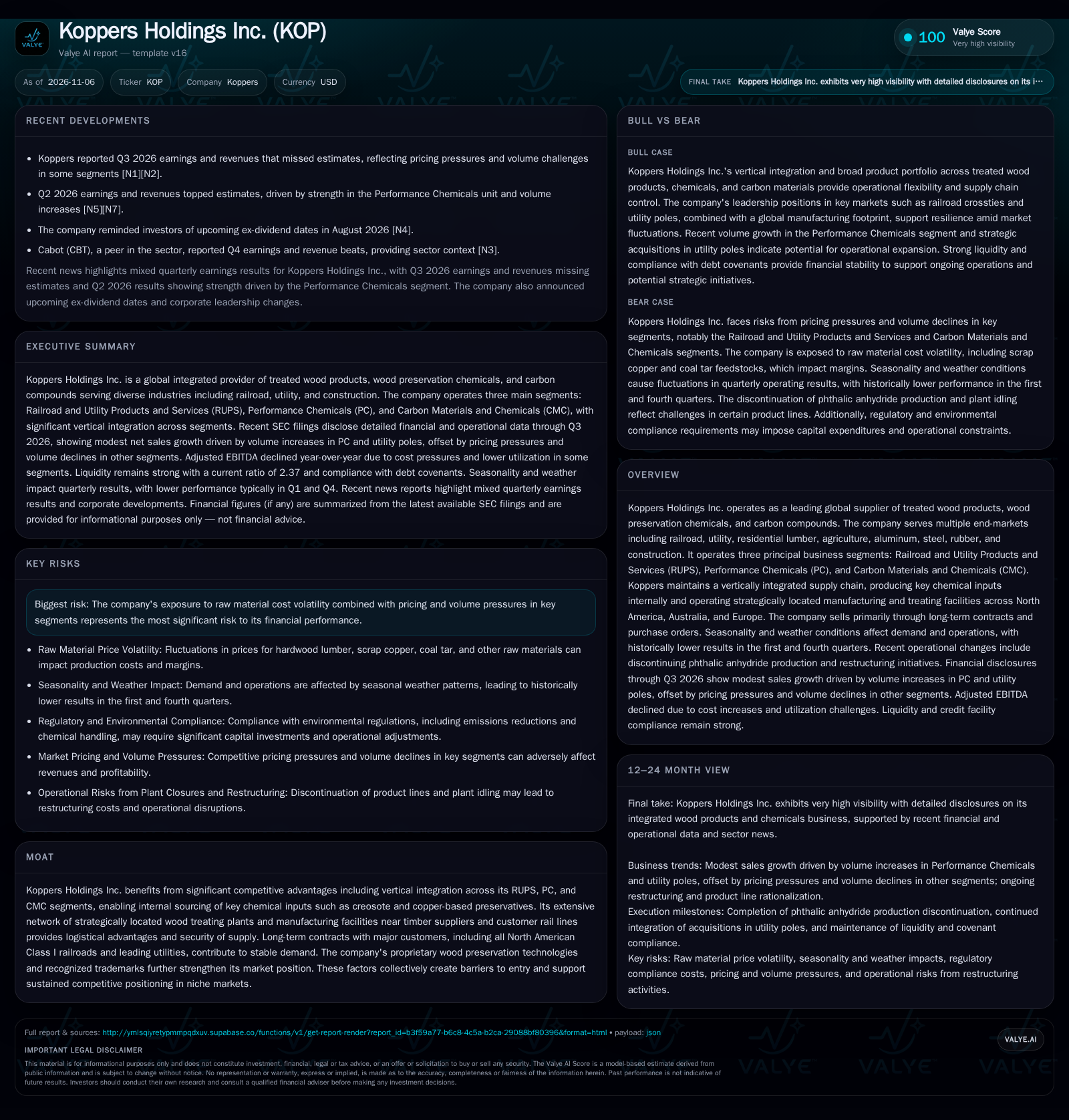
Koppers Holdings’ Q3 2026 results show modest sales growth from higher volumes in performance chemicals and utility poles, but adjusted EBITDA fell on pricing and cost pressures, especially in railroad and carbon segments. Vertical integration and long-term contracts buffer supply risks, yet competitive and commodity-driven pricing dynamics threaten margin stability. [S2]
Koppers Holdings Inc., a leading global supplier of treated wood products, wood preservation chemicals, and carbon compounds, is at a crossroads. While the company’s Q3 2026 results show that volume gains in its performance chemicals and utility pole segments are supporting top-line growth, persistent pricing pressures and cost inflation in its core railroad and carbon businesses are eroding margins. Koppers’ vertically integrated model and long-term customer relationships provide a buffer against supply disruptions, but do not fully shield earnings from volatile raw material markets and cyclical demand. The company’s next phase will be defined by its ability to sustain pricing power, optimize its product portfolio, and manage capital allocation in the face of industry headwinds and regulatory constraints. [S1] [S2]
Recent Results Signal Margin Squeeze Despite Revenue Gains
Koppers reported Q3 2026 net sales of $499.1 million, a 2.8% increase over the prior year, reflecting volume growth in its Performance Chemicals (PC) and Railroad and Utility Products and Services (RUPS) segments, particularly in Class I crossties and domestic utility poles. However, this growth was offset by continued pricing pressures in crossties and lower volumes in the Carbon Materials and Chemicals (CMC) segment. Adjusted EBITDA for the quarter fell 18.2% year-over-year to $58.0 million, with margin compression primarily driven by unfavorable pricing, higher raw material costs, and utilization issues in RUPS and CMC. The company reported a current ratio of 2.37 for the period. Koppers also continued its portfolio rationalization, discontinuing phthalic anhydride production at its Stickney, Illinois facility earlier in the year due to emissions goals and capital requirements. [S1] [S2]
How Koppers’ Vertically Integrated Model Drives—and Limits—Profitability
Koppers’ core economics are shaped by its vertically integrated supply chain, which allows internal production of key inputs like creosote and copper-based wood preservatives. This structure offers some cost control and supply security, particularly for the RUPS and PC segments, and allows the company to serve large, contract-driven end markets such as Class I railroads and utilities. The majority of sales are made through long-term contracts or regional purchase orders, contributing to a degree of revenue visibility and lowering customer churn risk.
However, the company’s cost structure remains highly exposed to commodity price swings—especially in hardwood timber, copper, and coal tar. While vertical integration can partly mitigate external supply shocks, it does not eliminate input cost inflation, particularly when global commodity cycles turn adverse. Fixed costs are significant due to the company’s 18 wood treating plants and regional manufacturing footprint, so volume declines or underutilization can rapidly erode margins. Segment economics differ: Performance Chemicals tends to have higher margins and more stable demand, while RUPS and CMC are more cyclical and sensitive to volume and price. The recently discontinued phthalic anhydride line underscores how regulatory and environmental costs can force capital reallocation and affect segment profitability. [S1] [S2]
Barriers to Entry and Competitive Pressures in Niche Industrial Markets
Koppers holds leading positions in several niche markets, including being the largest supplier of railroad crossties to Class I railroads in North America and the second largest producer of utility poles in the U.S. Its scale, proprietary chemical formulations, and vertically integrated operations create barriers to entry for potential competitors—especially in the capital-intensive and regulation-heavy treated wood and chemical segments. Long-term customer relationships, particularly with railroads and utilities, provide a baseline of recurring demand.
Nevertheless, Koppers faces structural challenges. Many of its end-markets are mature and subject to cyclical infrastructure spending and weather-driven variability. While its proprietary wood preservation technologies and trademarks support some pricing power, commodity-driven products in the CMC segment are exposed to global price competition and substitution risk from alternative materials. Large customers may exert negotiating leverage, limiting the company’s ability to pass through cost increases. Competing supplier categories include specialty chemical conglomerates, regional wood treaters, and global carbon materials producers.
Volume Leverage and Input Cost Relief Could Restore Margin Expansion
The most favorable scenario for Koppers would be a sustained period of strong infrastructure and utility spending, driving higher volumes in crossties, utility poles, and performance chemicals. If raw material prices for timber, copper, and coal tar stabilize or decline, and the company manages to pass through sufficient price increases to offset previous cost inflation, margin recovery could follow. The PC segment, with its higher margins and defensible market share, could act as a profit engine if demand for residential and commercial treated wood rebounds.
Signs that would confirm this scenario include sequential improvement in adjusted EBITDA margins, positive pricing trends in RUPS and CMC, and evidence of successful contract renegotiations or new long-term agreements with major customers. A favorable regulatory environment or successful adaptation to new emissions standards would further support expansion. Conversely, continued margin compression despite volume growth, or failure to pass through input costs, would falsify this scenario. [S2]
Steady Volumes, Ongoing Margin Volatility, and Incremental Optimization
The most plausible outcome is that Koppers maintains relatively stable volumes in its core segments, supported by long-term contracts and recurring infrastructure demand, but faces ongoing challenges in achieving consistent margin improvement. While the company’s vertical integration and customer relationships provide some resilience, continued exposure to input cost volatility and limited pricing flexibility—especially in commodity-driven segments—will likely constrain EBITDA growth.
Incremental improvements may come from ongoing restructuring, plant optimization, and portfolio rationalization, such as the recent exit from phthalic anhydride. However, the company will probably remain highly sensitive to swings in raw material prices and end-market demand. Confirmation of this scenario would come from flattish or modestly improving sales with persistent margin volatility, ongoing portfolio adjustments, and maintenance of covenant compliance. A material shift in segment profitability or a major new contract win/loss would signal deviation from this track. [S1] [S2]
Commodity Spikes and End-Market Weakness Threaten Earnings Stability
The adverse scenario involves a combination of renewed raw material price spikes—particularly in copper, timber, and coal tar—coinciding with volume declines in key end-markets like railroads and construction. In this environment, Koppers could see further margin compression, negative operating leverage, and potential covenant pressure if EBITDA declines outpace cost controls. Disruptions from regulatory changes, such as stricter emissions standards or unexpected capital requirements, could force additional plant closures or restructuring expenses.
Evidence supporting this scenario would include a further decline in adjusted EBITDA margins, negative sales growth, rising working capital needs, or a breach of debt covenants. A failure to renew key customer contracts or unexpected regulatory enforcement actions would also be warning signs. [S2]
Testing the Resilience of Koppers’ Integrated Model: Areas to Monitor
Adjusted EBITDA margin trends by segment, particularly RUPS and CMC, to assess the effectiveness of cost pass-through and operational leverage. [S2]
Quarterly volume and pricing changes in performance chemicals, utility poles, and crossties, as these drive the bulk of top-line growth and margin potential. [S2]
Raw material cost inflation or relief, especially in copper, hardwood timber, and coal tar—external data would help triangulate exposure.
Renewal or renegotiation of long-term contracts with major customers, including any disclosed changes in pricing or volume commitments.
Progress and financial impact of ongoing restructuring or plant rationalization initiatives, including cost savings and capital expenditure needs. [S1]
Compliance with debt covenants and any changes to credit facility terms—would signal either stability or emerging financial strain. [S2]
Regulatory developments around emissions, chemical handling, or treated wood standards that could affect capital allocation or operating costs.
If disclosed, customer retention rates and new contract wins/losses in core segments—would help test the durability of Koppers’ market position.
Disclaimer: This is research-only, informational analysis and not investment advice. It may include AI-generated interpretation and general industry context. Always verify important details using primary sources.

Comments