
Devon Energy Post-Coterra Merger: Scale, Synergies, and Integration Dynamics
The next phase hinges on realizing merger synergies, navigating regulatory and market headwinds, and demonstrating disciplined capital allocation.
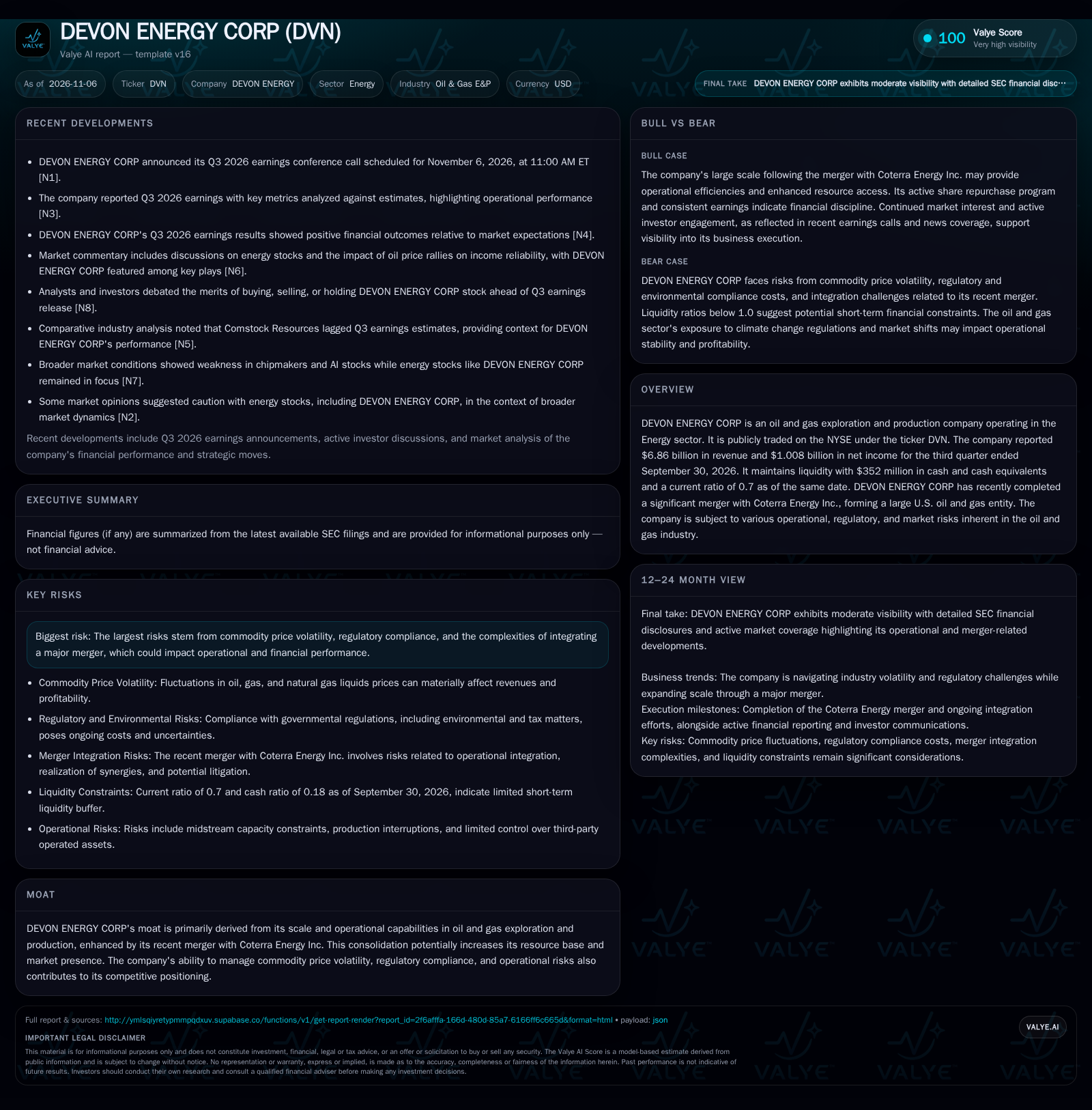
Devon Energy reported $6.86 billion in Q3 2026 revenue and $1.008 billion in net income, but faces a current ratio of 0.7 and a cash ratio of 0.18 post-merger. The $58 billion Coterra Energy merger brings scale and potential efficiencies, yet also introduces integration risk and amplifies sensitivity to commodity prices and regulatory shifts. Near-term performance will depend on successful synergy realization, cost discipline, and stable access to credit markets. [S2]
Devon Energy’s recent $58 billion merger with Coterra Energy marks a new chapter for the company, vaulting it into the top echelon of U.S. oil and gas producers by resource base and operational reach. The Q3 2026 financials show continued profitability and strong revenues, but also highlight a relatively tight liquidity position and the complex task of integrating two sizable enterprises. As Devon seeks to unlock merger synergies and navigate a volatile regulatory and commodity landscape, its ability to deliver on promised efficiencies while maintaining capital discipline will shape its trajectory through 2027 and beyond. [S2]
Current Financial Position and Merger Integration Status
Devon Energy’s Q3 2026 results are dominated by the recent $58 billion merger with Coterra Energy, which closed in May 2026 and created one of the largest independent oil and gas producers in the United States. For the quarter ended September 30, 2026, Devon reported $6.86 billion in revenue and $1.008 billion in net income, with earnings per share at $0.88. [S2]
On the balance sheet, Devon ended Q3 with $352 million in cash and cash equivalents, current assets of $4.82 billion, and current liabilities of $6.85 billion, resulting in a current ratio of 0.7 and a cash ratio of 0.18. [S2] The company also assumed $3.5 billion in Coterra debt but retired $1.25 billion in debt during the first nine months of 2026, with no significant maturities until Q2 2027. [S2]
Devon’s $8 billion share repurchase program has been completed, underscoring its recent focus on shareholder returns. However, the combined entity faces the challenge of realizing operational and financial synergies while managing liquidity and integration risks in a sector highly sensitive to commodity prices and regulatory developments.
Impact of Scale and Commodity Exposure on Devon’s Economics
Devon’s core business model is anchored in oil and gas exploration and production, with revenues and margins highly sensitive to realized commodity prices and production volumes. The merger with Coterra increases Devon’s reserve base and operational scope, which, if managed efficiently, could drive down unit costs through greater economies of scale and improved resource allocation.
The company’s cost structure typically features high fixed costs in the form of field development, infrastructure, and corporate overhead, with variable costs linked to production levels and service pricing. In theory, larger scale should allow Devon to spread fixed costs over a greater production base, potentially enhancing operating leverage and EBITDA margins if commodity prices remain supportive.
Cash flow is inherently volatile due to swings in oil, gas, and NGL prices. While hedging can partially mitigate this, sustained price downturns can quickly compress margins and strain cash generation, particularly if acquisition-related DD&A accelerates or integration costs prove higher than expected. Integration synergies—if realized—could include procurement savings, streamlined drilling operations, and optimized capital deployment, but these benefits are contingent on effective execution.
Devon’s capital needs remain substantial: sustaining production, replacing reserves, and integrating legacy Coterra assets all require ongoing investment. The company’s $3.0 billion undrawn credit facility with availability governed by the facility's disclosed terms as it balances shareholder returns against reinvestment and debt reduction. [S2]
Devon’s Competitive Edge Through Scale and Operational Efficiency
Devon’s merger-driven scale positions it as a peer to other large independent U.S. E&Ps, such as Pioneer Natural Resources, EOG Resources, and ConocoPhillips. Scale offers potential bargaining power with service providers and access to premium acreage, but also exposes Devon to the full force of sector cyclicality and regulatory scrutiny.
The principal sources of advantage in E&P remain resource quality, cost discipline, operational execution, and prudent capital allocation. Devon’s enhanced asset base could improve its standing on drilling inventory and resource quality, but competitors are similarly consolidating and pursuing efficiency gains.
Counterforces include energy transition pressures, the growing role of renewables, and investor skepticism around long-term oil and gas demand. Regulatory and environmental compliance costs are a persistent headwind, and climate-driven policy shifts could accelerate the risk of stranded assets or impose new capital requirements.
Switching frictions are relatively low for customers (often refineries or midstream operators), but high for Devon due to sunk costs and the long-cycle nature of upstream investments. The real competitive test will be Devon’s ability to deliver consistent free cash flow, manage integration, and adapt to evolving policy and market signals faster than peers.
Realizing Merger Synergies in a Favorable Commodity Environment
The clearest path to outperformance is successful and rapid integration of Coterra, resulting in meaningful cost synergies, operational efficiencies, and enhanced drilling inventory. If Devon manages to consolidate overlapping operations, reduce overhead, and optimize capital allocation, it could realize higher margins and improved free cash flow conversion.
A supportive macro backdrop—sustained or rising oil and gas prices—would amplify these benefits, enabling Devon to quickly de-lever, reinvest in high-return projects, and return additional capital to shareholders via dividends or further buybacks.
Evidence that would confirm this scenario includes: upward revisions to synergy targets, declining unit operating costs, sequential improvement in EBITDA margins, and robust free cash flow despite ongoing integration spend. Outperformance versus peer margins, as well as positive commentary from management on integration progress and drilling productivity, would further bolster the case.
Conversely, if cost savings are delayed or commodity prices weaken materially, the upside may be capped or deferred.
Progressing Integration Amid Market Fluctuations and Capital Constraints
The most probable trajectory for Devon is a mixed environment where integration proceeds at a measured pace, with moderate synergy realization offset by ongoing merger costs and sector volatility. Commodity prices may remain range-bound, providing steady but unspectacular cash flows.
Devon is likely to prioritize balance sheet stability and measured capital returns, using its undrawn credit facility to buffer against working capital swings while managing debt maturities and integration outlays. Operational improvements may emerge gradually as best practices are harmonized across the legacy Devon and Coterra portfolios.
Confirmation would come from steady production volumes, stable or improving unit costs, and disciplined capital expenditure in line with prior guidance. If disclosed, progress updates on integration milestones (e.g., ERP system harmonization, headcount rationalization, field operation consolidation) would help validate this scenario.
Falsification would be signaled by material cost overruns, repeated downward revisions to synergy targets, or a sustained deterioration in liquidity metrics.
Risks from Integration Delays and Commodity Price Declines
The adverse scenario features a combination of merger integration setbacks and a material decline in commodity prices. Integration failures—such as delayed system consolidation, cultural clashes, or unexpected asset impairments—could drive up costs and distract management, eroding anticipated synergies.
Should oil and gas prices fall sharply, Devon’s relatively low current and cash ratios would provide limited cushion, potentially leading to increased reliance on its credit facility or asset sales to shore up liquidity. Accelerated DD&A from acquisition accounting could further compress net income if reserve estimates or commodity price assumptions prove optimistic.
Confirmation would come from rising operating costs, negative free cash flow, drawdowns on the credit facility, or credit rating downgrades. Additional warning signs include missed synergy milestones, higher-than-expected integration charges, and guidance cuts tied to either operational or market headwinds.
A reversal of share buybacks or dividend reductions would also signal capital pressure under this scenario.
Key Milestones Influencing Devon’s Post-Merger Outlook
Progress on merger integration: Updates on synergy realization, headcount rationalization, and system/process consolidation would help test the integration thesis.
Unit cost trends: Quarterly disclosure of lifting costs per BOE and G&A per BOE, if provided, would clarify whether scale efficiencies are materializing.
Free cash flow: Sustained positive free cash flow, net of integration costs, would support the case for disciplined capital allocation.
Credit facility usage: Any drawdowns or changes in borrowing base availability may signal evolving liquidity needs.
Production volumes by basin: Reporting of output by legacy Devon and Coterra assets would indicate operational health and asset quality.
Capital expenditure discipline: Tracking actual versus guided capex will reveal management’s ability to balance investment and returns.
Debt ratings actions: Upgrades or downgrades by agencies would reflect market confidence in balance sheet strength post-merger.
Disclaimer: This is research-only, informational analysis and not investment advice. It may include AI-generated interpretation and general industry context. Always verify important details using primary sources.

Comments