
Sabine Royalty Trust: Income Stability Meets Commodity Cycles in a Fixed Asset Structure
Sabine Royalty Trust delivers monthly distributions from oil and gas royalty interests, offering income-oriented investors direct exposure to commodity cash flows—but with structural limits on growth and pronounced sensitivity to production and price cycles.
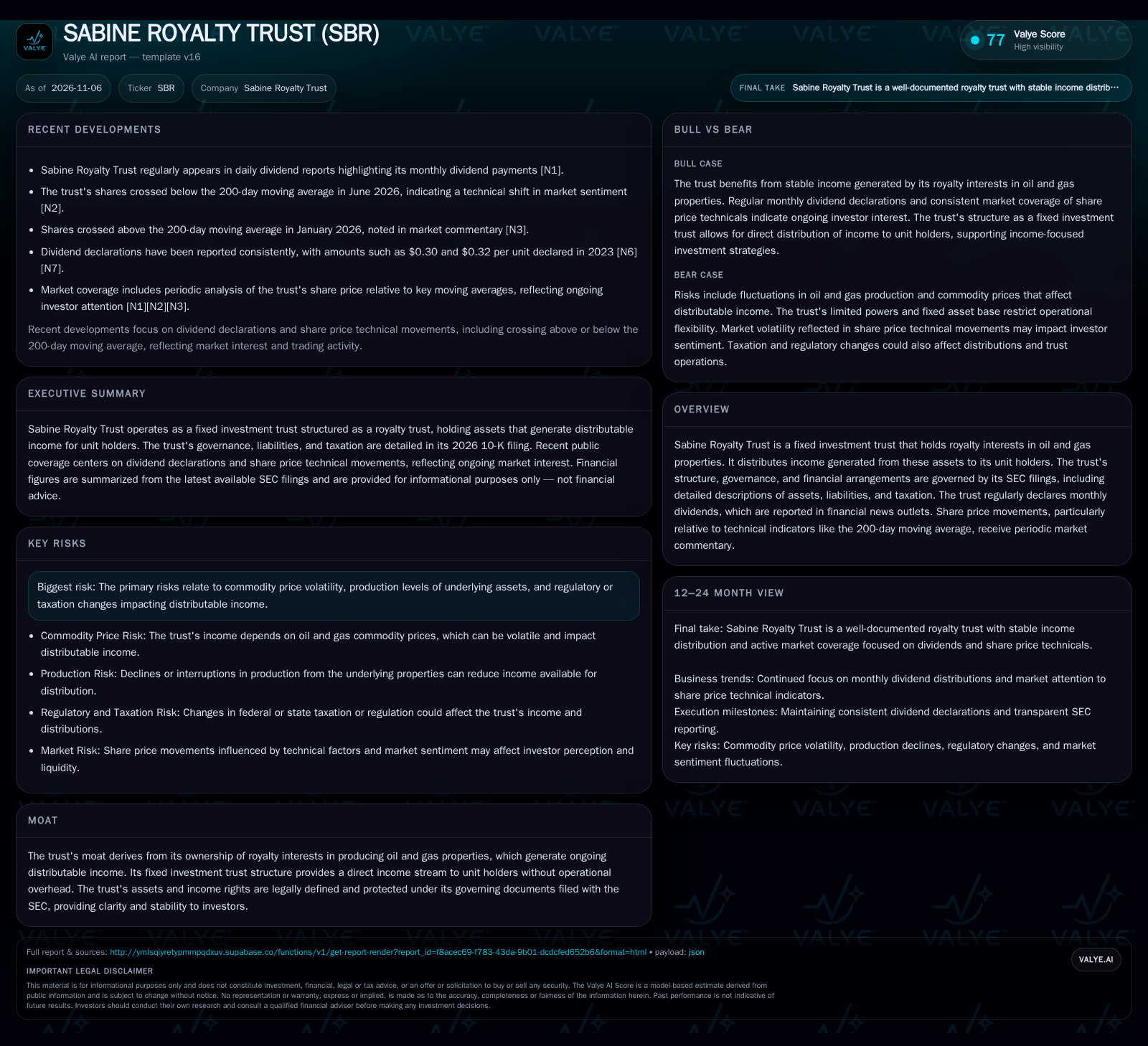
Sabine Royalty Trust provides investors with direct distributions from oil and gas royalty interests, benefiting from the legal clarity and low operational overhead of its trust structure. While recent news highlights continued monthly dividends and active market attention to share price technicals, the trust’s fixed asset base and lack of operational flexibility mean its distributions are inherently tied to the volatile cycles of commodity prices and production volumes. Structural risks include declining production, regulatory shifts, and changes in tax treatment, all of which could materially impact future distributions.[S1] [N1] [N2] [N3]
Sabine Royalty Trust stands out as a pure-play royalty trust, providing monthly income distributions driven by its oil and gas royalty portfolio. Its appeal to income-seeking investors is underpinned by a structure that strips out operating risk and overhead, but also locks in exposure to commodity and production cycles without avenues for active management or asset growth. Recent market coverage highlights both the consistency of its dividends and the sensitivity of its share price to technical trading signals, underscoring the dual realities of steady cash flow and inherent volatility.[S1] [N1] [N2] [N3]
Recent Dividend Consistency and Market Attention Shape Investor Sentiment
The cited source reports dividend-related activity; that disclosure alone does not establish dividend-policy continuity, management confidence, or a material constraint on capital flexibility. [N1] Meanwhile, the trust’s shares have exhibited notable technical trading activity, crossing below the 200-day moving average in June 2026 and above it in January 2026—events that have attracted periodic market commentary and may influence short-term investor sentiment.[N2] [N3] These facts underscore the trust’s dual identity as a steady income generator and a vehicle subject to market-driven volatility.
How the Royalty Trust Model Drives Distributable Income—And Its Limits
Sabine Royalty Trust’s economics are defined by its fixed ownership of royalty interests in producing oil and gas properties. Unlike operating companies, the trust does not manage wells or incur operating costs; instead, it receives a share of proceeds from the sale of oil and gas produced on its underlying properties. This structure means nearly all revenue (less minimal administrative costs and taxes) is distributed directly to unit holders, creating a pass-through model with high payout ratios and minimal retained earnings.[S1]
The trust’s distributable income is determined by two primary variables: production volumes from the underlying assets and prevailing commodity prices. Both are exogenous and volatile, leading to distributions that can fluctuate significantly from month to month and year to year. The lack of capital expenditure obligations or operating cost exposure shields unit holders from operational risks, but the fixed asset base means there is little potential for organic growth or active management to offset declines in production or commodity price downturns.
Operating leverage is largely absent in the traditional sense; administrative expenses are low and fixed, so changes in distributable income are almost entirely driven by upstream revenue fluctuations. Capital needs are minimal since the trust does not invest in new wells or expansions. This makes the trust highly efficient in converting gross receipts into distributions, but also means that depletion, natural production decline, and lack of reinvestment can gradually erode distributable income over time.
An additional consideration in the trust’s economic model is the impact of lease terms and contractual arrangements underlying the royalty interests. These agreements typically specify the royalty percentage and may include escalators or limitations that influence revenue flow over time. Understanding the specific terms is crucial because they can affect the sensitivity of distributions to price fluctuations and production changes. For instance, fixed-percentage royalties provide a direct linear relationship with revenues, while more complex structures could introduce nonlinearities or caps that moderate income volatility.
Royalty Trusts in Context: Asset Quality, Structural Advantages, and the Limits of Moat
Sabine Royalty Trust’s principal competitive advantage lies in its legal ownership of royalty interests that generate ongoing cash flow without operational overhead. This structure appeals to investors seeking transparency, simplicity, and high payout ratios. Compared to traditional oil and gas companies, royalty trusts avoid direct exposure to cost overruns, drilling risk, and capital expenditure cycles.
However, within the royalty trust category, differentiation depends on the quality, geographic diversity, and production profile of the underlying assets. Trusts with newer, more productive wells or more resilient basins may offer better long-term distribution potential. Sabine’s moat is durable in the sense that its income rights are legally protected and not easily replicable, but it is not immune to competitive pressure from other trusts with superior asset bases or from alternative income-generating vehicles such as MLPs, REITs, or dividend stocks.
Substitution risk is primarily driven by investor preferences for yield, tax treatment, and commodity exposure. The trust’s lack of growth mechanisms and its susceptibility to commodity and production declines limit its ability to defend market share if investors shift toward more dynamic or diversified income vehicles.
Commodity Upswings and Production Surprises Could Drive Higher Distributions
A favorable scenario for Sabine Royalty Trust would involve a sustained increase in oil and gas prices, possibly coupled with stable or unexpectedly strong production from its underlying properties. In such an environment, distributable income could rise, supporting higher monthly dividends and potentially lifting the trust’s unit price as yield-seeking investors bid up shares.
Evidence that would confirm this scenario includes multi-month increases in reported distributions, positive commentary on production stability or incremental development on trust properties (if disclosed), and upward price movements that outpace peer royalty trusts. Conversely, failure of distributions to respond to favorable commodity prices or production levels would falsify the upside case, suggesting asset depletion or underlying property issues.
Distributions Track Commodity and Production Trends with No Growth Catalyst
The most plausible trajectory for Sabine Royalty Trust is for monthly distributions to fluctuate in line with prevailing oil and gas prices and natural production decline from its fixed asset base. In this scenario, the trust continues to provide attractive yields relative to alternatives, but with no ability to offset declines through reinvestment or operational improvement.
Confirmation of this scenario would be continued regular monthly dividends that generally reflect broader commodity cycles and industry production trends, with no material change in the trust’s asset base or payout policy. Evidence to the contrary would include announcements of asset sales, property reversion, regulatory or tax changes affecting distributions, or unexplained deviations from commodity-linked income patterns.
Production Declines and Adverse Regulation Could Erode Distributable Income
The primary risk for Sabine Royalty Trust is a scenario where commodity prices fall sharply and/or production from the underlying properties declines faster than expected, resulting in materially lower distributions. This could be exacerbated by regulatory or tax changes that increase the trust’s obligations or reduce its distributable income.[S1]
Warning signs would include sustained reductions in monthly dividends, negative disclosures about production interruptions or asset depletion, and any regulatory filings indicating changes in tax treatment or compliance burdens. Confirmation of the downside would be a visible decoupling of distributions from commodity recoveries, indicating structural asset issues or external headwinds.
Testing the Stability and Sustainability of Sabine’s Distributions
Monthly distribution amounts and their responsiveness to changes in oil and gas prices.
Updates (if disclosed) on production volumes or reserve estimates for the underlying royalty properties.
Regulatory or legislative developments impacting tax treatment or compliance obligations for royalty trusts.
Comparative yield and price performance versus peer royalty trusts and alternative income vehicles.
Frequency and magnitude of share price movements relative to technical indicators such as the 200-day moving average.
Disclosures, if any, regarding property reversion, asset sales, or changes in the trust’s underlying asset base.
Market commentary or analyst reports highlighting shifts in investor appetite for commodity-linked income streams.
Disclaimer: This is research-only, informational analysis and not investment advice. It may include AI-generated interpretation and general industry context. Always verify important details using primary sources.

Comments