
First Mid Bancshares: Acquisition-Driven Expansion and the Levers of Regional Bank Resilience
First Mid Bancshares continues to lean on strategic acquisitions, most recently with the pending Evergreen Bancshares deal, to scale its core banking franchise. As it integrates new loan and deposit portfolios, manages off-balance sheet risk, and navigates regulatory and credit headwinds, the bank’s ability to translate growth into durable returns and balance sheet health will define its next chapter.
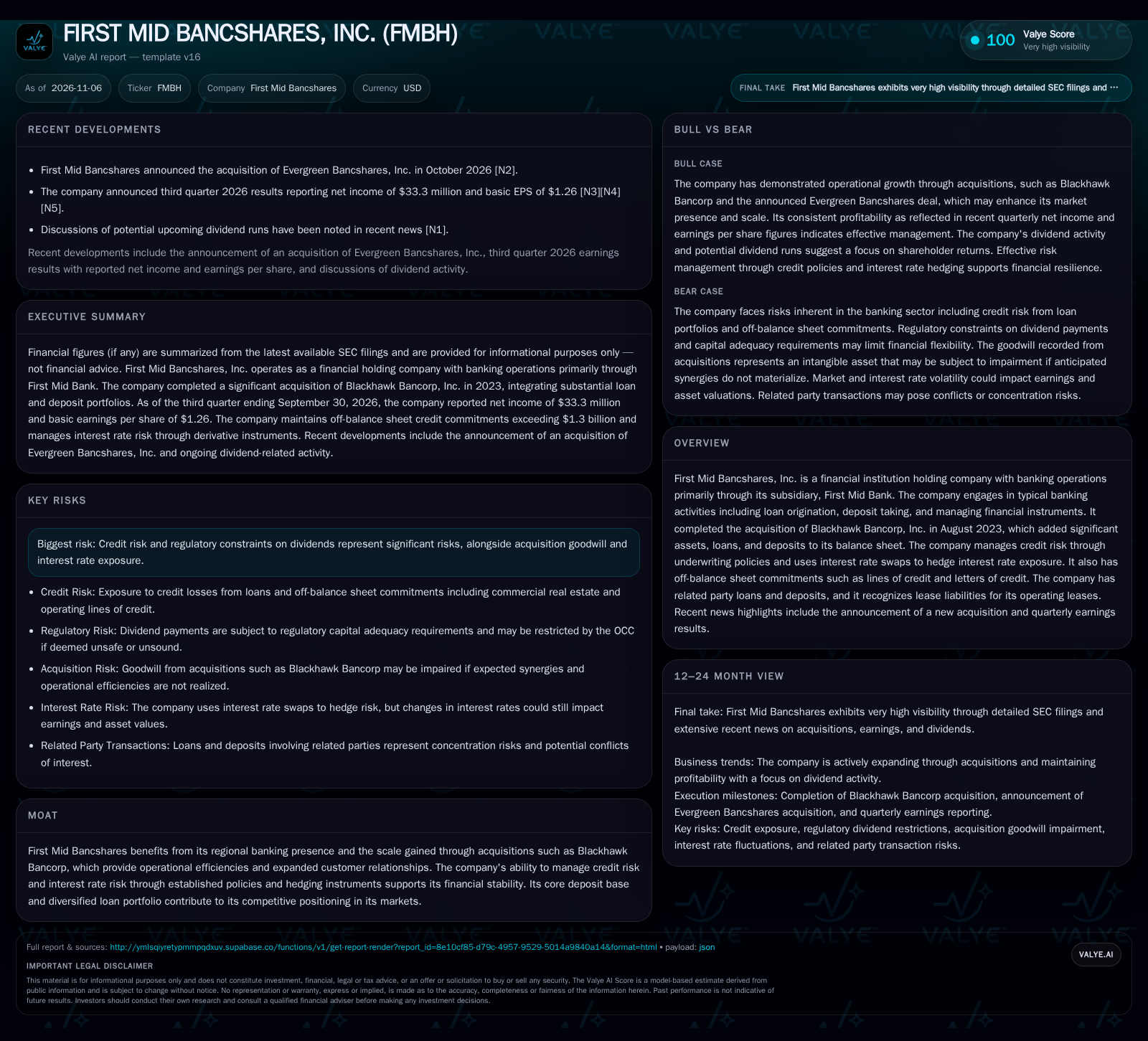
First Mid Bancshares is pursuing regional banking scale through a series of acquisitions, most recently Blackhawk Bancorp in 2023 and the pending Evergreen Bancshares deal. Net income reached $33.3 million in Q3 2026, but the bank faces outsized off-balance sheet credit commitments and must manage integration risk, regulatory dividend constraints, and potential goodwill impairment. The strategic question is whether growth through acquisition can sustainably strengthen the franchise in the face of sector-specific risks. [S1] [S2] [N2]
First Mid Bancshares has established itself as a consolidator in the Midwest regional banking space, pursuing scale and market share through a disciplined series of acquisitions. The recent integration of Blackhawk Bancorp and the announced Evergreen Bancshares deal underscore a strategic bet on operational leverage, expanded customer relationships, and cost synergies. Yet, as the bank grows through external deals, it must balance the upside of increased scale with risks tied to credit quality, regulatory capital, and the uncertain realization of acquisition synergies. The next phase will test whether First Mid can convert headline growth into sustainable returns in a volatile interest rate and regulatory environment.
Acquisition Momentum and Earnings: Recent Moves Reshape the Franchise
First Mid Bancshares completed the acquisition of Blackhawk Bancorp in August 2023, adding $1.27 billion in assets and $1.22 billion in liabilities, and recognized $50.1 million in goodwill from anticipated synergies [S1]. In October 2026, the company announced it would acquire Evergreen Bancshares, signaling continued commitment to growth via M&A [N2]. For the quarter ending September 30, 2026, First Mid reported net income of $33.3 million and basic EPS of $1.26 [S2]. Off-balance sheet credit commitments reached approximately $1.38 billion at the end of 2025, reflecting significant contingent exposure [S1]. These developments highlight the company’s focus on scaling its balance sheet, expanding its geographic and product footprint, and pursuing earnings growth. However, they also increase integration complexity and exposure to credit and operational risk.
How Scale, Funding Mix, and Risk-Sharing Shape Profitability
First Mid Bancshares generates revenue primarily through net interest income, fees, and ancillary financial services. Acquisitions like Blackhawk Bancorp and the pending Evergreen Bancshares deal may enhance revenue by increasing the loan and deposit base, enabling cross-selling, and which could improve operational efficiency. The bank’s ability to manage funding costs—particularly by growing low-cost core deposits—directly influences its net interest margin, a key profitability lever for regional banks. Larger scale can offer fixed-cost leverage if integration is successful, but also raises the bar for realizing synergies and controlling non-interest expenses.
The company holds substantial off-balance sheet credit commitments, which can be a source of future loan growth and fee income but also represent latent credit risk if drawdowns rise in a stressed economy. Interest rate swaps are used to hedge fixed-rate loan exposures, but such derivatives, while mitigating some margin volatility, add complexity and may not perfectly offset rate shocks. The cited source reports dividend-related activity; that disclosure alone does not establish dividend-policy continuity, management confidence, or a material constraint on capital flexibility.
Goodwill recognized from acquisitions, such as the $50.1 million from Blackhawk, is an intangible asset that could be impaired if synergies do not materialize. This creates a risk that headline earnings could be revised downward in the future, especially if integration proves challenging or market conditions worsen.
Regional Scale and Relationship Banking: Differentiation or Commoditization?
First Mid Bancshares operates in a highly competitive regional banking environment, where advantages typically accrue to institutions able to offer relationship-based services, localized underwriting, and a broad product suite. Scale—achieved through acquisitions—can reduce unit costs, expand the customer base, and enhance negotiating power with vendors and counterparties. However, as the bank grows, it faces increased competition from both larger regional banks and nimble community banks, as well as non-bank lenders targeting commercial and consumer credit.
The company’s use of interest rate swaps to manage risk and its diversified loan portfolio suggest a disciplined approach to risk management, which can be a differentiator if maintained as the bank grows. However, the growing volume of off-balance sheet commitments and related party transactions may expose the bank to concentration and governance risks if not carefully managed. The balance between offering competitive rates and maintaining credit quality will be critical as scale brings both opportunity and scrutiny.
If Acquisition Synergies Drive Operating Leverage, Value Accrues
The most favorable scenario sees First Mid successfully integrating Blackhawk Bancorp and Evergreen Bancshares, extracting cost synergies, and leveraging its enlarged deposit base to fund profitable loan growth. Effective cross-selling to a broader customer base and disciplined credit underwriting could further expand net interest margin and reduce credit losses relative to peers.
Evidence that would confirm this scenario includes: rising net interest margin, declining non-interest expense as a percentage of assets, stable or improving asset quality metrics, and continued earnings growth outpacing share dilution from acquisitions. Additionally, successful retention of acquired customer relationships and achievement of targeted cost savings would support the thesis.
Acquisitions Add Scale, but Integration and Credit Risks Temper Returns
The most plausible near-term outcome is that First Mid Bancshares grows its balance sheet and earnings through acquisition, but experiences moderate integration friction and some credit cost normalization. Net interest margins may remain under pressure from funding competition and a challenging interest rate environment, while non-interest expenses could rise as the bank absorbs integration costs and investments in systems or personnel.
Asset quality is likely to remain stable to slightly weaker, reflecting sector-wide credit normalization after a period of benign credit conditions. Confirmation of this scenario would come from steady, but not outsized, earnings growth; manageable credit losses; and limited goodwill impairment. Signs of integration progress—such as customer retention and cost realization—would help validate the base case.
Integration Stumbles, Credit Drawdowns, or Regulatory Barriers Could Derail Progress
A negative scenario could unfold if integration of Blackhawk or Evergreen proves more challenging than anticipated, leading to higher-than-expected non-interest expenses, operational disruptions, or customer attrition. If off-balance sheet credit commitments are drawn down rapidly during an economic downturn, the bank may face a spike in credit losses and higher provisioning needs. Regulatory capital constraints could force a cut to the dividend or limit growth initiatives, particularly if asset quality deteriorates or if goodwill from acquisitions is impaired.
Evidence supporting this scenario would include: unexpected spikes in non-interest expense, rising non-performing loans, adverse changes in regulatory capital ratios, or an announced dividend reduction. Recognition of goodwill impairment would signal that anticipated deal synergies have not materialized, further pressuring earnings and investor confidence.
What Will Determine Whether First Mid’s Acquisition Strategy Delivers Durable Value?
Integration progress and realized cost synergies from the Blackhawk and Evergreen acquisitions—if disclosed—would help test whether scale is translating into improved efficiency.
Net interest margin trends, particularly in relation to funding cost management and loan pricing strategies.
Credit quality metrics, such as non-performing loans, charge-offs, and provisions, especially as off-balance sheet commitments may be drawn.
Changes in regulatory capital ratios and any commentary on capital adequacy or dividend constraints.
Trends in non-interest expense as a percentage of assets, to assess whether efficiency is improving post-acquisition.
Evidence of customer retention and cross-sell rates in the acquired portfolios—if disclosed—as a signal of integration success.
Any impairments to goodwill, which would indicate failure to realize expected synergies from acquisitions.
Disclaimer: This is research-only, informational analysis and not investment advice. It may include AI-generated interpretation and general industry context. Always verify important details using primary sources.

Comments