
First Northern Community Bancorp: Profitability, Cybersecurity Focus, and the Limits of Community Bank Visibility
First Northern Community Bancorp delivers consistent profitability and maintains robust cybersecurity governance, yet faces the structural challenges of limited market disclosure and evolving investor sentiment. The durability of its earnings and risk management will be tested as the competitive landscape for community banks grows more complex.
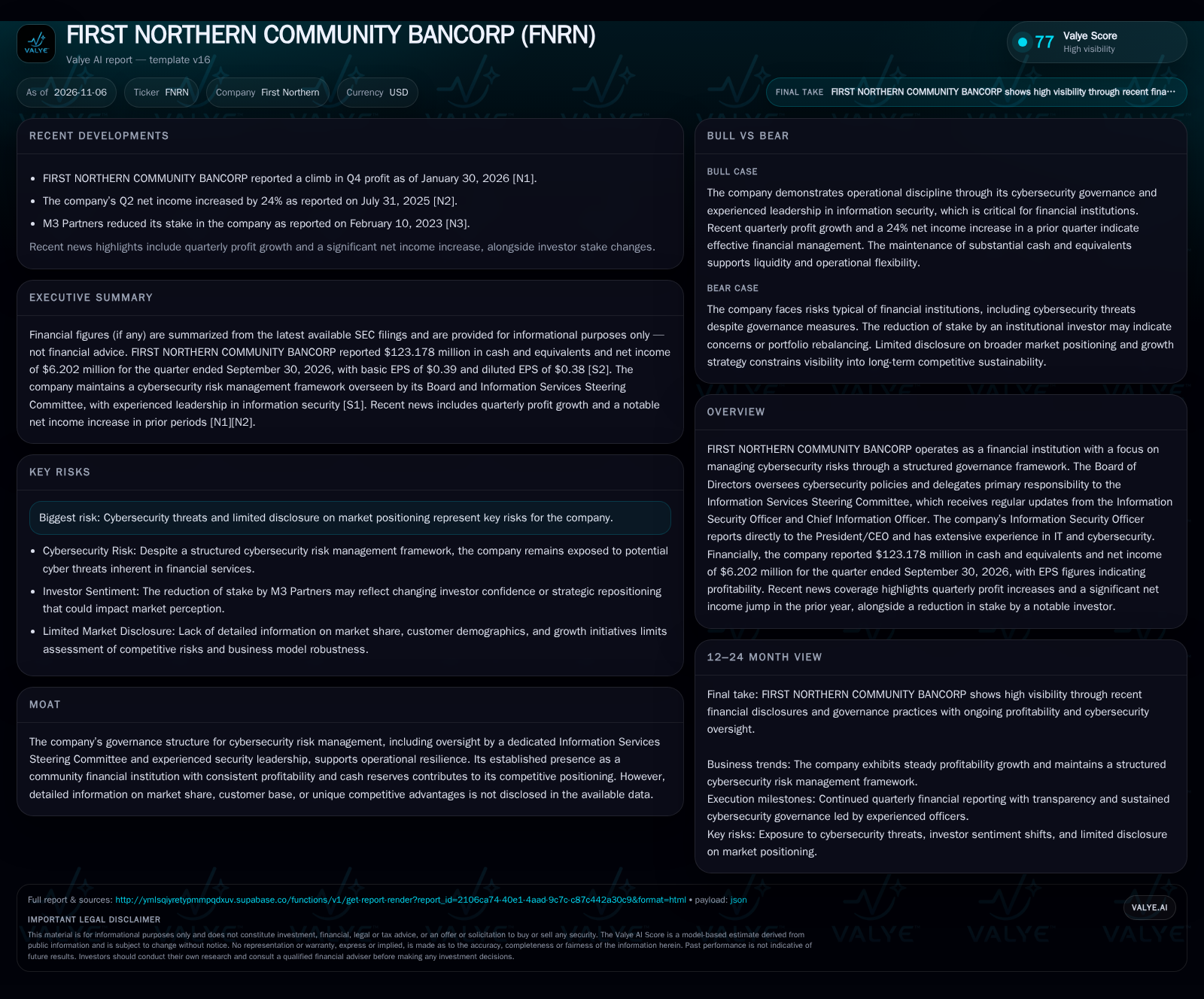
First Northern Community Bancorp reported $6.2 million in net income on $123 million in cash and equivalents for Q3 2026, continuing a trend of quarterly profit growth. The board’s active oversight of cybersecurity, backed by a highly experienced Information Security Officer, is central to its operational resilience. However, limited disclosure on its market positioning and future growth strategy constrains assessment of its long-term competitive edge. Investor stake reductions and sector-wide pressures add further uncertainty to the outlook. [S2] [N1] [N2] [N3]
First Northern Community Bancorp stands out among community banks for its steady profitability and highly structured approach to cybersecurity risk, anchored by direct board oversight and unusually experienced leadership in information security. With $123 million in cash and a profitable Q3 2026, the company’s operational discipline is clear. Yet, the lack of transparency around its market positioning, customer mix, and growth agenda means investors must weigh its track record against unknowns about its future trajectory and resilience to sector disruption. The interplay between strong governance, earnings consistency, and disclosure gaps will determine whether First Northern can sustain or enhance its competitive footing as industry dynamics evolve.
Recent Profitability and Cybersecurity Oversight Shape the Near-Term Narrative
As of September 30, 2026, First Northern Community Bancorp reported net income of $6.202 million and cash and cash equivalents of $123.178 million, evidencing ongoing profitability and liquidity. The company’s basic and diluted EPS for the quarter were $0.39 and $0.38, respectively, continuing a trend of quarterly profit growth, including a notable 24% jump in net income during Q2 2025. On the governance front, the board actively oversees cybersecurity risk, with an Information Security Officer who reports directly to the CEO and brings over three decades of relevant experience. These factors collectively signal a disciplined operating environment and a proactive approach to risk management, both of which are critical for a community-focused financial institution. However, a recent reduction in stake by institutional investor M3 Partners introduces a note of caution regarding external perceptions or strategic outlook. [S2] [S1] [N1] [N2] [N3]
Earnings Drivers, Cost Structure, and Capital Needs in a Community Banking Model
Community banks like First Northern typically generate revenue through net interest income—spreads between loans and deposits—augmented by fees and service charges. The reported steady profitability suggests a well-managed balance sheet and cost discipline, but the report does not disclose loan/deposit mix, asset quality, or fee income contributions. Fixed costs in the form of branch infrastructure and compliance requirements can limit operating leverage, while variable costs are driven by loan origination and servicing, technology investments, and risk management. The company reported cash and liquidity metrics for the period; these figures do not by themselves establish operating runway, investment capacity, financial flexibility, or financing capacity. Investments in cybersecurity, as indicated by board-level oversight and experienced leadership, likely represent a meaningful and growing cost center, reflecting both regulatory expectations and the rising threat environment.
Community Bank Differentiation: Governance Strengths vs. Scale and Disclosure Gaps
First Northern’s competitive position appears rooted in its operational discipline, robust cybersecurity governance, and consistent profitability. In the community banking sector, relationship-driven service, local knowledge, and trust are traditional differentiators. The company’s board-led cybersecurity oversight and long-tenured information security leadership may provide a reputational and regulatory edge versus peers with less mature frameworks. However, the absence of specific disclosures on customer demographics, market share, or unique product offerings makes it difficult to gauge the durability of its competitive moat. Larger regional and national banks, fintech firms, and credit unions all compete for the same deposit and lending relationships, often leveraging greater scale, digital capabilities, or niche targeting. Without evidence of unique technology, product innovation, or defensible local market share, First Northern’s advantage may be more vulnerable to disintermediation or margin pressure over time.
If Operational Discipline and Cybersecurity Drive Share Gains and Fee Growth
A favorable scenario would see First Northern leveraging its strong risk management reputation and disciplined operations to deepen relationships with existing customers and attract new business, particularly from clients sensitive to cybersecurity and regulatory compliance. If the company can translate its governance strengths into higher-value commercial lending, greater fee-based service penetration, or selective market share gains in its local footprint, earnings could compound even in a competitive market. Confirmation would come from future disclosures showing above-peer loan growth, increasing fee income as a percentage of revenue, and low credit losses relative to industry norms. Expanded commentary on digital offerings, customer acquisition channels, or strategic partnerships would further support the upside case. Falsification would occur if financial performance stagnates, or if incremental cybersecurity investments fail to translate into customer retention or market expansion.
Sustained Profitability Anchored by Risk Management, but Growth Remains Modest
The most plausible trajectory is continued profitability and capital stability, with earnings largely driven by traditional lending and deposit operations. The company’s focus on cybersecurity and operational discipline likely limits risk events and regulatory setbacks, supporting steady—if unspectacular—returns. Modest loan and deposit growth in line with local economic trends, coupled with prudent expense management, would characterize this scenario. Confirmation would include financial reports showing stable or gently rising net interest margins, low charge-offs, and consistent non-interest income. Falsification would be signaled by a spike in credit losses, a material cybersecurity incident, or stagnation in core revenue streams without offsetting fee growth.
Profitability Pressures Mount if Margin Compression or Disclosure Gaps Erode Confidence
The adverse scenario emerges if net interest margins compress due to competitive pressure, deposit outflows, or a less favorable rate environment, and if the company’s limited disclosure on market positioning leads to waning investor or customer confidence. Operational costs—including necessary cybersecurity investments—could outpace modest revenue growth, squeezing profitability. A high-profile cybersecurity breach, regulatory action, or meaningful credit deterioration would exacerbate downside risk. Evidence in support of this scenario would include declining EPS, rising efficiency ratios (cost/income), adverse asset quality trends, or negative commentary from ratings agencies or investors. Falsification would require the company to demonstrate resilience through stable margins, successful risk event containment, and adequate transparency to reassure stakeholders.
Factors That Will Define First Northern’s Competitive and Financial Resilience
Quarterly trends in net interest margin, loan growth, and non-interest income, if disclosed, would clarify whether profitability is sustainable or at risk of compression.
Updates on asset quality, including non-performing loan ratios and charge-off rates, would help assess credit risk management and capital resilience.
Disclosure of customer mix, market share, or geographic concentration would provide context for evaluating competitive positioning and vulnerability to local economic shocks.
Any changes in the scale or frequency of cybersecurity incidents, or related regulatory findings, would directly test the company’s risk management claims.
Investment in digital banking capabilities, product innovation, or partnerships, if disclosed, would indicate efforts to stay relevant amid evolving customer expectations.
Movement in core deposit balances and cost of funds, particularly in a shifting interest rate environment, would signal franchise strength or weakness.
Further changes in institutional ownership, analyst coverage, or ratings commentary could reflect evolving external confidence and inform potential capital market constraints.
Management commentary or disclosures regarding strategic growth initiatives or M&A activity would help illuminate the long-term roadmap and risk appetite.
Disclaimer: This is research-only, informational analysis and not investment advice. It may include AI-generated interpretation and general industry context. Always verify important details using primary sources.

Comments