
Delek US Holdings: Refining Strength, Debt Load, and the Volatility Equation
A surge in refining profitability has powered Delek US Holdings’ latest results, but substantial long-term obligations and exposure to commodity swings keep the company’s risk profile front and center. The interplay between operational execution, hedging discipline, and macro volatility will shape the next phase.
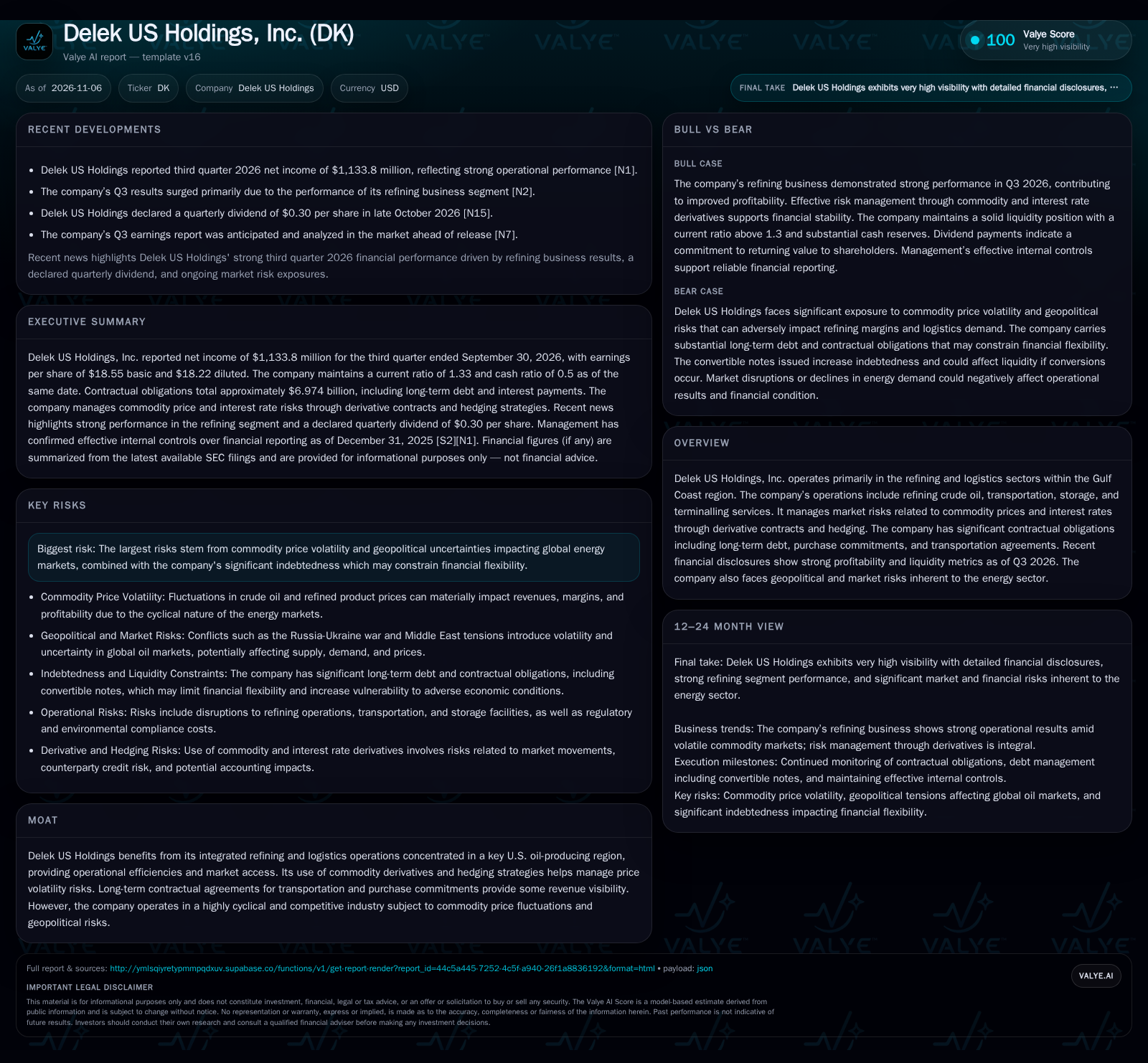
Delek US Holdings posted standout Q3 2026 earnings on the back of strong refining operations, reporting $1.13 billion in net income. [S2] [N1] [N2]
Delek US Holdings’ third quarter 2026 results highlight the company’s powerful earnings leverage when refining margins are strong, with over $1.1 billion in net income propelled by its Gulf Coast operations. Yet, the company’s capital structure remains heavily burdened by long-term obligations, and its fortunes are tightly linked to the unpredictable swings of commodity markets and global geopolitical tensions. The next phase for Delek will hinge on its ability to balance operational outperformance with disciplined risk management and capital allocation, all while navigating the inherent volatility of the energy sector.
Recent Performance: Refining Surge Meets Debt Realities
Delek US Holdings reported $1,133.8 million in net income for Q3 2026, a result primarily attributed to the strength of its refining segment [N1] [N2]. This performance was supported by a cash position of $1.335 billion and a current ratio of 1.33 as of September 30, 2026 [S2]. However, the company also faces $6.974 billion in total contractual obligations, including $3.458 billion in long-term debt and $460 million in recently issued convertible notes due 2031 [S2]. These figures highlight both the company’s earnings power in favorable market conditions and the persistent balance-sheet risks from significant leverage and contractual commitments.
Refining Margins, Scale, and the Mechanics of Profitability
Delek’s core economics are driven by the spread between crude oil input costs and refined product selling prices—a dynamic that can produce significant operating leverage in periods of favorable crack spreads. The company’s Gulf Coast refining footprint provides access to both domestic shale and imported crude, potentially enabling flexible feedstock sourcing and cost optimization. Logistics and storage operations can add stable, fee-based revenue, but the vast majority of profits are likely tied to the volatile refining margin environment.
A large fixed-cost base means that utilization rates and operational efficiency are critical: when plant throughput is high and spreads widen, incremental volumes can drop through at high margins. Conversely, downturns in energy demand or narrowing spreads can rapidly erode profitability, leaving the fixed cost structure exposed. The company’s capital needs are substantial, both for ongoing maintenance and for servicing its sizable debt load. Delek’s use of derivatives to hedge commodity price risk can dampen earnings volatility but introduces counterparty and mark-to-market exposures that require careful management [S1] [S2].
The cyclicality of refining margins also interacts with broader macroeconomic factors such as global economic growth rates, currency fluctuations, and trade policies, which can influence crude supply chains and product demand. For instance, shifts in international crude flows or tariffs can alter feedstock costs or product pricing dynamics, thereby impacting refining spreads. Additionally, regulatory changes related to emissions or fuel standards can impose incremental costs or require capital investments, subtly altering the cost structure and competitive positioning. Understanding these externalities is crucial for anticipating margin sustainability beyond short-term supply-demand imbalances.
Integrated Operations in a Crowded, Cyclical Arena
Delek’s competitive position is shaped by its integrated refining and logistics footprint in the Gulf Coast, a region known for its dense pipeline networks, ample storage, and proximity to both upstream crude sources and downstream product markets. This integration may offer some cost and operational advantages, such as reduced transportation costs and improved supply chain coordination.
However, the U.S. refining sector is highly competitive, with larger players often enjoying superior economies of scale, broader asset bases, and greater market reach. The barriers to entry are high but not insurmountable, and the threat of substitution from renewable fuels and electrification is a long-term structural headwind. Delek’s ability to differentiate may hinge on operational reliability, cost control, and the effectiveness of its risk management strategies, rather than on product or technology moats.
Moreover, the competitive landscape is increasingly shaped by technological advancements and digital transformation initiatives. Refineries that leverage data analytics, predictive maintenance, and process automation can achieve higher throughput and lower unplanned downtime, translating into improved margins and reliability. While Delek’s scale may limit certain technology investments compared to larger peers, targeted innovation and operational excellence could serve as differentiators. Furthermore, partnerships or alliances within the supply chain could enhance flexibility and reduce costs, helping to mitigate some competitive pressures inherent in a commoditized industry.
If Refining Margins Stay Elevated and Debt Is Managed Down
A favorable scenario for Delek emerges if crack spreads in the Gulf Coast remain strong—driven by supply constraints, robust product demand, or disruptions elsewhere—allowing the company to sustain high utilization and strong cash flow. In this environment, disciplined capital allocation could enable Delek to reduce net debt, extend maturities, and potentially return more capital to shareholders through dividends or buybacks, assuming no adverse shocks to hedging positions or operational reliability.
Confirmation of this scenario would come from continued high refining throughput, sustained or rising net income, visible progress on debt reduction, and stable or improving liquidity metrics. Conversely, signs of margin compression, rising input costs without offsetting product price increases, or material increases in debt service costs would challenge the upside case.
In addition to margin strength and debt management, a supportive macro environment—such as stable geopolitical conditions and balanced global inventory levels—would enhance the predictability of refining cash flows. Under such conditions, Delek could strategically prioritize debt repayment over capital expenditures, improving credit metrics and reducing interest burdens. Enhanced potential financial flexibility might also enable opportunistic investments in efficiency upgrades or modest capacity expansions, further bolstering competitive positioning. However, this scenario presupposes continued disciplined hedging and cost control to avoid margin erosion from unexpected commodity price swings or operational disruptions.
Sustaining Profitability Amid Volatility and Leverage
The most plausible trajectory for Delek is a cyclical oscillation: periods of strong refining profitability punctuated by inevitable downturns as commodity prices and crack spreads revert toward historical means. The company will likely continue to rely on hedging to moderate some earnings swings, but underlying exposure to market cycles and external shocks remains high. Cash flow will be allocated between debt service, maintenance capex, and selective capital returns, with limited scope for aggressive expansion.
This scenario is confirmed by stable current ratios, manageable debt service coverage, and the absence of forced asset sales or covenant breaches.
Commodity Shocks and Leverage: The Double-Edged Sword
A material adverse scenario would be triggered by a sustained collapse in refining margins—potentially due to oversupply, demand destruction from economic slowdown, or rapid changes in product mix needs. In this case, Delek’s large fixed-cost base and high leverage could magnify losses, forcing the company to curtail dividends, defer investments, or seek asset sales to preserve liquidity. Counterparty failures or adverse movements in derivative positions could further erode potential financial flexibility.
Evidence of this scenario would include declining cash balances, deteriorating current ratios, missed or renegotiated debt payments, or negative free cash flow even before capex. External shocks such as geopolitical events that disrupt input supplies or regulatory changes increasing compliance costs would exacerbate the downside risk.
Benchmarks for Delek’s Next Phase: What Will Separate Strength from Strain
Quarterly refining segment margin per barrel—if disclosed—would provide a direct readout on the underlying earnings engine and sensitivity to market swings.
Debt reduction progress and net leverage ratio trends, especially following the issuance of convertible notes, will signal whether balance sheet risks are receding or intensifying.
Cash flow from operations relative to debt service requirements: sustained coverage ratios above industry norms would suggest resilience.
Utilization rates and unplanned downtime in refining and logistics operations: high reliability is critical for capturing favorable spreads.
Notable changes in hedging strategy, derivative contract volumes, or realized hedge gains/losses would indicate management’s risk appetite and market view.
Material shifts in working capital, such as inventory build-ups or drawdowns, could flag demand swings or margin pressures.
External conditions: major regulatory changes, new environmental compliance costs, or evidence of demand erosion from alternative fuels would reshape the long-term outlook.
Disclaimer: This is research-only, informational analysis and not investment advice. It may include AI-generated interpretation and general industry context. Always verify important details using primary sources.

Comments