
Ingredion at a Crossroads: Margin Pressures, Clean-Label Growth, and the Tate & Lyle Acquisition
Ingredion faces ongoing margin pressure and operational headwinds while betting on clean-label innovation and a transformative acquisition of Tate & Lyle. The outcome will hinge on integration execution, cost discipline, and the ability to translate scale into durable competitive advantage.
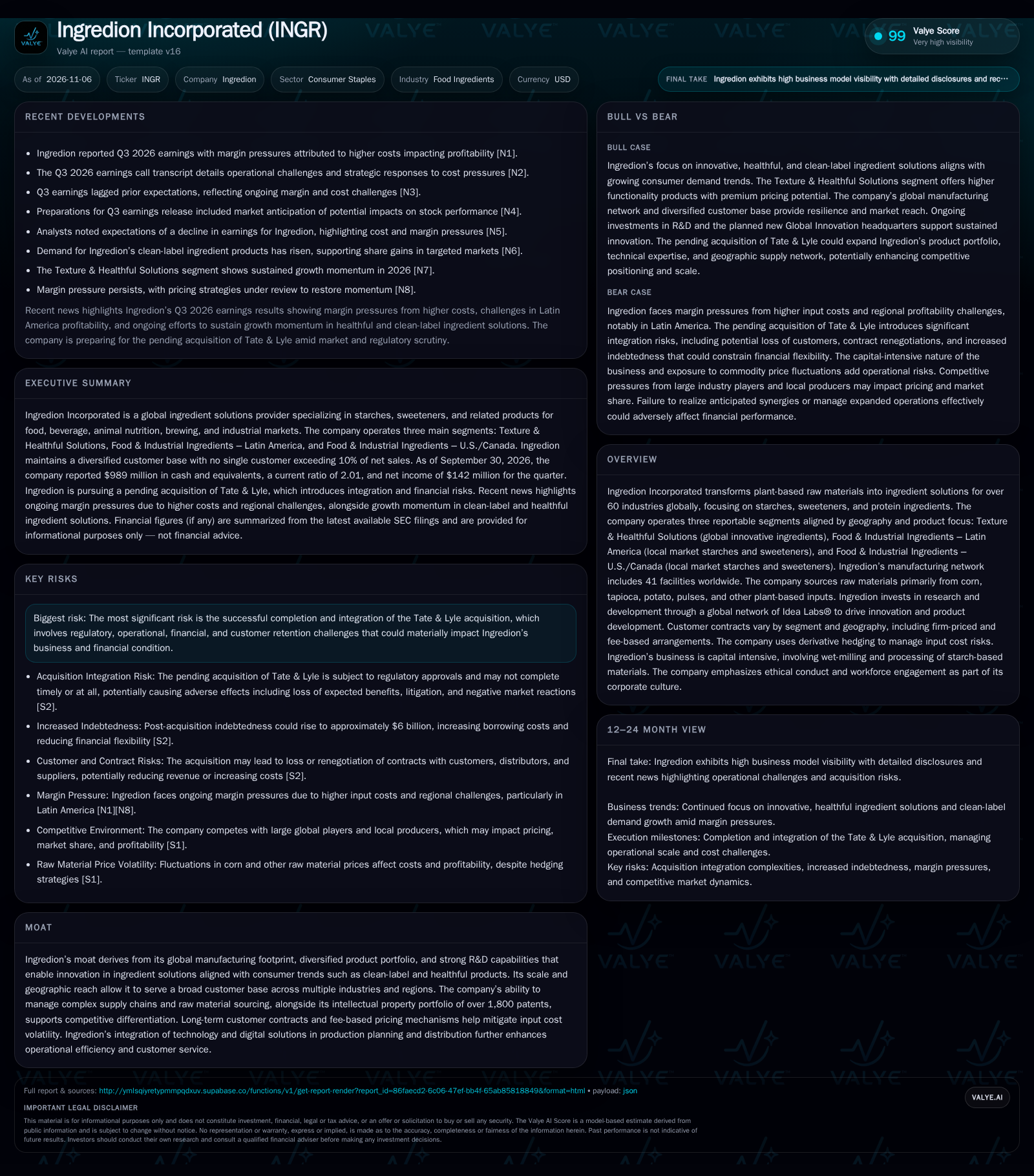
Ingredion continues to experience margin pressure due to higher input costs and regional challenges, notably in Latin America, but shows growth momentum in clean-label and healthful ingredients. The pending acquisition of Tate & Lyle introduces substantial integration and financial risk, with the potential to reshape the company’s scale and product mix if executed successfully. The next 12-24 months will test whether Ingredion’s innovation and diversification can offset cost headwinds and acquisition complexity. [S2] [N1] [N6] [N7] [N8]
Ingredion stands at a pivotal moment, balancing persistent cost and margin headwinds with strategic bets on innovation and acquisition. While its Texture & Healthful Solutions segment is gaining traction in clean-label and health-driven markets, the company faces operational challenges, particularly in Latin America, and ongoing input cost inflation. The pending acquisition of Tate & Lyle, if completed and integrated well, could redefine Ingredion’s scale and competitive positioning—but it also introduces substantial financial and operational risk. In the near term, execution on pricing, cost containment, and integration will likely determine whether Ingredion can translate its innovation pipeline and global footprint into sustainable value.
Recent Margin Pressure, Segment Divergence, and Acquisition Ambitions
Ingredion’s Q3 2026 earnings highlighted persistent margin pressure, with higher input and manufacturing costs weighing on profitability and further challenges in Latin America. Net income for the quarter was $142 million, down from the prior year, and operating income for the first nine months of 2026 fell 26% year-over-year, reflecting both cost inflation and operational disruptions at key facilities. The Texture & Healthful Solutions (T&HS) segment continued to show growth, supported by clean-label and healthful ingredient demand. Meanwhile, the company is preparing to acquire Tate & Lyle for approximately $3.5 billion, a move that could add up to $6 billion in total indebtedness post-deal and bring significant integration complexities. These developments set the stage for a period of elevated execution risk and strategic transformation. [S2] [N1] [N3] [N6] [N7] [N8]
How Ingredion’s Model Converts Commodities into Value-Added Ingredients
Ingredion’s economics are rooted in transforming commodity crops—primarily corn, but also tapioca, potatoes, pulses, and more—into a broad suite of starches, sweeteners, texturizers, and specialty ingredients for food, beverage, industrial, and animal nutrition markets. The company’s revenue mix is split roughly between starches (about 50% of net sales) and sweeteners (about 34%), with the remainder from proteins, co-products, and systems. Gross margins are structurally exposed to raw material cost swings, but hedging contracts and a mix of firm-priced and fee-based contracts help mitigate some volatility. Capital intensity is high due to wet-milling and processing infrastructure, with fixed costs spread across a global manufacturing base. Growth in higher-value, functional ingredients—such as those in the T&HS segment—offers better pricing power and margin potential, but still represents a smaller share of the portfolio. Operating leverage can be significant in up-cycles, but cost inflation, supply chain disruptions, and energy volatility can quickly erode profitability. The pending Tate & Lyle acquisition, if completed, would further increase fixed costs, scale, and integration complexity, while offering potential for broader product mix, cross-selling, and supply chain synergies. [S1] [S2]
Innovation, Scale, and the Battle for Ingredient Relevance
Ingredion competes in a global ingredient landscape marked by large multinationals, regional producers, and specialty ingredient innovators. Its scale, manufacturing reach (41 facilities), and diversified product range give it the ability to serve major food and beverage manufacturers as well as niche health and wellness brands. The company’s R&D engine—more than 500 scientists and 30 global Idea Labs®—supports ongoing innovation and adaptation to consumer trends such as clean-label, non-GMO, and plant-based solutions. Intellectual property (over 1,800 patents) and long-standing customer relationships provide some defensibility, but switching costs for basic ingredients remain moderate, and customers often dual- or multi-source for risk management. The T&HS segment’s focus on higher-value, functional, and clean-label ingredients may offer some insulation from pure commodity pricing, but the bulk of Ingredion’s revenue is still exposed to fierce competition and price sensitivity. The Tate & Lyle acquisition could enhance scale and product breadth, but also pits Ingredion more directly against the largest global ingredient players, raising the stakes for integration, customer retention, and operational execution. [S1]
If Integration Delivers and Healthful Demand Accelerates
The bull case for Ingredion rests on successful integration of Tate & Lyle, realization of anticipated synergies, and continued outperformance in healthful and clean-label categories. If the company manages to retain key customers, optimize the combined supply chain, and leverage its expanded R&D and sales capabilities, it could achieve increased scale efficiencies and cross-selling opportunities. Accelerated demand for functional, non-GMO, and plant-based ingredients—particularly in the T&HS segment—would support higher-margin growth. Confirmation would come from sequential margin improvement, above-industry revenue growth in specialty and healthful ingredients, timely synergy realization, and stable or growing share in core customer segments. Evidence of higher pricing power and improved operating leverage post-acquisition would further validate this scenario.
Navigating Margin Headwinds While Pursuing Incremental Growth
The most plausible outcome is that Ingredion continues to face margin pressure from input costs and regional volatility, while achieving moderate growth in healthful and clean-label segments. The Tate & Lyle acquisition likely closes in late 2027, with integration proceeding unevenly—some synergies realized, but also operational friction and elevated costs. Revenue growth is driven primarily by innovation in the T&HS segment and gradual recovery in challenged geographies. Margins remain below historical highs, but cost discipline and pricing initiatives help stabilize profitability. This scenario would be confirmed by steady net sales, flat-to-modestly improving operating margins, satisfactory acquisition integration updates, and resilience in key customer relationships. Any signs of persistent cost overruns, major customer losses, or integration setbacks would challenge this view.
If Cost Inflation, Integration Risk, and Customer Attrition Compound
The bear case unfolds if input cost inflation persists or accelerates, further eroding gross margins, particularly in price-sensitive or operationally challenged regions like Latin America. If the Tate & Lyle acquisition closes but results in significant customer defections, contract renegotiations, or operational disruptions, the anticipated benefits could be outweighed by higher debt service, integration costs, and missed synergy targets. Failure to offset higher costs with pricing or mix improvements would pressure earnings, and elevated leverage could constrain strategic flexibility. Confirmation would come from continued margin compression, negative trends in net income and EPS, loss of key accounts, and repeated downward revisions to synergy and integration targets.
Signals That Will Determine Whether Ingredion’s Transformation Succeeds
Sequential and year-over-year trends in segment operating margins—especially within Texture & Healthful Solutions and Latin America—would help test whether cost inflation is being offset by pricing or mix improvements.
Progress on closing and integrating the Tate & Lyle acquisition, including timelines, regulatory hurdles, and realized versus targeted synergies, will be critical to the forward thesis.
Net debt and leverage ratios post-acquisition, as well as interest coverage, would indicate whether the balance sheet remains manageable and flexible.
Customer retention rates and contract renewals in the wake of the acquisition, if disclosed, would provide insight into integration risk and the durability of the revenue base.
Growth rates in clean-label, non-GMO, and functional ingredient product lines within T&HS would show whether innovation is translating into profitable expansion.
Operating cash flow trends and capital expenditure levels, especially as the company absorbs new assets, would help test the sustainability of ongoing investments.
Updates on cost-saving initiatives, plant optimization, and supply chain efficiencies—particularly in challenged geographies—would signal management’s ability to restore margin momentum.
Any major adverse events (e.g., facility disruptions, regulatory setbacks, or litigation) post-acquisition would be important downside watchpoints.
Disclaimer: This is research-only, informational analysis and not investment advice. It may include AI-generated interpretation and general industry context. Always verify important details using primary sources.

Comments