
New England Realty Associates: Capital Allocation Discipline Meets Rising Cost Pressures in a Concentrated Regional Portfolio
With a consistent equity repurchase program and ongoing dividends, New England Realty Associates demonstrates capital return discipline. Yet, recent net losses and a heavy geographic focus raise questions about the sustainability of distributions and resilience to regional and macroeconomic headwinds.
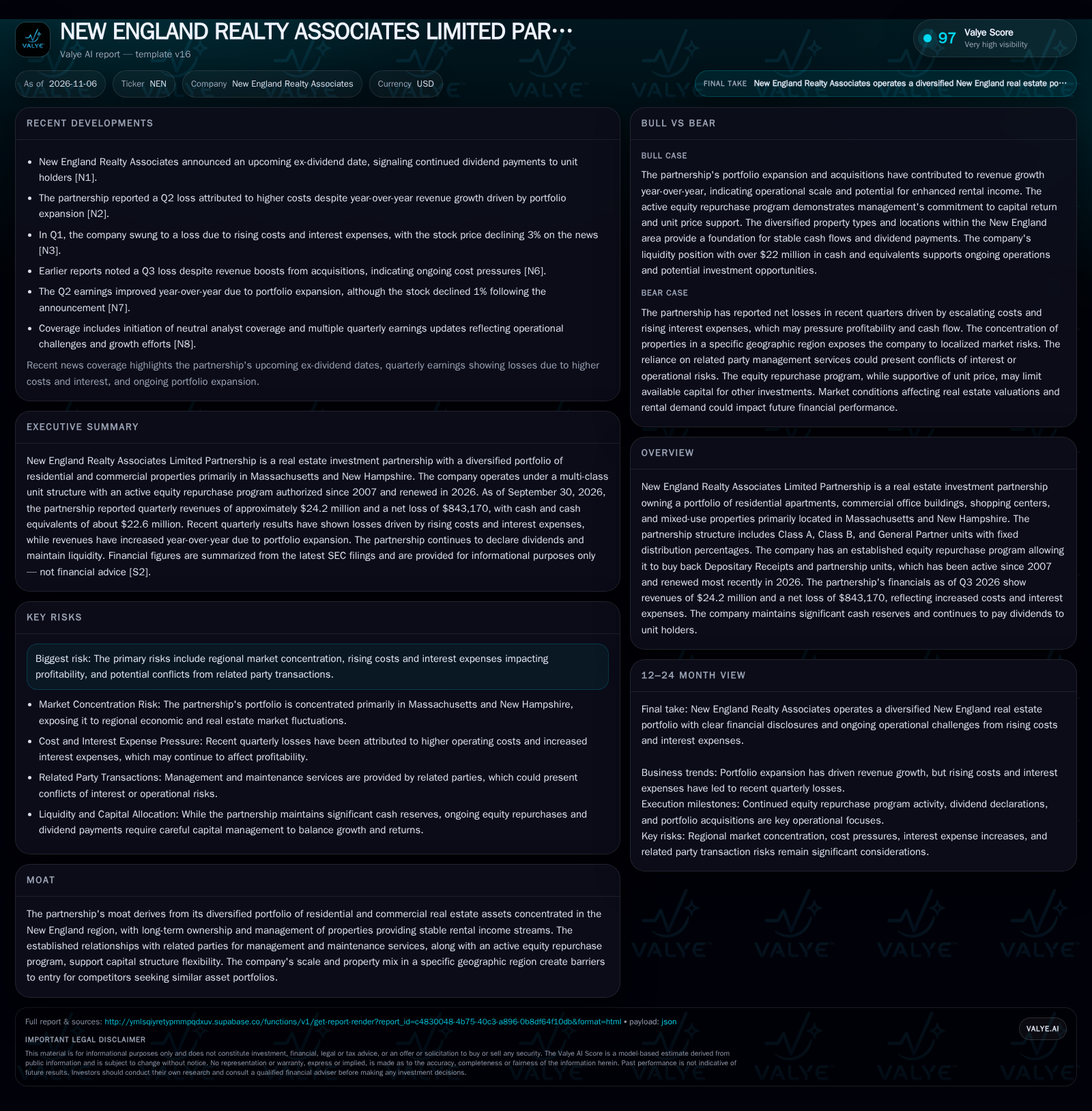
New England Realty Associates maintains a diversified New England real estate portfolio and has actively returned capital through buybacks and dividends. However, a Q3 2026 net loss and ongoing cost and interest expense pressures highlight the need to monitor profitability, capital allocation, and market concentration risks going forward. [S2] [N1]
New England Realty Associates Limited Partnership stands out for its combination of multi-decade property ownership, a disciplined capital return program, and a tightly concentrated New England real estate portfolio. As of Q3 2026, the partnership continued to buy back equity and pay dividends, maintaining a reported cash balance of over $22 million. However, the recent swing to a net loss amid rising operating and interest costs raises the stakes for future profitability and distribution sustainability. The company's fortunes remain closely tied to the economic and regulatory climates of Massachusetts and New Hampshire, and its reliance on related-party management structures adds another layer of complexity to the investment thesis. [S2] [N1]
Recent Losses and Capital Return Activity Reshape the Investment Landscape
New England Realty Associates reported revenues of $24.2 million and a net loss of $843,170 for the quarter ending September 30, 2026. This loss is attributed to rising operating and interest expenses, marking a reversal from earlier periods of profitability. The partnership maintains an active equity repurchase program, having bought back 18,783 Depositary Receipts at an average price of $60.49 per receipt during the nine months ended September 30, 2026, totaling approximately $1.14 million. The renewed buyback authorization in March 2026 reflects management’s ongoing commitment to capital return, even as cost pressures intensify. [S2] [N1]
How the Partnership’s Economics Balance Rental Yields, Cost Inflation, and Capital Allocation
New England Realty Associates generates revenue primarily from rental income across a diversified portfolio of residential apartments, commercial offices, shopping centers, and mixed-use properties. The economics of this model depend on occupancy rates, rent levels, and the ability to control operating costs such as maintenance, property taxes, insurance, and utilities. Fixed costs are significant due to property taxes, insurance, and debt service, while variable costs include repairs and administrative expenses.
The partnership’s capital structure includes Class A, Class B, and General Partner units, each entitled to fixed distribution percentages, creating a recurring obligation to return capital to unit holders. Active buybacks further influence capital allocation, potentially supporting unit prices but also reducing funds available for new investments or debt reduction.
Operating leverage is a double-edged sword: high fixed costs mean that incremental revenue growth can materially improve margins, but cost inflation or occupancy declines can quickly erode profitability. Recent net losses suggest that rising interest rates and operating expenses are outpacing revenue growth, challenging the sustainability of both dividends and buybacks unless conditions improve. [S2]
The interplay between rental income and cost inflation is further complicated by the partnership's capital allocation decisions, which directly influence liquidity and reinvestment capacity. For instance, consistent equity buybacks, while supporting unit price stability, reduce available cash that could otherwise be deployed toward property improvements or debt reduction. This trade-off becomes increasingly critical in an environment of rising interest rates, where refinancing opportunities may be limited or more costly. Consequently, the partnership must carefully balance the benefits of returning capital to investors against the need to maintain potential financial flexibility to weather economic downturns or capitalize on market opportunities.
Regional Focus Provides Scale Advantage but Heightens Exposure to Localized Risks
The partnership’s portfolio concentration in Massachusetts and New Hampshire allows for operational efficiencies, local market expertise, and established relationships with tenants and service providers. Long-term ownership of properties can provide stable income streams, brand recognition, and leverage in property management.
However, this geographic focus also increases vulnerability to regional economic downturns, regulatory changes (such as rent control or zoning shifts), and competitive pressures from new developments or alternative housing options. The real estate sector in these states is subject to supply constraints, local demographic trends, and periodic shifts in demand for both residential and commercial space.
While the company’s property mix—spanning residential, commercial, and mixed-use assets—offers some diversification, the absence of exposure to faster-growing or countercyclical markets limits its ability to offset regional headwinds. Competitors include local and regional property owners, REITs with broader geographic reach, and institutional investors with greater access to capital and diversified risk profiles. [S1] [S2]
Moreover, the regional concentration amplifies the impact of local regulatory changes, which can vary significantly even between neighboring jurisdictions. For example, shifts in property tax assessments or the introduction of rent stabilization policies could disproportionately affect profitability given the partnership's limited geographic diversification. In addition, the competitive landscape includes not only established local players but also emerging market entrants leveraging technology-driven property management or alternative financing structures, which could pressure traditional operators. The partnership's ability to leverage its scale and local knowledge must therefore be weighed against these evolving competitive dynamics and regulatory uncertainties.
Operational Discipline and Market Recovery Could Restore Profitability and Support Premium Valuation
If New England Realty Associates can stabilize or reduce operating and interest expenses—either through refinancing, cost control, or efficiency gains—while maintaining high occupancy and rental growth, net income could recover, supporting continued distributions and buybacks. A rebound in regional rental demand or successful repositioning of underperforming assets would further bolster cash flows.
Evidence confirming this scenario would include a return to quarterly profitability, rising same-property net operating income, and stable or increased dividend declarations. Additional property acquisitions at attractive cap rates or successful asset sales above book value would signal effective capital deployment. Expansion of the repurchase program or upward revisions to distribution rates would further validate management’s confidence in future cash flows. [S2] [N1]
Falsification would come from persistent net losses, declining occupancy, or the need to curtail dividends or buybacks due to cash flow constraints.
Sustained Cash Generation with Ongoing Margin Pressure Defines the Most Likely Outcome
A plausible middle path is that the partnership continues to generate stable rental income, but ongoing inflation in operating and interest expenses limits the ability to expand margins. Dividends and buybacks continue, but at a pace constrained by available cash and the need to maintain balance sheet flexibility.
Supporting evidence would include steady cash balances, moderate net income or only modest losses, and the maintenance of current distribution levels. Periodic property upgrades or selective acquisitions may occur, but aggressive expansion is unlikely without a substantial improvement in operating conditions.
This scenario would be challenged by a sharp rise in vacancies, a regulatory shock affecting rent collections, or a material increase in debt service costs.
Prolonged Cost Escalation or Regional Downturn Could Force Distribution Cuts and Strategic Retrenchment
A regional economic downturn, declining property values, or new regulatory burdens could accelerate this dynamic.
Evidence for this scenario would include consecutive quarters of deepening net losses, depletion of cash reserves, reduced or suspended dividends, and a slowdown or halt in equity repurchases. Forced asset sales at unfavorable prices or covenant breaches could also occur.
Falsification would come from stabilization or reversal in cost trends, successful rent increases, or evidence of effective hedging against interest rate risk.
In a prolonged adverse scenario, the partnership might face constrained access to capital markets, elevating refinancing risk and potentially necessitating asset sales under distressed conditions. Such sales could crystallize losses and reduce the portfolio's income-generating capacity, further pressuring distributions. Additionally, operational challenges such as increased tenant defaults or higher vacancy rates could exacerbate cash flow volatility. The reliance on related-party service providers might also introduce governance risks, particularly if cost structures become misaligned with market standards, thereby undermining operational efficiency and investor confidence. These factors collectively could compel management to prioritize balance sheet stabilization over capital return, altering the partnership's historical distribution profile.
Tests for Distribution Sustainability and Regional Resilience at New England Realty Associates
Quarterly net income or loss, with particular attention to trends in operating and interest expenses relative to rental revenue. [S2]
Occupancy rates and average rent per unit across the residential and commercial portfolio, if disclosed.
Changes in cash and cash equivalents, especially following periods of buyback or dividend activity. [S2]
Continuation, reduction, or suspension of dividend declarations and equity repurchase activity. [N1] [S2]
Property acquisition, disposition, or refinancing activity that materially alters the risk or return profile, if announced.
Any regulatory or legislative developments in Massachusetts or New Hampshire affecting rent control, property taxes, or zoning.
Updates on related-party transactions or changes in management/maintenance service arrangements, if disclosed.
Debt maturity schedules and refinancing terms, particularly in the face of rising interest rates, if provided.
Disclaimer: This is research-only, informational analysis and not investment advice. It may include AI-generated interpretation and general industry context. Always verify important details using primary sources.

Comments