
Freeport-McMoRan: Expansion Ambitions Meet Commodity, Regulatory, and Executional Crosscurrents
Freeport-McMoRan’s multi-billion-dollar U.S. production expansion, robust Q3 profitability, and strategic positioning as a critical minerals supplier heighten its leverage to the global energy transition—but expose it to commodity volatility, regulatory scrutiny, and operational complexity.
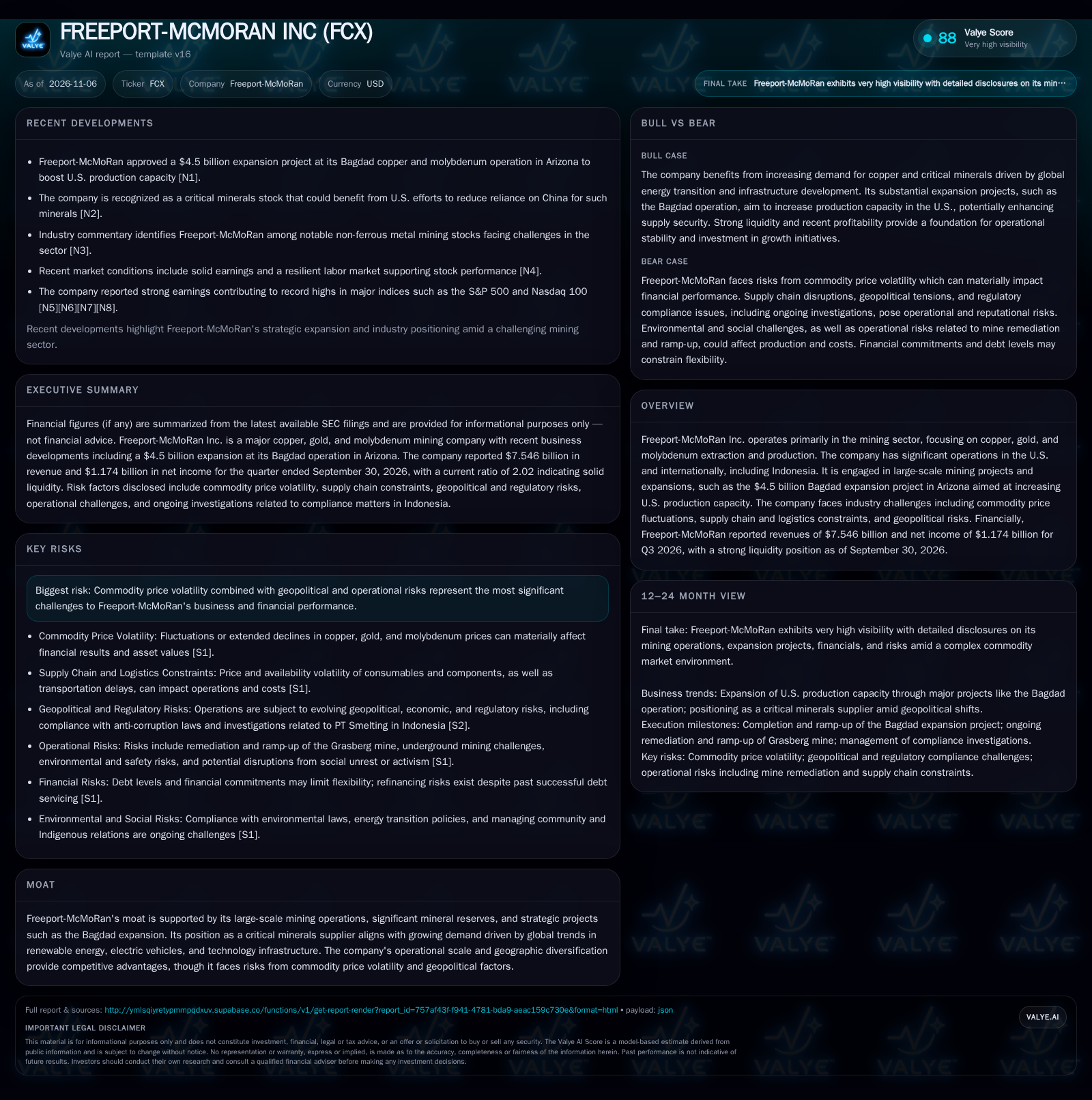
Freeport-McMoRan is executing a $4.5 billion Bagdad expansion to boost U.S. copper output and reported Q3 2026 net income of $1.174 billion on $7.546 billion in revenue. Track project execution, copper price trends, and regulatory developments for thesis updates. [S2] [N1]
Freeport-McMoRan is at a strategic inflection point: the company is leveraging a robust balance sheet and strong recent profitability to invest in major capacity expansion, notably the $4.5 billion Bagdad project in Arizona. This move directly aligns with rising U.S. and global demand for copper—a critical input for electrification and energy transition infrastructure. Yet, this opportunity brings heightened exposure to commodity price swings, regulatory and operational risks, and the need to execute flawlessly on large, capital-intensive projects. The next several quarters will test whether Freeport’s scale and strategic positioning can overcome these headwinds and deliver durable value.
Expansion, Profitability, and Risk: The Q3 2026 Snapshot
Freeport-McMoRan reported Q3 2026 revenues of $7.546 billion and net income of $1.174 billion, indicating continued profitability in a volatile mining environment [S2]. [S2] [N1] However, Freeport-McMoRan also disclosed ongoing risk factors including commodity price volatility, supply chain and logistics constraints, and regulatory/compliance issues, notably an FCPA investigation tied to its Indonesian joint venture, for which the SEC does not intend to pursue enforcement [S2]. Together, these elements frame a business that is simultaneously capitalizing on sector tailwinds and navigating complex operational and regulatory headwinds.
How Large-Scale Mining Translates Into Cash Flow—and Where Leverage Bites
Freeport-McMoRan’s core economics are driven by the volume of copper, gold, and molybdenum produced, multiplied by prevailing market prices—both of which are highly cyclical and exposed to global demand shifts. The company’s cost structure is a blend of high fixed costs (mine development, labor, maintenance) and variable costs (energy, consumables, logistics). Operating leverage can be substantial: when commodity prices rise, incremental profits can expand rapidly due to fixed-cost absorption. However, when prices fall, margins compress sharply, and large projects can quickly become cash drains.
The $4.5 billion Bagdad expansion is a classic high-stakes capital allocation: if copper demand and pricing remain robust, new capacity could translate into strong incremental cash flow and reinforce Freeport’s position as a critical minerals supplier. Conversely, if project costs overrun, ramp-up is delayed, or global copper prices soften, the economics could deteriorate. Supply chain disruptions and regulatory delays would further pressure margins. [S2]
The capital intensity inherent in large-scale mining projects like the Bagdad expansion necessitates a nuanced understanding of capital allocation timing and return horizons. Given the long lead times from project initiation to full production ramp-up, Freeport-McMoRan must balance near-term cash flow constraints against long-term capacity gains. In this context, the company's ability to maintain potential financial flexibility—such as access to credit lines or liquid reserves—can be critical to weathering periods of cost overruns or commodity downturns without compromising ongoing operations or strategic investments. Additionally, the interplay between fixed and variable costs means that operational efficiency improvements at existing assets can materially influence overall margins, especially when copper prices are subdued.
Strategic Advantages Amid Shifting Supply Chains and Policy Priorities
Freeport-McMoRan’s scale, resource base, and operational footprint provide meaningful competitive advantages. Its U.S. assets, in particular, are increasingly strategic as policymakers seek to secure domestic sources of critical minerals and reduce dependence on foreign (especially Chinese) supply chains. The company’s ability to execute large-scale projects like Bagdad is a differentiator in a sector where permitting, environmental, and social challenges can stymie new entrants and slow expansion by peers.
However, these advantages are counterbalanced by significant risks. Commodity price cycles can rapidly erode competitive positioning, especially for higher-cost mines. Geopolitical and regulatory risks, such as those encountered in Indonesia, can disrupt operations or add unexpected costs. Additionally, substitutes for copper in certain applications—such as aluminum in power transmission—could cap long-term pricing power should technological or economic shifts accelerate substitution. Peer competitors include other global diversified miners and regionally focused copper producers, each with their own cost structures, reserve quality, and policy exposures.
From a strategic standpoint, Freeport-McMoRan’s positioning within U.S. critical minerals supply chains could yield differentiated access to policy-driven incentives, including tax credits, grants, or streamlined permitting processes. However, such benefits are often contingent on compliance with evolving regulatory standards and environmental, social, and governance (ESG) expectations. Failure to meet these criteria could lead to delays or reputational risks that erode competitive advantages. Moreover, the company’s exposure to geopolitical risks in jurisdictions like Indonesia underscores the importance of diversified asset portfolios to mitigate localized disruptions. The potential for technological substitution in copper applications further emphasizes the need to monitor innovation trends and maintain cost competitiveness to preserve market share.
If U.S. Copper Demand Surges and Execution Is Pristine, Value Could Compound Fast
A favorable scenario for Freeport-McMoRan would see global and U.S. copper demand accelerating, driven by electrification, renewable energy buildout, and infrastructure investment. If copper prices remain elevated and the Bagdad expansion is completed on time and within budget, the company could realize step-change gains in cash flow and profitability. U.S. policy incentives for domestic mineral supply could further reduce regulatory friction and enhance pricing leverage.
Confirmation of this scenario would include evidence of timely Bagdad project milestones, minimal cost overruns, and robust copper pricing supported by supply-demand tightness. Additional signs would be stable or improving operational performance at legacy assets (especially Grasberg), successful management of geopolitical and environmental risks, and new offtake agreements or partnerships with U.S.-based manufacturers or energy companies. Watch for explicit disclosures of increased production volumes and margin expansion in future filings.
Execution Delivers Growth, but Volatility and Friction Persist
The most plausible trajectory is one in which Freeport-McMoRan delivers incremental production growth from Bagdad and other projects, but navigates ongoing volatility in commodity prices and faces periodic regulatory or operational setbacks.
Evidence supporting this scenario would be steady progress on expansion timelines, continued profitability, and manageable cost inflation—even if not all projects run perfectly. Signs that would falsify this trajectory include sustained cost overruns, major delays at Bagdad or Grasberg, or a prolonged downturn in copper prices that forces capital discipline and curtails investment. Monitoring quarterly production and sales volumes, realized pricing, and capex discipline will help test whether the company is tracking to this middle path.
When Commodity Shocks and Project Missteps Collide
The key risk to Freeport-McMoRan is a scenario where copper prices decline sharply—perhaps due to a global recession or weaker-than-expected electrification momentum—just as capital commitments for expansion projects peak. If supply chain disruptions, regulatory delays, or technical setbacks drive project costs materially above budget or delay production, cash flows could come under pressure, forcing the company to tap debt markets or defer growth initiatives.
Confirmation of this scenario would include evidence of declining realized copper prices, negative project updates (cost overruns, delays), and deteriorating cash flow or liquidity metrics. Regulatory or compliance setbacks, such as renewed scrutiny in Indonesia or the U.S., could amplify downside pressure. If disclosed, rising net debt or asset impairments would further signal that operational and market risks are crystallizing.
What Will Most Convincingly Shift Freeport-McMoRan’s Long-Term Value Proposition?
Quarterly copper production volumes and realized pricing—if disclosed—would clarify whether expansion projects are translating into scale and margin gains.
Bagdad expansion project milestones: On-time, on-budget progress reports versus cost overruns or delays.
Updates on regulatory investigations or compliance matters, especially any new developments in Indonesia or the U.S.
Evidence of new supply agreements, offtake contracts, or partnerships with domestic manufacturers or energy companies.
Operating cost per pound of copper produced—if disclosed—would help track inflationary pressures and margin resilience.
Quarterly updates on supply chain constraints or logistics disruptions, given ongoing risk disclosures.
Disclaimer: This is research-only, informational analysis and not investment advice. It may include AI-generated interpretation and general industry context. Always verify important details using primary sources.

Comments