
Weyco Group: Brand Strength, Liquidity, and Resilience Factors in a Changing Footwear Market
Weyco Group’s recent performance reflects both the upside of strong legacy brands and the persistent external pressures of tariffs and retail demand volatility.
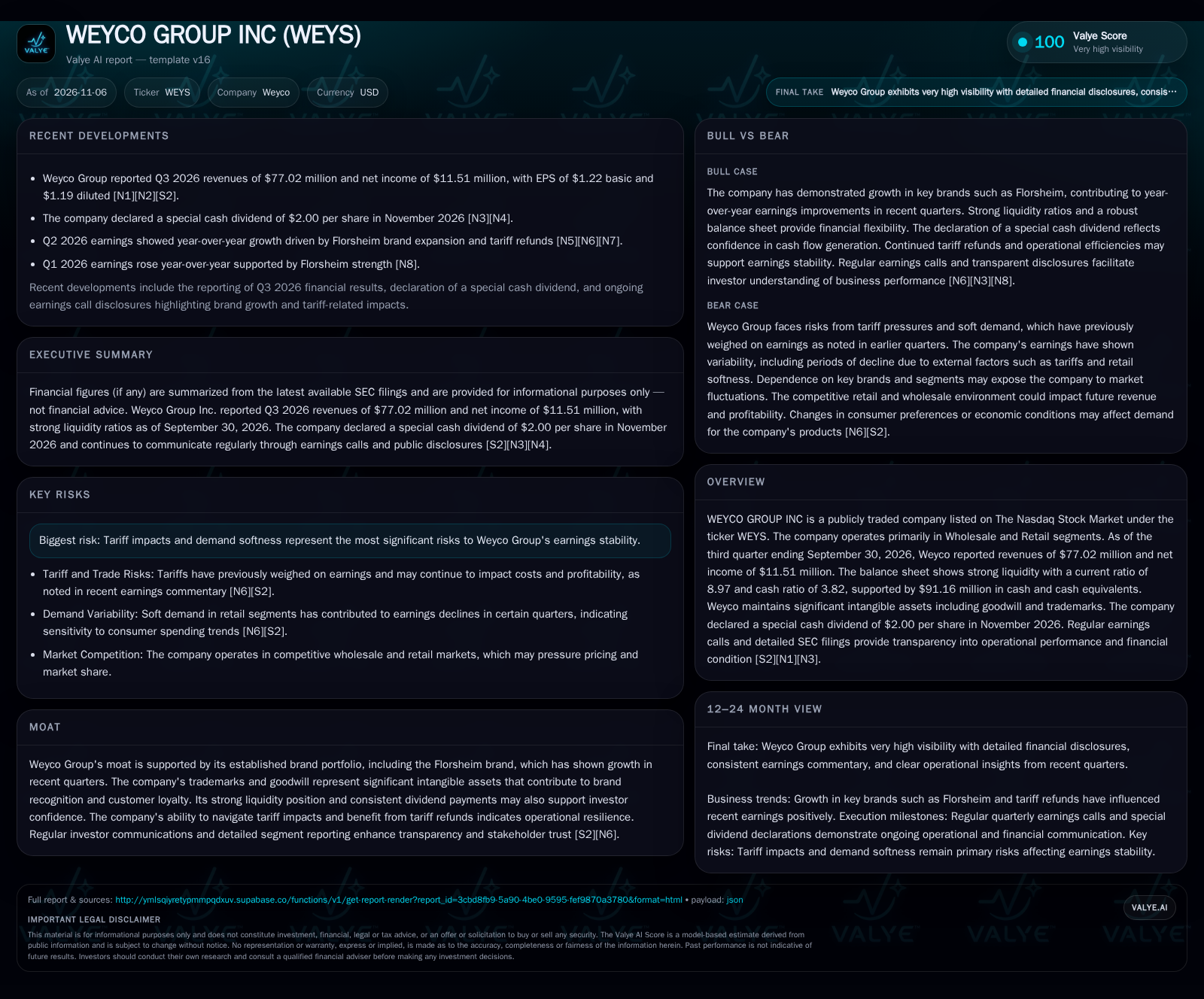
Weyco Group reported Q3 2026 revenues of $77.02 million and net income of $11.51 million, underpinned by a reported balance sheet position and notable growth in its Florsheim brand. The declaration of a $2.00 per share special dividend underscores recent cash flow strength, yet the company remains exposed to tariff pressures and demand fluctuations in its wholesale and retail segments. The key question is whether brand momentum and operational flexibility can offset ongoing competitive and macroeconomic headwinds. [S2] [N3] [N6]
Recent quarters featured both operational tailwinds—like tariff refunds and brand-driven sales—and the familiar risks of demand softness and tariff volatility. The core challenge for Weyco is translating its balance sheet strength and brand equity into sustainable, margin-accretive growth in a competitive retail and wholesale landscape. Understanding the company's economics, competitive pressures, and the durability of its recent performance is key to assessing its future trajectory.
Insights from Recent Financial Performance
Weyco Group reported Q3 2026 revenues of $77.02 million and net income of $11.51 million, translating to basic EPS of $1.22 and diluted EPS of $1.19 [S2]. The company reported cash and liquidity metrics for the period; these figures do not by themselves establish operating runway, investment capacity, financial flexibility, or financing capacity. [S2] The company declared a special $2.00 per share cash dividend in November 2026, signaling recent cash flow strength [N3] [N4]. Growth in the Florsheim brand and the receipt of tariff refunds were key drivers behind earnings improvements in 2026 [N6] [N8]. These facts highlight a company with both operational momentum and potential financial flexibility, but do not resolve the sustainability of these drivers in the face of industry headwinds.
Beyond headline revenue and net income figures, a deeper analysis of Weyco’s cash flow components provides insight into operational efficiency and capital allocation priorities. For instance, if disclosed, the breakdown of operating cash flow into working capital changes, depreciation, and non-cash expenses would help assess whether earnings quality is robust or reliant on one-time tariff refunds. Additionally, understanding the mix of capital expenditures versus dividends or share repurchases can illuminate management’s strategic focus—whether on growth investments, brand development, or returning cash to shareholders. The timing and sustainability of tariff refunds also merit scrutiny, as these can create episodic income spikes rather than steady earnings improvement.
Analyzing Weyco’s Earnings: Brand Impact, Margin Dynamics, and Cost Structure
Weyco’s core economics are shaped by its dual wholesale and retail segments, with the wholesale channel likely providing scale and margin leverage, while retail (including e-commerce) may offer higher unit economics but more volatility and fixed costs. The company’s reported net income margin for Q3 2026 implies a relatively healthy profitability profile for the footwear industry [S2].
Pricing power is most evident in legacy brands like Florsheim, which have supported top-line resilience and may provide some insulation against commoditization. However, exposure to tariffs introduces earnings volatility, as cost of goods sold can swing with policy changes and refund timing. Variable costs (materials, labor, shipping) are sensitive to global supply chain disruption, while retail operations introduce fixed cost risk (leases, staffing) that can pressure margins during demand downturns.
The special dividend hints at strong recent free cash flow, but the durability of such returns depends on consistent earnings and prudent reinvestment.
The interplay between wholesale and retail segments introduces complexity in margin management and growth strategies. Wholesale channels, while benefiting from scale and broader distribution, often operate under tighter margins due to retailer markups and competitive pricing pressures. Conversely, retail channels, especially e-commerce, may command higher gross margins but incur increased fixed costs and marketing expenses. This dichotomy suggests that Weyco’s ability to optimize channel mix and control fixed costs will be critical to sustaining profitability. Moreover, the company’s cost structure sensitivity to raw material price fluctuations and labor cost inflation requires careful monitoring, as these factors can erode margins unless offset by pricing power or operational efficiencies.
Evaluating the Brand Portfolio Amid Footwear Market Differentiation Challenges
Weyco’s competitive position is anchored by heritage brands, with Florsheim acting as a growth engine in recent quarters [N6] [N8]. In footwear, established trademarks and customer loyalty can create moderate switching frictions, but barriers are not insurmountable: consumers frequently experiment with new styles, and retailers often allocate shelf space based on recent sell-through rather than legacy relationships.
Peer groups include other branded footwear manufacturers with wholesale and direct-to-consumer models, such as domestic mid-market legacy brands and global players with broader product lines. Private label offerings and digitally native brands present substitution risk, especially if Weyco’s product differentiation, design, or perceived value lags evolving consumer tastes.
Brand equity, demonstrated by $32.9 million in trademarks and $12.3 million in goodwill, remains a double-edged sword—it could support premium pricing and retailer access but requires ongoing investment to maintain relevance. The current competitive environment is marked by promotional intensity, supply chain recalibration, and the risk of margin compression if demand softens or tariffs return.
Maintaining brand relevance in a rapidly evolving footwear market hinges not only on heritage but also on innovation and responsiveness to consumer trends. Weyco’s established brands benefit from customer loyalty, yet the rise of digitally native brands and fast-fashion competitors introduces a dynamic where speed-to-market and digital engagement increasingly influence market share. The company’s investment in design, marketing, and digital channels will be pivotal in differentiating its offerings. Additionally, the ability to leverage data analytics to anticipate consumer preferences and optimize inventory could mitigate risks associated with fashion cycles and overstock. The balance between preserving brand heritage and embracing innovation will shape Weyco’s competitive resilience.
Potential for Growth Through Brand Momentum and Cost Control
A favorable outcome for Weyco would see continued growth in flagship brands like Florsheim, enabling both volume and selective price increases.
Sustained tariff relief or further refunds would reduce cost volatility, supporting margin expansion. The ability to maintain or grow the special dividend over time would be a strong indicator of persistent free cash flow generation.
Confirmation would come from sequential revenue and earnings growth, rising gross and net margins, and evidence of market share gains in core brands. Falsification would be signaled by stagnation in brand performance, margin erosion despite stable revenues, or a pullback in capital returns due to cash flow constraints.
Brand Strength as a Foundation for Stability Despite Margin Pressures
Evidence supporting this scenario would include stable top-line trends, modest margin compression in the face of external headwinds, and continued investment in brand and channel development. A reversal would be indicated by a rapid decline in brand relevance, sustained revenue drops, or major cost shocks not offset by pricing or operational discipline.
Earnings Risks from Tariff Changes and Shifting Consumer Demand
If tariff pressures re-emerge or consumer demand for Weyco’s core brands softens meaningfully, the company could experience margin compression and earnings volatility. Retail exposure heightens risk, as fixed cost deleverage can magnify income declines during downturns.
Brand fatigue, fashion shifts, or loss of shelf space to private label or nimbler competitors could accelerate revenue declines and force promotional activity, eroding gross margins. If working capital needs spike or cash flow deteriorates, the company may need to curtail dividends or draw on its liquidity cushion, signaling operational stress.
This scenario would be confirmed by sequential revenue declines, sharp drops in gross or net margins, reduced dividend payouts, and signs of inventory build or discounting. It would be falsified by resilient brand performance and stable or improving operating margins despite adverse external conditions.
Factors Influencing Weyco’s Brand and Financial Strength Over Time
Quarterly revenue and net income trends by segment (Wholesale vs. Retail) to assess the sustainability of recent brand-driven gains and exposure to retail volatility, if disclosed.
Gross margin evolution, especially in the context of tariff changes, supply chain costs, and promotional activity.
Year-over-year performance of the Florsheim brand and other key trademarks, as ongoing brand health is critical to the thesis.
Cash flow from operations and free cash flow, to test the repeatability of special dividends and capital return policy.
Inventory levels and turnover, as elevated inventory could signal demand weakness or supply chain misalignment.
Retail channel performance, including comparable store sales and e-commerce trends, if disclosed, to gauge demand resilience and digital execution.
Disclaimer: This is research-only, informational analysis and not investment advice. It may include AI-generated interpretation and general industry context. Always verify important details using primary sources.

Comments