
QuinStreet Accelerates Revenue and Margin Gains, but Client Concentration and Media Cost Dynamics Shape the Next Phase
A surge in both home services and financial services demand, bolstered by targeted acquisitions, has propelled QuinStreet to record revenue and sharply improved margins. Yet as regulatory scrutiny tightens and competition for high-quality media intensifies, the company’s ability to sustain profitable growth hinges on diversification, acquisition integration, and resilience to client and media-source volatility.
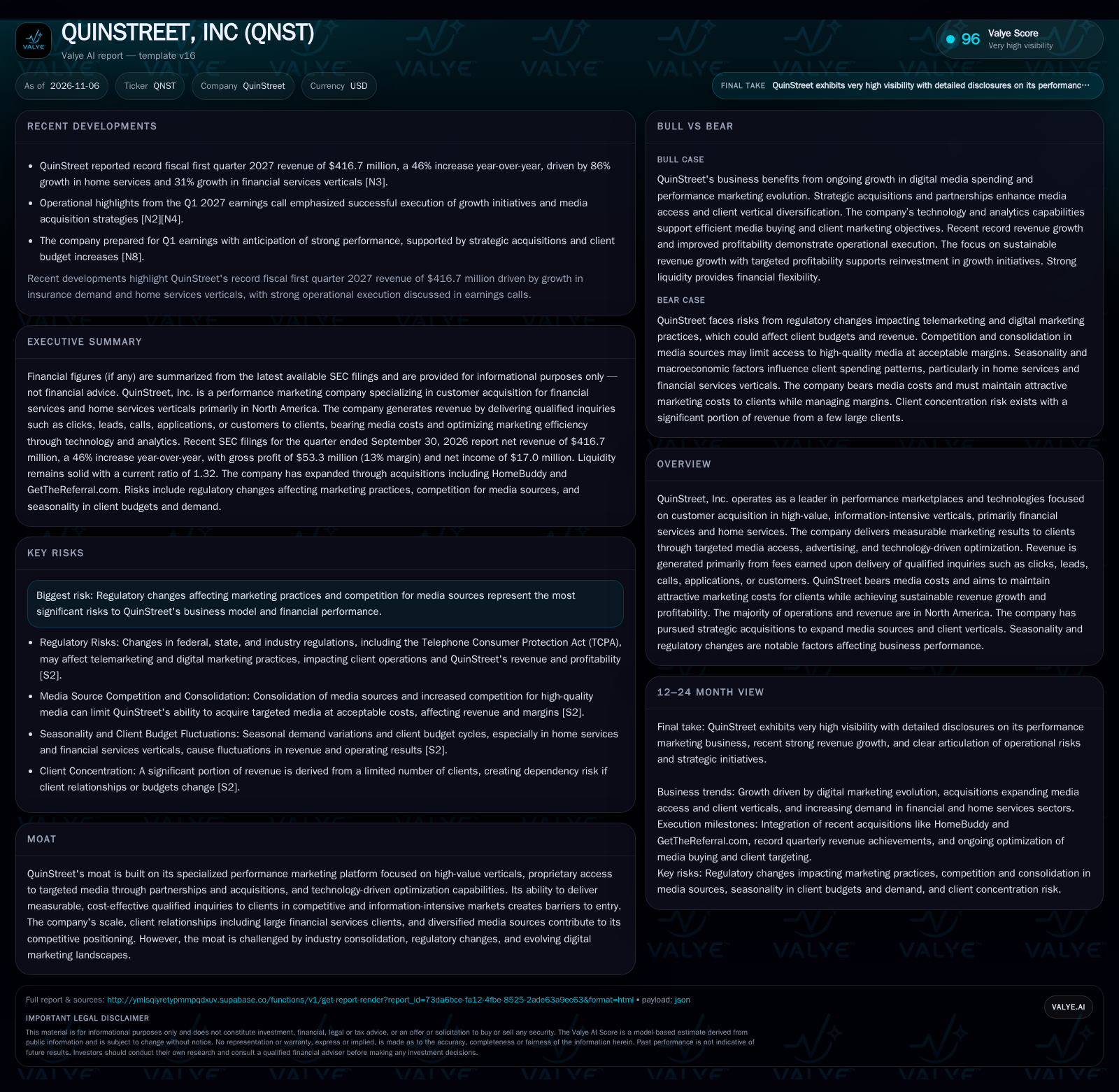
QuinStreet posted a 46% year-over-year revenue jump to $416.7 million in its fiscal Q1 2027, with both home and financial services growing robustly. Gross margin expanded to 13%, up from 9% a year ago, and operating income saw a fivefold increase. Recent acquisitions (HomeBuddy, GetTheReferral.com) have extended the company’s reach. However, with one client representing 19% of revenue, and external risks from regulation and media-source consolidation, future results may hinge on client diversification, integration execution, and media cost management. [S2] [N3]
QuinStreet’s latest quarter marks a dramatic inflection point: record revenue growth, margin expansion, and strategic acquisitions have propelled the company to new highs in both scale and profitability. However, beneath this top-line momentum lie crosscurrents—client concentration, regulatory uncertainty, and a rapidly consolidating media landscape—that will test whether QuinStreet’s technology-driven, performance-marketing engine can continue to deliver both growth and resilience. The next phase will be defined by how effectively the company manages its customer mix, integrates new assets, and navigates a digital advertising ecosystem in flux.
Record Revenue and Margin Gains, but Concentration and Acquisition Integration Take Center Stage
QuinStreet reported fiscal Q1 2027 net revenue of $416.7 million, up 46% year-over-year, with home services revenue surging 86% and financial services up 31%. This acceleration was attributed to both increased client budgets and the impact of recent acquisitions, including HomeBuddy and GetTheReferral.com. Gross margin improved markedly to 13% (from 9% a year prior), and operating income rose to $23.3 million, or 5.6% of revenue. However, a single client in the financial services vertical accounted for 19% of net revenue, underscoring the risk of customer concentration. Liquidity stood at $141.5 million in cash and equivalents, with a current ratio of 1.32 as of September 30, 2026. [S2] [N3]
Performance Marketing Economics: Scale, Media Cost Pressures, and Operating Leverage
QuinStreet's revenue model is rooted in performance marketing: clients pay for qualified inquiries—clicks, leads, calls, or applications—rather than impressions or ad placements. This pay-for-performance approach aligns client spend with measurable outcomes, but places the burden of media acquisition, optimization, and upfront cost on QuinStreet. The company acquires media from search engines, social platforms, and display networks, then uses proprietary technology and analytics to optimize conversion and margin.
Variable costs are dominated by media acquisition. As QuinStreet scales, fixed costs (technology, analytics, platform maintenance) are spread over a larger revenue base, enabling operating leverage—evident in the jump in operating margin from 1.6% to 5.6% year-over-year. However, gross margin remains relatively thin at 13%, reflecting intense competition for high-quality media and the need to keep client acquisition costs attractive. Acquisitions provide access to new media sources and verticals, but introduce integration costs and execution complexity. The company reported cash and liquidity metrics for the period; these figures do not by themselves establish operating runway, investment capacity, financial flexibility, or financing capacity. [S2]
Media Access, Technology, and Vertical Focus: Where QuinStreet Competes and Where It’s Vulnerable
QuinStreet’s competitive differentiation rests on its ability to source targeted media, optimize campaigns through technology, and focus on high-value, information-intensive verticals like financial and home services. Proprietary optimization tools, data-driven targeting, and established client relationships (notably in financial services) provide some defense against commoditization.
However, the digital media and performance marketing landscape is fiercely competitive and consolidating. Search engines, large digital platforms, and other performance marketers all vie for the same high-intent traffic. Changes in search algorithms, auction dynamics, or media source consolidation can materially impact both cost and availability of quality media. Additionally, as competitors vertically integrate or develop their own in-house performance marketing capabilities, QuinStreet must continually invest in technology and media partnerships to defend its position. Regulatory changes, particularly in telemarketing and digital lead generation practices, could also erode competitive advantages if compliance costs rise or certain channels are curtailed. [S2]
If Acquisition Synergies and Client Diversification Accelerate Profitable Growth
A favorable scenario unfolds if QuinStreet successfully integrates recent acquisitions, unlocking new media channels and verticals that broaden the client base and reduce reliance on a handful of large accounts. Synergies—such as improved lead quality, expanded advertiser reach, and more efficient media buying—could drive further gross margin expansion and operating leverage. Sustained investment in analytics and targeting may enhance conversion rates, allowing QuinStreet to command premium pricing or retain a larger share of client budgets.
Confirmation would come from continued revenue growth outpacing overall digital ad market expansion, further reduction in client concentration (with no single client representing a double-digit percentage of revenue), and evidence of margin improvement even as media costs fluctuate. Accelerated cross-sell into newly acquired verticals or geographies would further validate the upside case.
Sustained Growth, Margin Volatility, and the Ongoing Juggle of Media and Client Dynamics
The most plausible near-term trajectory is one of continued revenue growth, supported by digital marketing tailwinds and incremental gains from acquisitions, but tempered by persistent margin volatility. QuinStreet’s ability to pass on higher media costs to clients or offset them through technology-driven efficiency will be tested as competition and regulatory complexity increase. Periodic spikes in client budgets—especially in financial services—may continue to drive quarterly upside, but seasonality and cyclical softness in home services would create recurring revenue swings.
In this scenario, gross margin may fluctuate within a mid-teens band, and operating leverage remains positive but exposed to cost shocks. Client concentration risk persists but gradually moderates if cross-vertical expansion succeeds. Evidence would include revenue and margin trends tracking with broader digital ad market growth, stable or slightly declining client concentration metrics, and successful integration of recent acquisitions as reflected in segment reporting and commentary. [S2]
Margin Compression if Media Costs Rise, Regulation Tightens, or Major Clients Pull Back
A negative scenario could develop if competition for high-quality media intensifies, driving up acquisition costs faster than QuinStreet can pass them through to clients. Regulatory changes—such as stricter enforcement of telemarketing rules or digital privacy restrictions—could also curtail lead flow or increase compliance expenses, squeezing already-thin gross margins. Client budget cuts or the loss of a major account (notably the one representing 19% of revenue) would further erode revenue and profit, especially if acquisition-driven gains stall or integration falters.
Falsifying evidence would include a reversal of recent gross margin gains, a spike in client concentration, declining revenue in core verticals despite overall market growth, or significant acquisition-related write-downs. Regulatory headlines or litigation affecting lead generation practices would also support the downside case. [S2]
Milestones and Metrics That Will Define QuinStreet’s Resilience and Upside
Revenue growth rate by vertical (financial services vs. home services) and evidence of successful cross-sell or entry into new client segments, if disclosed.
Gross margin and operating margin trends as a function of media cost inflation and technology-driven efficiency gains.
Client concentration: percentage of revenue from the top five clients and any material changes in contractual relationships or budgets.
Integration progress and revenue contribution from recent acquisitions (HomeBuddy, GetTheReferral.com), as discussed in future filings or calls.
Regulatory developments affecting digital marketing and lead generation, especially around TCPA or similar frameworks, and related compliance costs.
Seasonality patterns and quarterly swings in media availability or client budgets, particularly in the home services vertical.
Competitive responses: emergence of new digital media sources, changes in search engine or social platform policies, or consolidation among key suppliers.
Disclaimer: This is research-only, informational analysis and not investment advice. It may include AI-generated interpretation and general industry context. Always verify important details using primary sources.

Comments