
Auburn National Bancorporation: Local Market Strength and Margin Expansion Amid Sector Headwinds
Auburn National Bancorporation, a century-old Alabama-based bank holding company, has delivered rising net interest income and consistent profitability, leveraging deep community ties. Yet, it faces mounting pressures from economic volatility, evolving competition, and the imperative for digital transformation.
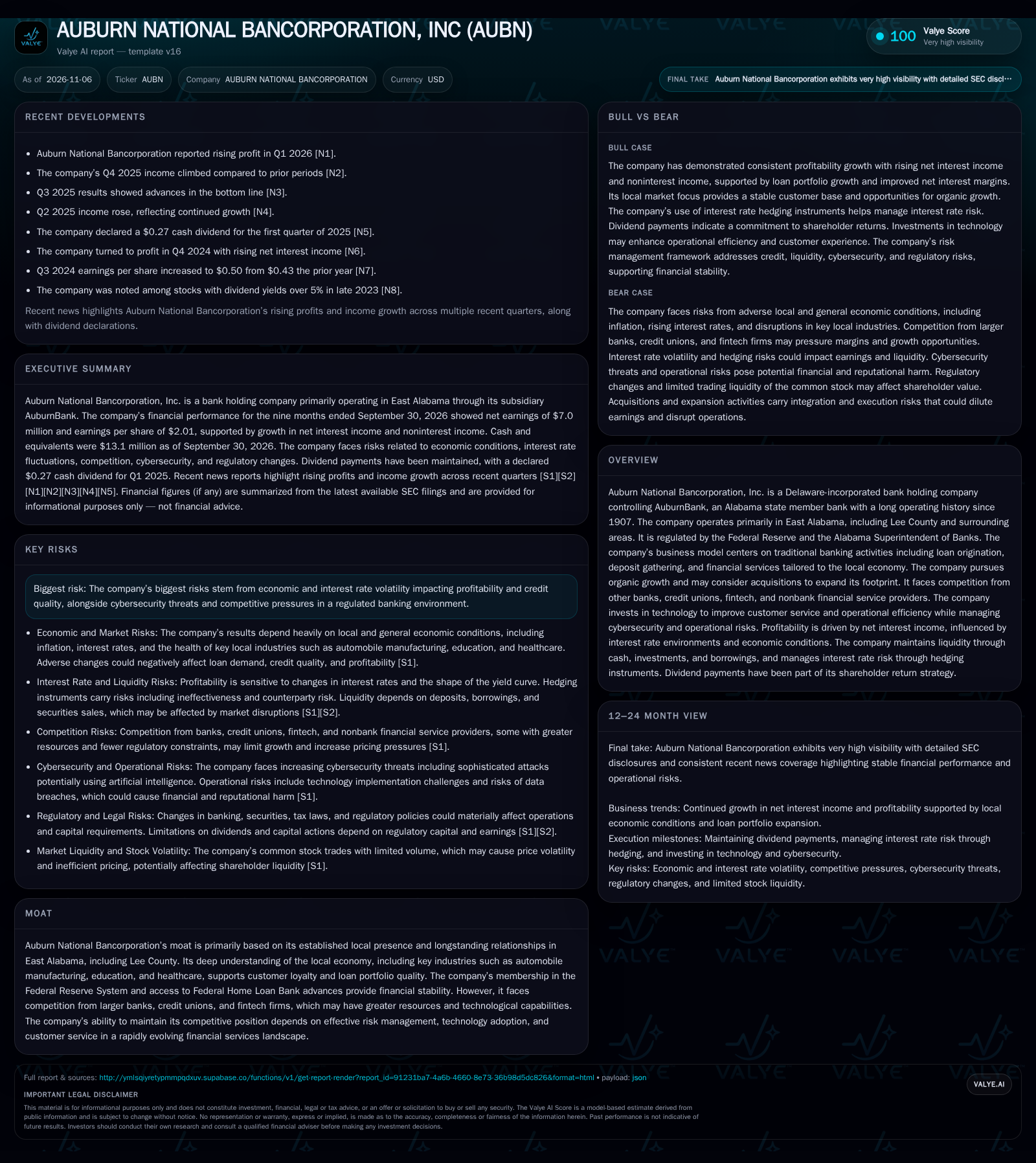
Auburn National Bancorporation has posted higher net income and expanded net interest margins through the first nine months of 2026, reflecting loan growth and improved asset yields. Its financial model remains highly dependent on local economic health and interest rate dynamics. While investments in technology and risk management are ongoing, exposure to regional economic shocks, rising fintech competition, and cybersecurity risks continues to shape its risk/reward outlook. The company’s ability to sustain margin gains and organic growth while navigating these external pressures will be critical for forward returns. [S2]
Auburn National Bancorporation stands out among regional banks for its ability to deliver consistent earnings growth, even as the broader banking sector faces macroeconomic turbulence and intensifying competition from nontraditional players. Through the first nine months of 2026, Auburn National grew both net interest income and overall profitability, supported by disciplined loan growth and effective margin management in its East Alabama markets. However, the company’s fortunes remain tightly coupled to local economic health, and the rise of digital-first banking models presents both a competitive challenge and a catalyst for operational evolution. The next phase for Auburn National will test its agility in balancing traditional relationship banking with the demands of a rapidly changing financial landscape.
Recent Financial Performance Underscores Margin Gains and Credit Quality
Auburn National Bancorporation reported net income of $7.0 million for the first nine months of 2026, translating to basic and diluted EPS of $2.01. Net interest income (tax-equivalent) increased 8% year-over-year, reaching $23.9 million, driven by a combination of loan growth and improved net interest margins. Noninterest income also rose to $2.7 million, while a negative provision for credit losses of $374 thousand indicated favorable credit performance and economic expectations in its core markets. Cash and equivalents stood at $13.1 million as of September 30, 2026. These results highlight the bank’s ability to generate higher earnings from its asset base and maintain strong asset quality in the current environment. [S2]
How Auburn National Earns: Net Interest Margins, Operating Leverage, and Capital Allocation
Auburn National’s core business model is classic community banking: gathering local deposits and lending primarily to individuals and businesses in East Alabama. Profitability is fundamentally driven by the spread between interest earned on loans and investments versus interest paid on deposits and borrowings. The 8% increase in net interest income for 2026 to date suggests that Auburn National has either grown its loan book, benefited from higher-yielding assets, or managed to control funding costs more effectively than peers. The negative loan loss provision indicates that credit costs have not pressured earnings, likely due to stable borrower performance and conservative underwriting.
Noninterest income, while a smaller contributor, is trending upward, reflecting efforts to diversify revenue through ancillary services. The company also invests in technology, aiming to improve efficiency and customer experience, which could create operating leverage if digital adoption reduces branch costs or enables scalable service delivery. However, as a relatively small institution, Auburn National’s fixed cost base may limit the degree of operating leverage achievable compared to larger banks. Capital allocation includes maintaining regulatory capital, supporting loan growth, and returning capital to shareholders via dividends, as evidenced by the $0.27 per share payout for Q1 2025. [S2] [N5]
Local Relationships Remain a Moat—But Competitive Pressures Intensify
Auburn National’s principal competitive advantage is its deep-rooted presence in East Alabama, with longstanding customer relationships and institutional knowledge of the local economy. This enables better credit selection and customer retention, especially among small businesses and households that value personalized service. However, the banking landscape is shifting: larger regional banks, aggressive credit unions, and fintech entrants are all targeting retail and small business customers with digital offerings and sometimes more attractive pricing.
Fintech and nonbank financial service providers can erode fee income and deposit market share, especially as younger demographics show a preference for digital-first solutions. While Auburn National has invested in technology, the pace of innovation and scale of digital investment among larger competitors could outstrip what a community bank can deliver. Regulatory compliance requirements and the risk of cybersecurity breaches further complicate the cost and execution of digital transformation.
The company’s ability to defend its franchise will hinge on blending high-touch relationship banking with improved digital capabilities, while maintaining prudent credit and risk management.
Sustained Margin Expansion and Digital Adoption Drive Outperformance
A favorable scenario would see Auburn National continuing to expand its net interest margin as higher-yielding loans and prudent deposit pricing offset any increases in funding costs. Benign local economic conditions—particularly in sectors like automobile manufacturing, education, and healthcare—could support further loan growth and keep credit costs low. If the company’s technology investments succeed in boosting operational efficiency, Auburn National could realize improved profitability without material branch expansion.
Additional upside could come from noninterest income growth if the bank successfully cross-sells financial services or captures a larger share of transaction and advisory fees. The maintenance of conservative underwriting and effective risk management would be crucial in sustaining low credit losses. Evidence confirming this scenario would include continued year-over-year growth in net interest income and noninterest income, stable or improving credit quality metrics, and positive customer adoption of new digital services.
Earnings Stability Anchored in Local Market, but Growth Moderates as Competition Rises
The most likely path is that Auburn National delivers steady, if unspectacular, earnings growth anchored by its established customer base in East Alabama. Loan growth may continue, but at a more moderate pace as competition for both loans and deposits intensifies. Net interest margins could remain stable if the bank balances asset yields against rising deposit costs, but upside may be capped by competitors’ pricing actions and any flattening of the yield curve.
Noninterest income likely grows incrementally, but remains a secondary contributor. Credit quality may stay strong barring a sharp downturn in the local economy. Technology investments improve service and efficiency, but do not fundamentally transform the company’s cost structure or competitive position in the near term. Evidence supporting this scenario would be stable quarterly profitability, modest increases in net interest and noninterest income, and no significant deterioration in asset quality or regulatory capital ratios.
Adverse Economic Shock or Digital Disruption Pressures Margins and Credit
A negative turn could materialize if East Alabama’s economy weakens—potentially due to job losses in local industries like auto manufacturing or education—leading to slower loan growth, higher delinquencies, and increased credit loss provisions. Rising interest rates could also compress net interest margins if deposit costs outpace asset yields, especially if Auburn National is unable to reprice loans quickly or retain low-cost funding.
A more aggressive push by digital-first competitors or fintechs could erode core deposit relationships and fee income, particularly if Auburn National’s technology upgrades lag customer expectations. Cybersecurity incidents or regulatory compliance failures could result in direct financial losses and reputational harm. Evidence confirming this scenario would include a spike in loan loss provisions, declining net interest margin, stagnating or falling loan balances, and signs of customer attrition to digital competitors.
Milestones and Metrics That Will Shape Auburn National’s Strategic Trajectory
Quarterly trends in net interest margin and net interest income, as these will reveal the bank’s ability to manage funding costs and asset yields in a shifting rate environment.
Loan growth rates by segment—particularly commercial versus consumer—to gauge the health of core markets and the bank’s competitive positioning.
Provision for credit losses and nonperforming asset ratios, which will signal any emerging credit stress or deterioration in local economic conditions.
Adoption rates for new digital services and customer engagement metrics (if disclosed), to assess whether technology investments are translating into customer retention and operating leverage.
Quarterly noninterest income growth, as an indicator of successful cross-selling or service diversification.
Changes in deposit mix, with a focus on the proportion of low-cost versus higher-cost funding sources.
Evidence of customer attrition or market share loss to larger banks, credit unions, or fintechs.
Material cybersecurity incidents or regulatory compliance issues, given their potential to disrupt operations and erode stakeholder trust.
Disclaimer: This is research-only, informational analysis and not investment advice. It may include AI-generated interpretation and general industry context. Always verify important details using primary sources.

Comments