
Heritage Insurance: Margin Improvements Tested by Persistent Pricing Pressures and Catastrophe Risk
Heritage Insurance Holdings, Inc. delivered strong Q3 2026 earnings and margin gains, but faces ongoing pricing pressure and catastrophe exposure. The company’s capital allocation strategy, including a $50 million buyback, underscores confidence, yet future profitability will hinge on underwriting discipline and reinsurance management in a volatile market.
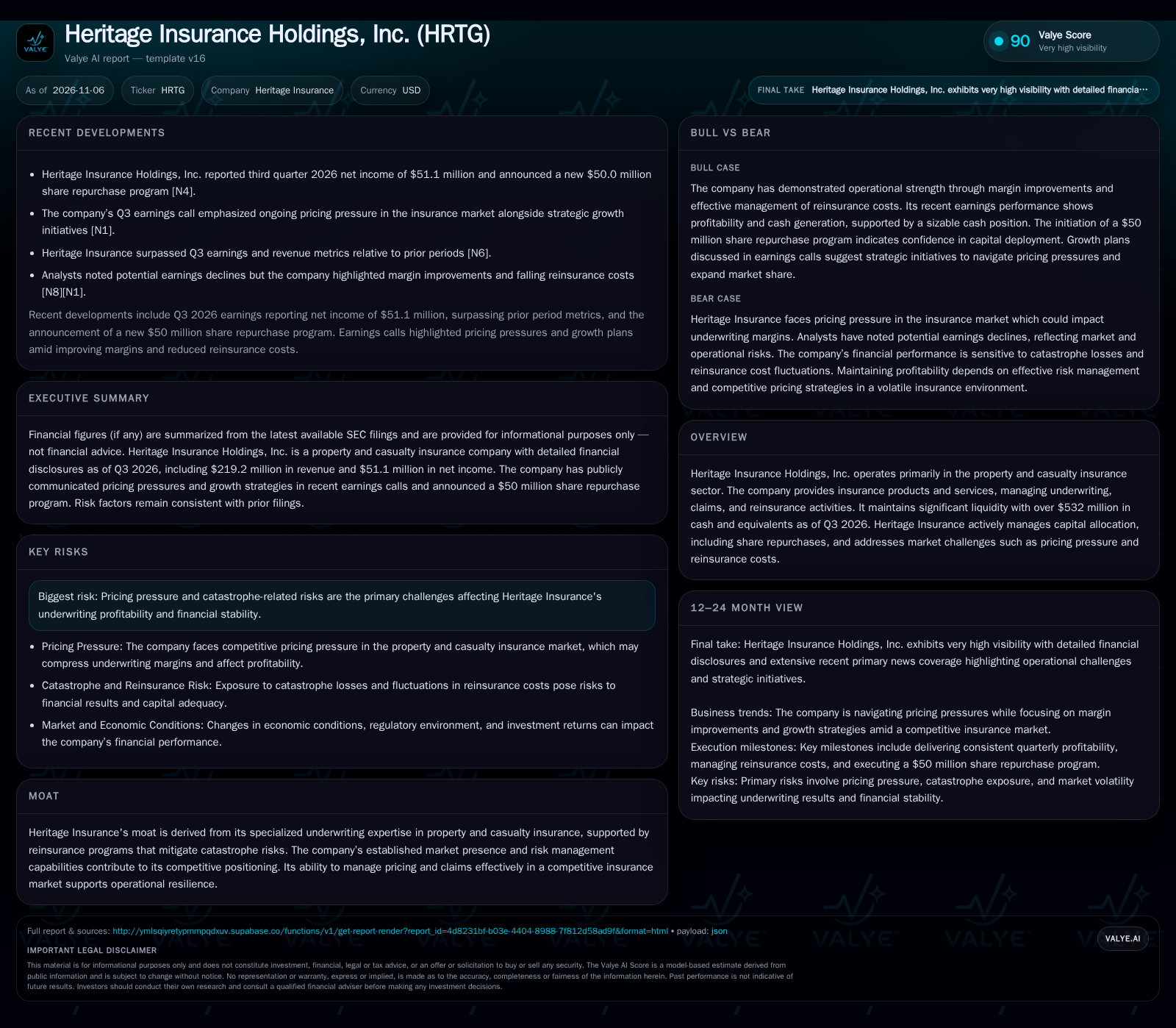
Heritage Insurance posted robust Q3 2026 earnings, highlighted by $51.1 million in net income and margin improvements. The company’s $50 million share repurchase program signals capital confidence, but ongoing pricing pressure and catastrophe risk remain central challenges. Future results will depend on effective risk selection, pricing strategy, and the ability to manage reinsurance costs and claims volatility. [S2] [N4] [N8]
Heritage Insurance Holdings, Inc. has delivered a notable rebound in profitability, reporting $51.1 million in net income for Q3 2026 amid a challenging property and casualty insurance landscape. Management’s willingness to deploy $50 million for share repurchases suggests confidence, but the insurance sector’s competitive pricing, potential for large catastrophe losses, and reinsurance cost swings continue to test the company’s ability to sustain earnings. The core question is whether recent margin gains and capital discipline can persist as external pressures intensify. [S2] [N4] [N8]
Recent Financial Outperformance Meets Strategic Capital Moves
Heritage Insurance reported Q3 2026 revenue of $219.2 million and net income of $51.1 million, with basic and diluted EPS at $1.72. The company ended the quarter with $532.1 million in cash and equivalents. Notably, Heritage initiated a $50 million share repurchase program, highlighting a willingness to return capital to shareholders. These developments matter because they signal both operational momentum and management’s assessment of intrinsic value, while also providing a buffer against near-term volatility. However, these results arrive against a backdrop of sector-wide pricing pressure and persistent catastrophe risk, both of which could quickly erode margin gains if not managed proactively. [S2] [N4] [N8]
Underwriting, Risk Selection, and the Levers of Insurance Profitability
Heritage Insurance’s core economics are shaped by three levers: premium pricing, loss ratio management, and reinsurance costs. In property and casualty insurance, gross written premiums generate revenue, but profitability depends on disciplined underwriting—selecting and pricing risks to keep claims costs (loss ratio) below collected premiums. Fixed costs (administrative, IT, compliance) are significant, but substantial variable costs stem from claims payouts, which can spike with severe weather or catastrophes.
Reinsurance is a critical cost factor, allowing Heritage to offload peak risks but at a price set by global reinsurance markets. Recent margin improvements and reduced reinsurance costs have supported results, but these benefits can reverse if catastrophe activity intensifies or reinsurance pricing hardens. The company’s ability to flex capital—illustrated by the share repurchase—suggests some financial resilience, yet underwriting discipline and risk selection remain the primary drivers of sustainable returns. If Heritage can maintain prudent risk selection and favorable reinsurance terms, it may preserve or even improve margins; a reversal in either area could quickly compress profitability. [S2] [N8]
An additional dimension influencing underwriting profitability is the company’s ability to leverage predictive analytics and emerging technologies to refine risk segmentation and pricing models. If Heritage can integrate more granular data inputs—such as localized weather patterns, property characteristics, and behavioral risk indicators—into its underwriting process, it may enhance risk selection accuracy and reduce loss volatility. Conversely, failure to adapt underwriting models to evolving risk landscapes, including climate change impacts, could result in mispriced policies and increased claims frequency. This dynamic underscores the conditional importance of technology adoption and data sophistication as complementary levers alongside traditional pricing and reinsurance management.
Pricing Dynamics and the Challenge of Differentiation in a Crowded Insurance Market
Heritage Insurance operates in a highly competitive segment, with rivals ranging from national carriers to regional specialists, all vying for price-sensitive customers. The company’s competitive position rests on underwriting expertise, established market presence, and risk management capabilities. However, the property and casualty market is notorious for ‘soft’ pricing cycles—when competitive pressures drive down premiums, often at the expense of future profitability.
Differentiation often comes from superior risk analytics, claims handling, and customer service, but these factors are difficult to sustain as durable moats unless paired with proprietary data or technology. Reinsurance relationships and catastrophe modeling are also sources of relative advantage, particularly in weather-exposed regions. The risk is that, absent discipline, price competition can lead to underpricing and adverse selection, eroding margins even for experienced operators. Heritage’s recent margin improvements suggest some execution edge, but these advantages are perennially tested by market cycles and catastrophic events. [N1] [N8]
Market positioning also depends on Heritage’s capacity to balance scale advantages with niche specialization. Larger insurers may benefit from broader diversification and economies of scale in claims processing and capital deployment, while smaller or regional players often compete through tailored product offerings and local market knowledge. Heritage’s competitive strategy must therefore navigate the trade-off between expanding market share—which can dilute underwriting discipline if not carefully managed—and maintaining focused risk appetite to preserve margin integrity. Additionally, shifts in consumer expectations for digital engagement and faster claims resolution could alter competitive dynamics, making investments in operational efficiency and customer experience critical for differentiation in a commoditized market.
Margin Expansion if Risk Selection and Reinsurance Costs Stay Favorable
A bullish scenario for Heritage would see the company consistently outperform sector peers by sustaining disciplined underwriting and leveraging improved reinsurance terms. If catastrophe activity remains moderate and reinsurance markets stay stable, Heritage could maintain or further improve its loss and expense ratios, driving higher net income and potentially supporting additional capital returns.
Confirmation of this scenario would come from several quarters of low loss ratios, stable or declining reinsurance expense as a percentage of premiums, and continued EPS outperformance versus both internal targets and consensus estimates. Further, if the company successfully expands into new markets or product lines while maintaining underwriting discipline, it could achieve premium growth without sacrificing profitability. Evidence that would falsify this scenario includes a sudden spike in catastrophe losses, reinsurance cost inflation, or a deterioration in combined ratios back toward or above industry averages.
Profitability Moderates as Pricing Pressure and Catastrophe Risk Persist
The most plausible path is that Heritage experiences moderate earnings over the next several quarters, as margin improvements partially offset ongoing pricing pressure and episodic catastrophe losses. Management may continue to deploy capital opportunistically—such as through share repurchases—when earnings are strong, but the inherent volatility of property and casualty insurance will limit the ability to deliver consistent outperformance.
In this scenario, underwriting results fluctuate year-to-year depending on weather events, competitive pricing, and reinsurance market conditions. The company maintains profitability, but with a risk of periodic setbacks. Evidence supporting this scenario would include quarterly earnings that oscillate around current levels, stable but not sharply improving loss and expense ratios, and ongoing discussion of external market headwinds in earnings commentary. A deviation—either sustained margin expansion or a sharp decline due to catastrophe or pricing missteps—would falsify the middle-ground outlook.
Adverse Selection, Pricing Wars, or Catastrophe Events Erode Earnings Power
A bearish scenario would unfold if competitive pressures force Heritage to underprice risk, leading to adverse selection and deteriorating loss ratios. Simultaneously, a spike in catastrophe events or a hardening of reinsurance markets could dramatically increase claims and reinsurance costs, compressing margins and potentially triggering net losses.
This scenario would be confirmed by a rapid rise in the combined ratio (claims plus expenses as a percentage of premiums), negative EPS, and reduced capital flexibility. Additional warning signs would include management guidance downgrades, suspension of share repurchases, or a need to raise external capital. Persistent adverse trends could also result in credit rating downgrades or regulatory scrutiny, further constraining strategic options.
What Will Reveal Heritage Insurance’s True Underwriting Edge?
Quarterly loss and combined ratios, especially relative to sector averages, will reveal whether recent margin improvements are sustainable or cyclical.
Trends in reinsurance expense as a percentage of gross premiums will show whether Heritage can maintain favorable terms or faces cost headwinds.
Reported catastrophe losses and management’s commentary on catastrophe modeling assumptions will indicate vulnerability to severe weather events.
Premium growth rates—both in aggregate and by market segment—will help assess whether expansion comes with disciplined underwriting or through risky growth.
Share repurchase activity and changes in capital allocation priorities will reflect management’s confidence and potential financial flexibility.
Earnings guidance updates and management commentary on pricing trends will clarify whether competitive pressures are intensifying or easing.
Regulatory filings or rating agency commentary on capital adequacy and risk management practices would help test resilience in adverse scenarios.
Disclaimer: This is research-only, informational analysis and not investment advice. It may include AI-generated interpretation and general industry context. Always verify important details using primary sources.

Comments