
Jack Henry & Associates: Cloud Momentum, Contract Dynamics, and the Resilience Test in Fintech Infrastructure
Jack Henry & Associates is navigating a pivotal phase as cloud and payments growth offset contract renewal pressures and cybersecurity threats. The company’s economics hinge on recurring revenue, technology investment, and its ability to maintain trust and relevance amid intensifying fintech competition.
Jack Henry’s recent earnings underscore the importance of cloud and payments momentum, but the interplay of long-term contracts, cybersecurity, and operational risk will determine whether its foundational role in financial technology infrastructure remains defensible. Core metrics to watch include contract renewal rates, cloud services adoption, operational disruptions, and the scope of deconversion revenue.
Jack Henry & Associates is at a strategic crossroads, balancing the tailwinds of cloud and payments growth with the ever-present risks of client churn, contract repricing, and cybersecurity threats. The company’s technology platform is deeply embedded in the operations of regional banks and credit unions, providing both resilience through switching costs and vulnerability to shifts in vendor preference or regulatory requirements. As the fintech landscape evolves, Jack Henry’s ability to renew and expand contracts, invest in infrastructure, and maintain operational integrity will shape its long-term economics and competitive posture.
Recent Results Highlight Cloud Growth and Contract Transition Activity
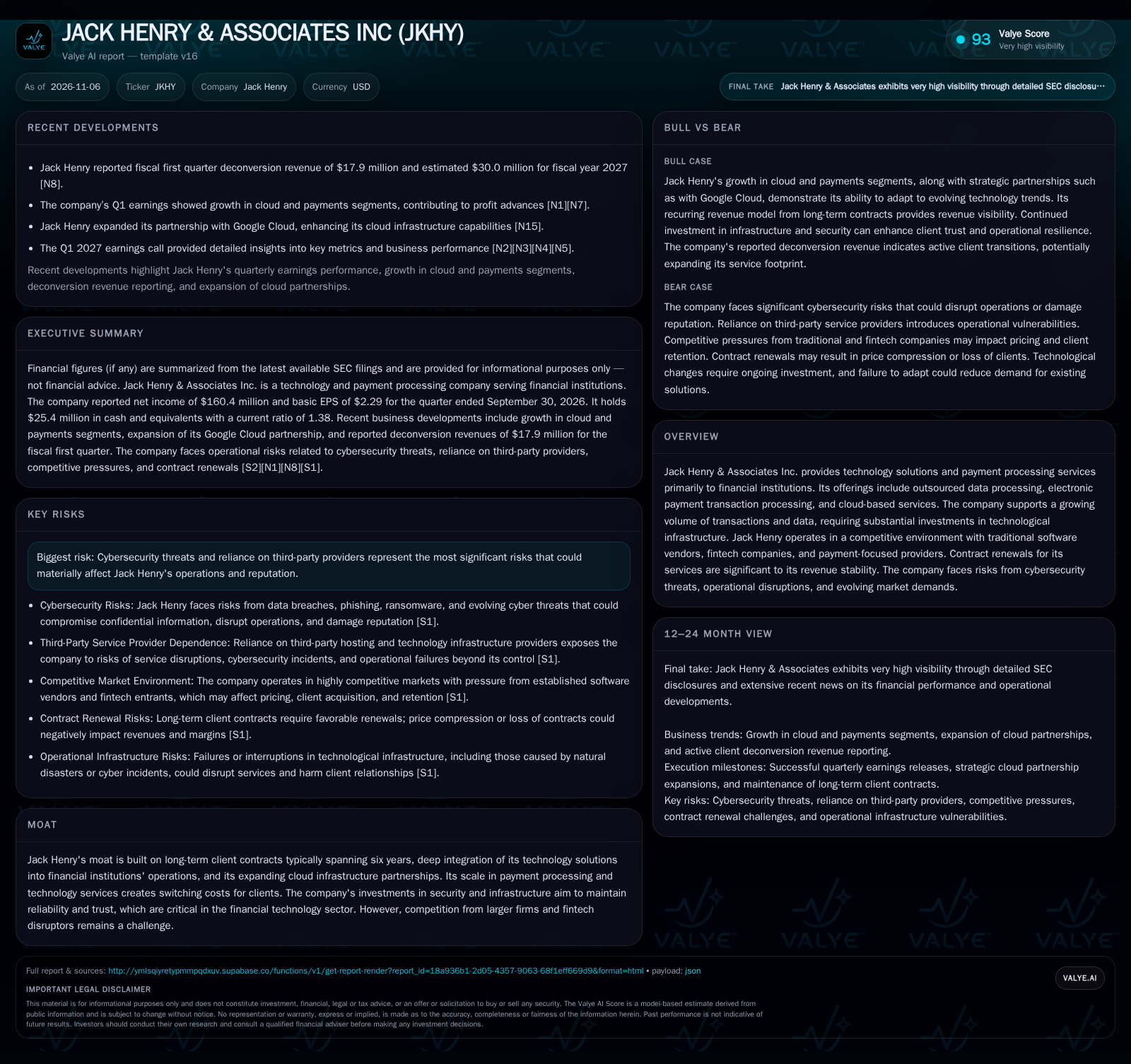
Jack Henry reported net income of $160.4 million for the quarter ended September 30, 2026, with basic EPS of $2.29 and diluted EPS of $2.28, underscoring continued profitability amid sector volatility [S2]. The company’s recent quarterly performance showed clear momentum in its cloud and payments segments, reflecting ongoing shifts in client technology adoption [N1] [N7]. Notably, Jack Henry disclosed $17.9 million in fiscal Q1 deconversion revenue and projected $30 million for fiscal year 2027, a figure indicative of active client transitions—either to new Jack Henry platforms or as part of client attrition [N8]. As of September 30, 2026, Jack Henry’s balance sheet listed $25.4 million in cash and a current ratio of 1.38, providing a neutral snapshot of liquidity [S2]. These facts collectively point to a business in transition, with growth opportunities and structural risks closely intertwined.
Recurring Revenue, Margins, and the Economics of Platform Modernization
Jack Henry’s core economics are anchored by long-term contracts for outsourced data processing, payments, and cloud services—typically six years in length—which provide a base of recurring revenue and predictable cash flows [S1]. Pricing is often structured as a blend of per-transaction fees, user-based licenses, and platform subscriptions, with a significant portion tied to client transaction volumes. As financial institutions migrate to cloud-based and digital-first offerings, Jack Henry must continually invest in infrastructure, cybersecurity, and compliance, creating an ongoing capital expenditure burden but also the potential for operating leverage if incremental cloud revenues outpace cost growth.
Deconversion revenue reflects fees earned as clients transition off legacy platforms, either as part of internal upgrades or when switching providers. While this provides a one-time bump, it may also signal client attrition or competitive churn if not offset by new contract wins or platform migrations. The company’s reliance on third-party service providers for hosting and technology infrastructure introduces both variable costs and operational dependencies [S1]. The long-term margin profile will depend on Jack Henry’s ability to grow higher-margin cloud and payments services while managing infrastructure costs and minimizing contract repricing during renewals.
Switching Costs, Integration Depth, and the Threat from Fintech Disruptors
Jack Henry’s competitive edge traditionally stems from deep integration into core banking operations, which creates significant switching frictions for regional banks and credit unions. Multi-year contracts and the complexity of data migration make wholesale transitions costly and risky for clients, especially in regulated environments. However, the financial technology landscape is rapidly evolving: established software vendors, cloud-native fintechs, and specialized payments providers are all competing for the same institutional relationships [S1].
Fintech entrants often promise lower costs, faster innovation cycles, and open-API architectures, which can erode the stickiness of legacy platforms. Jack Henry’s expanding partnerships (such as with Google Cloud) and migration to cloud-native solutions represent a strategic response, but the question remains whether these moves are sufficient to counterbalance the speed and flexibility of newer competitors. The company’s moat, while still meaningful, is at risk of gradual erosion if contract renewals increasingly occur at lower price points or if clients opt for modular, best-of-breed alternatives.
Cloud Adoption and Contract Expansion Unlock Margin Upside
A favorable trajectory for Jack Henry would see accelerating adoption of its cloud and payments platforms among existing and new clients, driving up transaction volumes and enabling higher-margin service delivery. Successful contract renewals—particularly those that expand scope or embed additional cloud modules—would reinforce revenue visibility and potentially support modest pricing power. The company’s ability to demonstrate robust cybersecurity performance and operational reliability could further solidify client trust and reduce attrition risk.
Evidence that would confirm this scenario includes sustained double-digit growth in cloud and payments revenue, stable or rising average contract duration, and a declining rate of deconversion revenue as churn subsides. Additional proof points would be public wins of major new client contracts, successful renewals at favorable terms, and margin expansion attributable to operating leverage in the cloud infrastructure.
Incremental Growth Balanced by Renewal and Cybersecurity Pressures
The most plausible outlook is for Jack Henry to deliver steady, mid-single-digit revenue growth as cloud and payments segments gradually offset legacy platform attrition. Contract renewals may increasingly occur at compressed price points, reflecting both competitive pressure and client negotiation leverage. While the company is likely to maintain its base of regional bank and credit union clients, the mix will slowly shift toward cloud and digital payments, requiring ongoing investment in infrastructure and compliance. Margins may be stable or face modest compression, depending on the pace of migration and the ability to control costs.
This scenario would be confirmed by moderate growth in cloud and payments revenue, relatively stable deconversion revenue (indicating manageable churn), and recurring headlines around contract renewals without major client losses. Evidence of continued cybersecurity incidents or operational disruptions would be a negative confirming trend for the bear scenario.
Contract Churn, Price Compression, and Cyber Incidents Threaten Core Economics
A negative chain of events could unfold if major clients accelerate their transition to alternative fintech providers or if Jack Henry faces heightened price compression during contract renewals. Significant deconversion revenue, without offsetting new wins, would indicate net client attrition and shrinking platform relevance. The greatest existential threat is a material cybersecurity incident—such as a high-profile data breach—that undermines trust and prompts regulatory scrutiny or client flight [S1]. Reliance on third-party providers compounds operational risk, as service outages or security failures could be outside of Jack Henry’s direct control.
This scenario is confirmed by a sharp uptick in deconversion revenue, declining total contract value, loss of major client relationships, and publicized cyber or operational disruptions. Margin contraction and negative revenue growth would be further symptoms of a deteriorating franchise.
What Will Test Jack Henry’s Relevance and Resilience in Fintech Infrastructure?
The pace of cloud and payments revenue growth, if disclosed, as an indicator of platform adoption and product mix evolution.
Trends in deconversion revenue, which signal net client churn or successful migration to new Jack Henry platforms.
Contract renewal rates and average contract duration, if disclosed, to assess client retention and pricing power.
Incidence and severity of cybersecurity events, including data breaches or major phishing attacks.
Operational reliability metrics, such as frequency and duration of service outages—especially those related to third-party service providers.
Net new client wins or losses, particularly among regional banks and credit unions.
Evidence of price compression or margin impact resulting from increased competition at contract renewal.
Disclaimer: This is research-only, informational analysis and not investment advice. It may include AI-generated interpretation and general industry context. Always verify important details using primary sources.

Comments