
Ameren’s Growth Ambitions Meet Liquidity Constraints: Navigating Regulation, Capex, and Emerging Demand Drivers
Ameren reported year-over-year revenue and profit growth in Q3 2026, outperforming expectations.
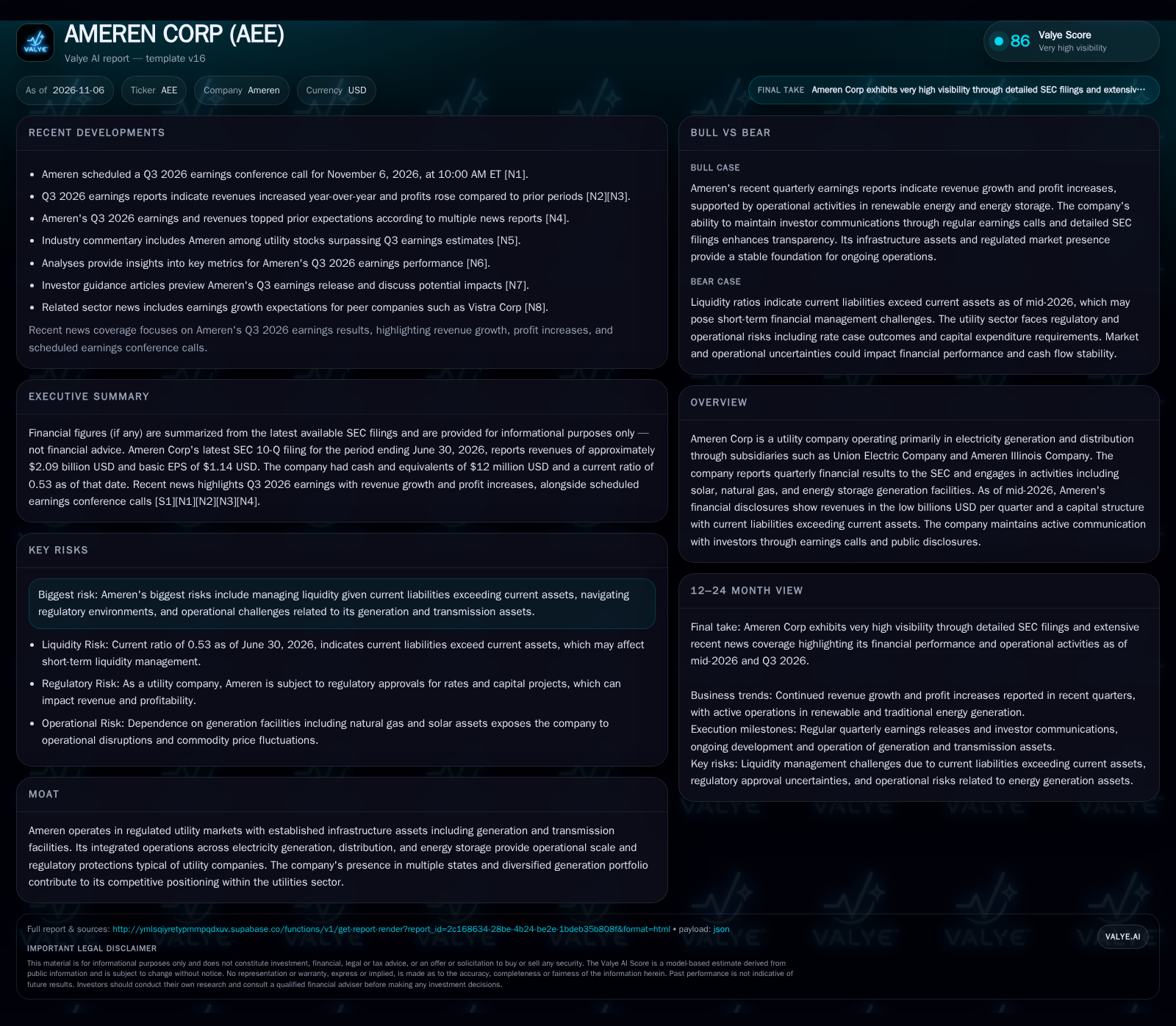
Ameren reported year-over-year revenue and profit growth in Q3 2026, outperforming expectations. However, a current ratio of just 0.53 and a cash balance of $12 million illustrate a tight liquidity position as of mid-2026. The company’s integrated utility operations, including renewables and energy storage, underpin its regulated earnings base, but future value creation depends on successfully managing capital spending, regulatory approvals, and rate recovery—especially as large new loads like data centers emerge. Watch for regulatory outcomes, customer demand patterns, and any shifts in capital structure or funding strategy as key signposts for the next phase.
Ameren Corp’s latest results show the classic strengths and challenges of a regulated utility. While the company has delivered revenue and profit growth that outpaces expectations, its current ratio of 0.53 and minimal cash reserve as of mid-2026 underscore the sector’s reliance on robust capital markets and constructive regulatory frameworks. As Ameren pursues investments in renewables, storage, and grid modernization—often in anticipation of demand from data centers and other large customers—its ability to recover costs, secure timely approvals, and manage its capital structure will determine whether recent momentum translates into durable shareholder value.
Recent Financial Results Spotlight Growth—and Liquidity Tightness
Ameren reported approximately $2.09 billion in Q2 2026 revenue with basic EPS of $1.14, and news reports confirm both revenue and profit grew year-over-year in Q3 2026, surpassing analyst expectations [S1] [N2] [N3] [N4]. This operational momentum is being delivered against a backdrop of tight liquidity: as of June 30, 2026, Ameren’s current assets ($2.64 billion) were roughly half its current liabilities ($4.98 billion), yielding a current ratio of 0.53 and a cash balance of only $12 million [S1]. The juxtaposition of strong regulated earnings and a stretched short-term balance sheet is a central feature of Ameren’s present position.
Utility Revenue Model: Regulated Returns and Capital Intensity
Ameren’s core business model is built around regulated electricity and gas distribution, where revenues are determined by approved rate bases and allowed returns on equity. This model offers stability and a degree of downside protection, but is highly capital-intensive: ongoing investments in generation, transmission, and grid modernization require significant upfront capital, with cost recovery dependent on regulatory approval. The company’s infrastructure—spanning renewables, natural gas, and energy storage—provides long-lived, depreciable assets that underpin the rate base and justify continued capital deployment.
Fixed costs dominate, with labor, maintenance, and depreciation largely set, while variable costs are tied to fuel and purchased power. Operating leverage is substantial: incremental load growth, such as from data center expansion, can yield outsized returns if incremental revenue exceeds marginal costs and regulatory frameworks allow timely rate adjustments. However, the lag between capital deployment and rate recovery can create cash flow mismatches, especially when liquidity is tight and short-term liabilities exceed available cash.
The capital-intensive nature of Ameren’s utility operations inherently ties its financial health to the timing and certainty of regulatory approvals. Because rate cases can span multiple quarters or even years, the company must carefully manage working capital and financing strategies to bridge periods where expenditures outpace recoveries. This dynamic underscores the importance of a flexible capital structure and access to diverse funding sources, including debt markets and potentially equity, to maintain liquidity without compromising credit quality. Furthermore, the interplay between depreciation schedules and allowed returns influences the long-term economics of asset additions, meaning that changes in regulatory policy on depreciation or return parameters could materially affect investment incentives and valuation.
Regulatory Environment and Asset Base Define Competitive Edge
Ameren’s competitive positioning is shaped less by market rivalry and more by regulatory relationships, asset footprint, and the ability to execute large-scale capital projects within approved frameworks. The company’s integrated operations across Missouri and Illinois, with a diversified mix of renewables, natural gas, and storage, provide economies of scale and operational resilience.
Switching frictions are high: customers have limited alternative suppliers, and infrastructure investments are sunk and regulated. However, Ameren faces indirect competition from distributed generation, energy efficiency measures, and evolving customer preferences—especially as advances in private solar, storage, and demand-side management technologies become more cost-competitive. The key counterforce is regulatory: adverse rate case outcomes, cost disallowances, or tighter caps on return on equity could erode future earnings power.
While Ameren’s regulatory environment provides a moat by limiting direct competition, the rise of distributed energy resources (DERs) introduces a nuanced competitive dynamic. As DER adoption grows, it can reduce the utility’s volumetric sales, potentially eroding the rate base unless regulatory frameworks evolve to compensate for these shifts through mechanisms like fixed charges or performance-based regulation. Additionally, customer preferences for sustainability and resilience may pressure Ameren to accelerate investments in grid modernization and smart technologies, which could increase capital requirements but also create opportunities for differentiated service offerings. Navigating these trends requires proactive regulatory engagement and innovation in rate design to balance customer interests with financial sustainability.
If Regulatory Outcomes and Demand Growth Align, Earnings Expansion Could Accelerate
The most favorable scenario for Ameren involves a virtuous cycle where regulatory bodies approve timely rate increases and robust returns on equity, enabling the company to recover and earn on its expanding capital base. If demand from large new loads—such as data centers that signed electric service agreements in 2026—materializes as forecast and drives incremental volume, Ameren could see operating leverage translate into higher earnings and cash flow [S1].
Confirmation would come from: (a) regulatory filings approving new rate cases or capital expenditure recovery, (b) updates showing large load customers ramping usage as planned, and (c) evidence that cost of capital remains manageable, allowing the company to fund projects without excessive dilution or adverse refinancing terms. Falsification would involve regulatory pushback, delays in connecting new customers, or a spike in funding costs that erodes the economics of new investment.
Sustained Growth, But Capital and Regulatory Headwinds Limit Optionality
The most probable outcome is that Ameren continues to generate stable, regulated returns with moderate revenue and profit growth, supported by incremental investments in renewables and grid upgrades. Rate cases and regulatory approvals proceed, but not without negotiation, leading to some lag in cost recovery and periodic pressure on free cash flow. The reported current ratio suggests that external financing—debt or equity—remains necessary to bridge timing gaps between capex and rate recovery.
Evidence for this scenario would be ongoing, if modest, year-over-year earnings growth; regular, though sometimes contested, rate case approvals; and continued reliance on capital markets for refinancing and project funding. A shift away from this scenario would be indicated by either a marked tightening in capital markets or a regulatory regime less willing to approve timely or adequate returns.
Liquidity Constraints or Adverse Regulation Could Disrupt Investment and Growth Plans
If Ameren faces an unfavorable combination of regulatory disallowances, delayed rate approvals, or a further tightening in liquidity, the company could be forced to slow or defer capital investments, threatening both near-term earnings and long-term growth.A reported current ratio and minimal reported cash balance increase vulnerability to shocks, such as cost overruns, unexpected outages, or spikes in interest rates.
Downside confirmation would come from: (a) regulatory decisions denying or delaying cost recovery, (b) disclosure of deferred or canceled projects, (c) higher borrowing costs or constrained access to capital markets, or (d) deterioration in credit ratings. A significant mismatch between capex outflows and recovered revenues could force asset sales or dilutive equity issuance, eroding shareholder value.
A protracted mismatch between capital expenditures and regulatory recoveries could exacerbate liquidity pressures, especially if external financing conditions deteriorate simultaneously. In such a scenario, Ameren might face higher borrowing costs or restrictive covenants that limit operational flexibility. Moreover, regulatory disallowances or rate freezes could impair cash flow generation, forcing the company to prioritize projects with the highest short-term returns or defer critical infrastructure upgrades, potentially impacting service reliability and long-term competitiveness. This constrained environment might also heighten the risk of credit rating downgrades, further increasing capital costs and creating a feedback loop that challenges the sustainability of the current business model.
Milestones and Metrics That Will Define Ameren’s Next Phase
Regulatory outcomes for pending and upcoming rate cases in Missouri and Illinois, including decisions on capital expenditure recovery and allowed returns on equity.
Evidence of new large-load customers—such as data centers—ramping up usage within Ameren’s service territory, and whether their demand growth matches company forecasts.
Trends in external financing: any announced debt or equity issuances, refinancing activity, or changes in credit ratings that reflect Ameren’s ability to bridge liquidity gaps.
Updates on capital expenditure plans, including scale, timing, and any disclosed project delays or cost overruns.
Operating cash flow and free cash flow trends, if disclosed, to assess the timing mismatch between investment outlays and rate recovery.
Customer usage patterns, especially shifts in distributed generation adoption or energy efficiency that could impact load forecasts and revenue growth.
Any material changes in the regulatory or legislative environment that affect cost recovery mechanisms, rate caps, or the structure of allowed returns.
Disclaimer: This is research-only, informational analysis and not investment advice. It may include AI-generated interpretation and general industry context. Always verify important details using primary sources.

Comments