
Westamerica Bancorporation: Navigating Margin Pressure and Regional Concentration in a Competitive California Banking Market
Westamerica Bancorporation’s recent earnings show resilient profitability and robust capital ratios, but declining loan balances and rising noninterest expenses signal mounting margin pressures. With its fortunes tightly linked to Northern and Central California’s economic pulse, the bank’s ability to defend spreads and manage costs is increasingly tested by competition and operational headwinds.
The cited source reports dividend-related activity; that disclosure alone does not establish dividend-policy continuity, management confidence, or a material constraint on capital flexibility. The bank’s future hinges on its ability to offset shrinking loan balances and rising expenses amid intensifying competition and evolving regulatory and economic risks.
Westamerica Bancorporation stands as a steady regional bank with deep roots in Northern and Central California, emphasizing small business and consumer banking. Its recent results reveal a business balancing stable capital strength and consistent dividends with the realities of modest net income declines and higher operational costs. As loan balances ease and competitive intensity rises, Westamerica’s core challenge is to defend its profitability and relevance in a fast-evolving, highly regulated, and increasingly crowded regional banking landscape.
Recent Earnings Reveal Stable Dividends but Mounting Margin Pressure
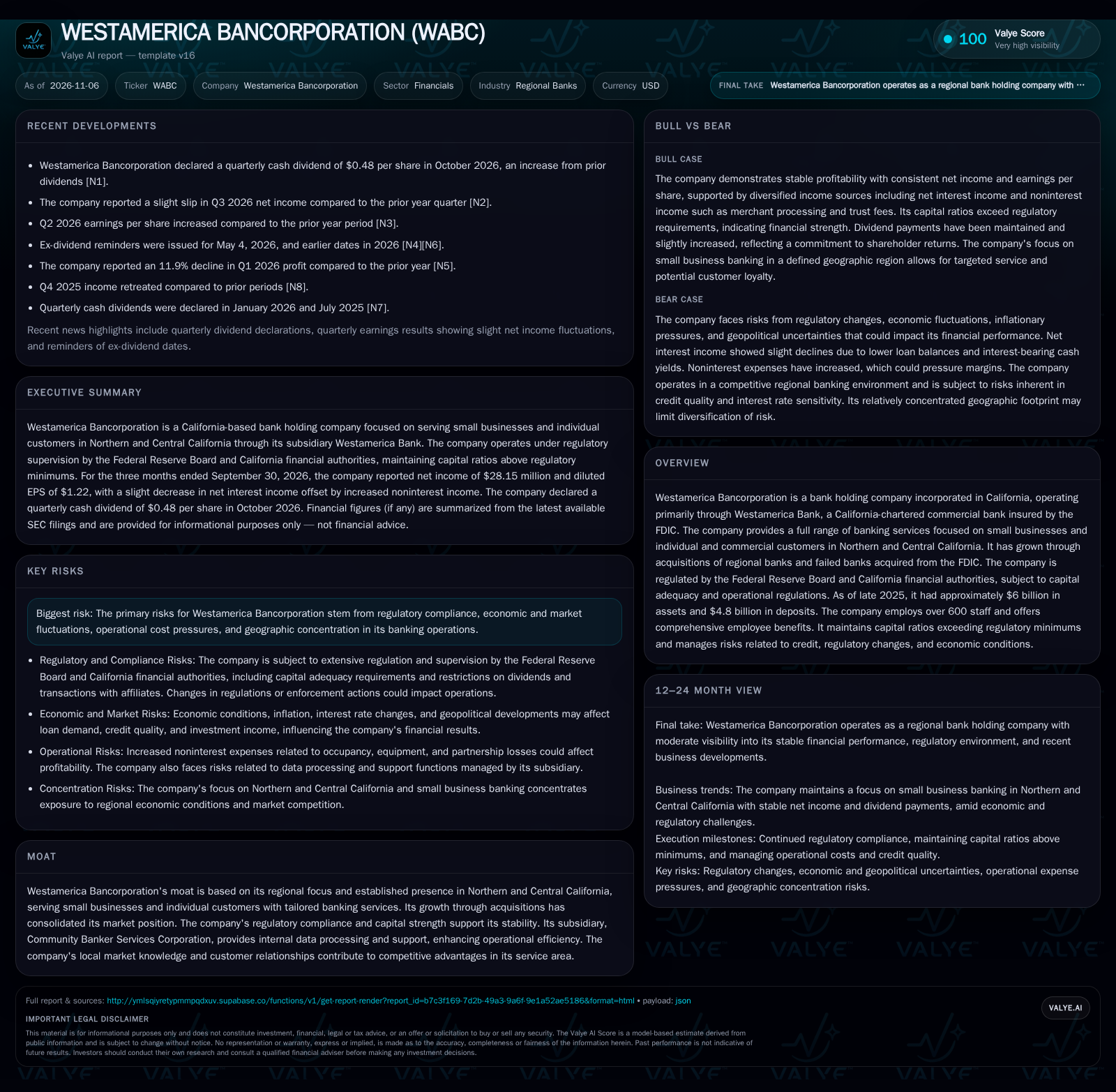
For the third quarter of 2026, Westamerica Bancorporation reported net income of $28.15 million, a slight decrease from $28.26 million in Q3 2025, while diluted EPS increased to $1.22 from $1.12. This subtle shift underscores continued but pressured profitability, as modest growth in per-share earnings was offset by absolute profit contraction [S2]. The company’s net interest and loan fee income slipped due to lower average loan balances and reduced yields on interest-bearing cash, though this was partially offset by higher balances and yields in investment securities [S2]. Noninterest income rose, led by merchant processing, trust fees, and service charges, but was counterbalanced by increased noninterest expenses, particularly in occupancy, equipment, and limited partnership losses [S2].
The cited source reports dividend-related activity; that disclosure alone does not establish dividend-policy continuity, management confidence, or a material constraint on capital flexibility. [N1] Capital ratios remain robust, with a total risk-based capital ratio of 24.29% and tangible equity to tangible assets of 11.78% at September 30, 2026, well above regulatory requirements [S2]. These facts signal a bank that is well-capitalized and intent on maintaining investor confidence, even as margin headwinds and cost inflation persist.
How Westamerica’s Revenue Mix and Cost Structure Shape Earnings Trajectory
Westamerica Bancorporation’s core earnings engine is its net interest income, derived from the spread between interest earned on loans/securities and interest paid on deposits and borrowings. With the recent reduction in average loan balances and lower yields on interest-bearing cash, the company’s net interest income has shown vulnerability to both asset mix and prevailing rate cycles [S2]. Rising investment securities balances and yields have provided a partial offset, but the fundamental question is whether securities income can sustainably replace lost loan yield, especially in a low-credit-growth environment.
Noninterest income, while growing—thanks to merchant processing, trust fees, and service charges—remains a secondary but increasingly important contributor, offering a buffer against net interest margin compression [S2]. However, the rise in noninterest expenses, particularly from occupancy, equipment, and partnership losses, introduces cost drag that may erode operating leverage. Like most regional banks, Westamerica’s fixed-cost base (branches, technology, compliance) is substantial relative to its scale, making cost management a critical determinant of future profitability.
The bank’s robust capital ratios provide regulatory headroom and optionality, but with limited geographic diversification and a focus on relationship-based lending, capital deployment opportunities may be constrained by local economic dynamics. This also means that organic growth and efficiency improvements—rather than aggressive expansion—are likely to be the principal levers for earnings growth.
Local Focus, Intensifying Competition, and the Threat from Nonbank Lenders
Westamerica’s competitive moat historically has rested on its entrenched presence in Northern and Central California, deep relationships with small business and retail customers, and a reputation for tailored service. However, the competitive landscape is shifting: traditional banks, credit unions, and national banking franchises all vie for the same deposit and lending relationships, often leveraging greater scale and more sophisticated digital offerings.
Nonbank and fintech lenders are a rising force, offering online and mobile-first experiences, rapid underwriting, and sometimes more favorable loan terms. These players often operate with lighter regulatory burdens and can outspend smaller regional rivals on technology and marketing. While Westamerica’s core customer base may value local knowledge and branch access, the risk is that younger or more digitally oriented clients migrate to competitors with superior digital platforms or more attractive rates.
Furthermore, the regulatory environment—while a barrier to entry for some—also constrains Westamerica’s flexibility relative to less-regulated fintechs. The bank’s ability to preserve its margin and relevance will depend on its capacity to defend its relationship-driven model while selectively modernizing its service offering and controlling costs.
Profitability Could Rebound if Loan Growth and Fee Income Outpace Cost Inflation
A favorable scenario for Westamerica would be a return to loan book growth as regional economic activity strengthens, particularly among small businesses and consumer borrowers. If the bank can expand lending without materially loosening credit standards, higher average loan balances and improved asset yields could restore net interest income to a growth trajectory.
Further, if noninterest income (especially from merchant processing and trust services) continues to grow faster than noninterest expense, the bank could achieve positive operating leverage. This would likely require disciplined cost management, technological upgrades that improve efficiency, and potentially modest branch rationalization to offset fixed costs.
Confirmation of this scenario would come from sequential increases in loan balances, net interest margin stabilization or expansion, and a continued rise in noninterest income outpacing expense growth. A reversal of recent deposit outflows or successful cross-selling of fee-based services would also validate the upside thesis.
Earnings Stability Hinges on Cost Discipline and Defense of Core Relationships
The most plausible path forward is a continuation of current trends: modest net income fluctuations, stable but pressured margins, and incremental dividend growth. In this scenario, loan balances may remain flat or decline slightly as competitive intensity and regional economic constraints persist. Net interest margins could stay compressed, but noninterest income growth and careful expense management would help cushion the impact on overall profitability.
This scenario would be confirmed by relatively stable quarterly EPS, manageable expense increases, and capital ratios consistently above regulatory minimums.
Prolonged Margin Compression or Regional Downturn Could Threaten Earnings Resilience
A more adverse scenario would see loan growth stagnate or reverse more sharply, with competitive pricing and customer attrition further squeezing net interest margins. Rising noninterest expenses—whether from inflation, technology investments, or compliance costs—could outpace any gains in noninterest income, leading to sustained earnings erosion.
Should the Northern and Central California economy experience a significant downturn—through recession, regulatory shocks, or environmental events—credit quality could deteriorate, leading to higher provisions for loan losses and further pressure on profitability. In this scenario, even robust capital ratios could come under stress if losses mount.
This outcome would be confirmed by sequential declines in net income, shrinking loan balances, rising charge-offs or provisions, and a deteriorating efficiency ratio. Dividend growth could stall or reverse if profitability weakens materially.
What Could Shift the Westamerica Bancorporation Thesis in the Next Year
Quarterly trends in average loan balances and loan growth—especially commercial and small business lending—would help test whether the bank can regain net interest income momentum.
Net interest margin (NIM) trends, if disclosed, would reveal the bank’s ability to defend spreads in a competitive and potentially lower-rate environment.
Noninterest income growth from merchant processing, trust fees, and service charges—relative to noninterest expense growth—will signal whether operating leverage can improve.
Efficiency ratio changes, if disclosed, would clarify whether cost inflation is outpacing revenue growth or if expense discipline is sufficient to protect margins.
Deposit inflow/outflow trends and changes in deposit mix would indicate customer loyalty and sensitivity to rate competition.
Credit quality metrics (e.g., nonperforming assets, charge-offs, provision levels), if disclosed, will be vital if regional economic conditions deteriorate.
Capital ratios and dividend declarations should be monitored for signs of stress or management shifting capital allocation in response to profit pressures.
Progress on digital banking capabilities, branch rationalization, or cost-saving initiatives—if reported—would provide insight into management’s strategy for defending relevance and efficiency.
Disclaimer: This is research-only, informational analysis and not investment advice. It may include AI-generated interpretation and general industry context. Always verify important details using primary sources.

Comments