
Gentex: Stable Profitability Anchors Upside, but Competitive and Innovation Gaps Shape the Next Phase
Gentex posts steady earnings and maintains reported liquidity position, but the absence of explicit disclosures on product innovation or clear competitive moats leaves questions about the sustainability of its growth trajectory in an evolving auto supply landscape.
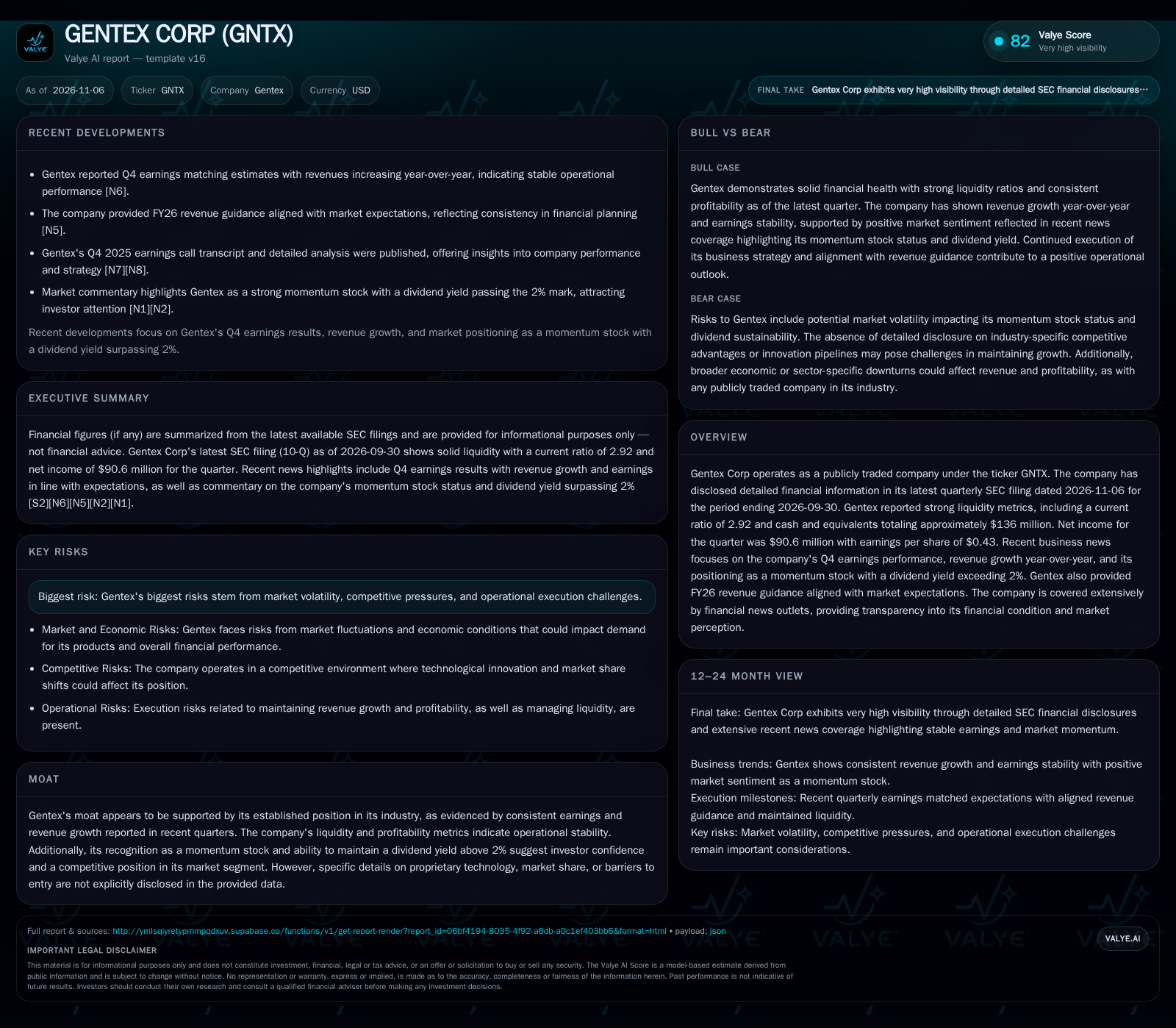
Gentex reported $90.6 million in net income and a current ratio of 2.92 as of September 2026, reflecting continued profitability and balance-sheet strength. Revenue increased year-over-year and earnings matched market expectations, but the company has not disclosed specific details on technological differentiation or innovation pipelines. The next phase for Gentex will likely hinge on its ability to defend its position amid intensifying competition and industry transformation. [S2] [N6]
Gentex Corp’s latest quarterly report underscores a business with reliable earnings and a robust current ratio, marking it as a stable performer in the automotive supply chain. However, while recent financials and news coverage emphasize operational steadiness and momentum, the lack of explicit detail around innovation, competitive moats, or proprietary technology raises questions about the durability of Gentex’s edge as industry dynamics shift. The company’s performance over the next several years will likely be shaped less by balance-sheet strength than by its response to sector-wide pressures around product differentiation, technological change, and evolving customer requirements.
Gentex’s Recent Financial Results Highlight Operational Consistency
As of September 30, 2026, Gentex reported $90.6 million in net income for the quarter, with basic and diluted earnings per share of $0.43. The company’s current assets stood at approximately $1.18 billion against $404.4 million in current liabilities, yielding a current ratio of 2.92 and a cash ratio of 0.36. Year-over-year revenue growth was noted, and earnings matched consensus estimates for the quarter. These results point to ongoing operational stability and financial health, positioning Gentex as a consistent performer within its sector. However, the available disclosures focus more on aggregate financial performance than on underlying product, customer, or innovation details. [S2] [N6]
How Gentex’s Revenue Model and Cost Structure Shape Its Economic Profile
Gentex’s business model, as inferred from its historical pattern and typical sector practices, likely revolves around the design, manufacture, and sale of advanced automotive components—such as auto-dimming mirrors, electronic vision systems, and related technologies. Revenue is presumably driven by supply agreements with OEMs (original equipment manufacturers) and possibly Tier 1 suppliers, with volume and pricing determined by the adoption rate of these technologies in new vehicle platforms.
Automotive suppliers like Gentex tend to operate with significant fixed costs (R&D, plant, and tooling) but can achieve strong operating leverage as production volumes scale. Margins are typically pressured by pricing negotiations with automakers, but can be supported by proprietary technology, premium features, or integration into high-value vehicle programs. The absence of explicit disclosures on Gentex’s innovation pipeline, proprietary product attributes, or customer lock-in mechanisms means it is unclear whether the company enjoys premium pricing or must compete primarily on cost and reliability.
The company reported cash and liquidity metrics for the period; these figures do not by themselves establish operating runway, investment capacity, financial flexibility, or financing capacity. However, for durable value creation, sustaining or expanding margins will likely depend on defending product relevance and negotiating favorable contract terms in a cyclical, cost-sensitive supply chain. [S2]
Defending Market Share as Automotive Technology Shifts
While Gentex’s financials reflect stability, the company’s competitive position faces several crosscurrents. The automotive supplier landscape is characterized by intense competition, rapid technology adoption, and periodic shifts in OEM sourcing strategies. Peer categories include electronics suppliers, mirror and vision-system producers, and a broader set of sensor and connectivity technology firms.
Without explicit disclosures on proprietary technologies, patents, or unique integration capabilities, it is difficult to assert a durable moat for Gentex. The company’s established relationships with OEMs and history of consistent delivery may provide some switching friction, but this can erode if competitors offer superior or lower-cost solutions. Additionally, the accelerating pace of innovation in automotive electronics—driven by ADAS (advanced driver assistance systems), connectivity, and electrification—raises the bar for incumbents to maintain product relevance.
If Gentex can demonstrate meaningful product differentiation, long-term supply agreements, or embedded software capabilities, its position will be stronger. In the absence of these, the risk is that value migrates to more technologically advanced or integrated suppliers over time.
Technological Differentiation Unlocks Margin Expansion
The most favorable outcome for Gentex involves successfully innovating in core product lines—such as integrating advanced sensors, displays, or software into its automotive components—and securing long-term supply agreements with major OEMs. This could enable pricing power, margin expansion, and high visibility on future revenue streams.
Evidence that would confirm this scenario includes disclosures of patented technologies, announcements of multi-year supply contracts for next-generation vehicle platforms, or material increases in R&D spending tied to new product launches. If Gentex can demonstrate that its solutions are mission-critical for OEMs’ safety, connectivity, or ADAS strategies, barriers to entry rise and competitive threats diminish.
Conversely, a lack of new product wins, stagnant R&D, or loss of share in key vehicle programs would falsify this upside and suggest commoditization risk.
Mature Supplier Navigates Incremental Gains in a Competitive Market
The most plausible trajectory is that Gentex continues to deliver stable profitability, with revenue and margin performance closely tied to overall vehicle production volumes and incremental feature adoption. The company may benefit from modest growth if it can maintain existing customer relationships and participate in new vehicle launches, but is unlikely to substantially outpace the broader industry without clear innovation leadership.
Confirmation of this scenario would be continued earnings and revenue in line with market expectations, steady or slightly improving margins, and no major customer losses or contract disruptions. Falsification would come from abrupt margin compression, revenue declines outpacing industry trends, or disclosures of lost contracts to technologically superior competitors.
Erosion of Product Relevance and Margin Compression as Industry Evolves
The adverse scenario for Gentex centers on the risk that its core products become commoditized or displaced by new technologies (e.g., camera-based systems replacing traditional mirrors, or integrated electronics platforms reducing the value of standalone components). In this case, Gentex could face price pressure, margin erosion, and potential loss of key customer contracts.
Evidence supporting this scenario would include a decline in win rates for new vehicle platforms, shrinking gross margins, or explicit disclosures of competitive displacement. Broader industry shifts—such as OEMs vertically integrating critical components or pivoting to new suppliers with more advanced ADAS features—could also accelerate this downside. Conversely, resilience in core product lines and stable gross margins would falsify a severe downside outcome.
What Will Determine Gentex’s Strategic Trajectory in the Next Phase?
Disclosures of major new supply agreements with global automakers, especially for next-generation or electric vehicle programs, would help test Gentex’s customer relevance.
If disclosed, the proportion of revenue or orders derived from new product lines (e.g., advanced sensors, displays, or ADAS-related components) would clarify innovation momentum.
R&D spending trends—absolute dollar amounts and percentage of sales—would provide insight into Gentex’s commitment to technology leadership.
Gross and operating margin trajectories, especially relative to sector peers, would signal pricing power and cost discipline.
Announcements of lost or won contracts for key vehicle platforms would illuminate competitive dynamics.
Any disclosures of proprietary technology, patents, or unique integration capabilities would help assess the company’s moat.
Updates on capital allocation—such as share repurchases, dividends, or M&A—would clarify management’s confidence in organic versus inorganic growth opportunities.
Broader industry adoption rates of mirrorless, camera-based, or smart-cabin technologies could indicate the pace of structural change and potential threats to Gentex’s core business.
Disclaimer: This is research-only, informational analysis and not investment advice. It may include AI-generated interpretation and general industry context. Always verify important details using primary sources.

Comments