
First Community Bankshares: Acquisition-Driven Expansion Tests the Durability of the Community Banking Model
With two major acquisitions in 2026 and record earnings, First Community Bankshares is scaling its regional footprint and testing the economics of community banking at a larger scale. The challenge: integrating new franchises and maintaining the relationship-driven model amid intensifying competition and regulatory complexity.
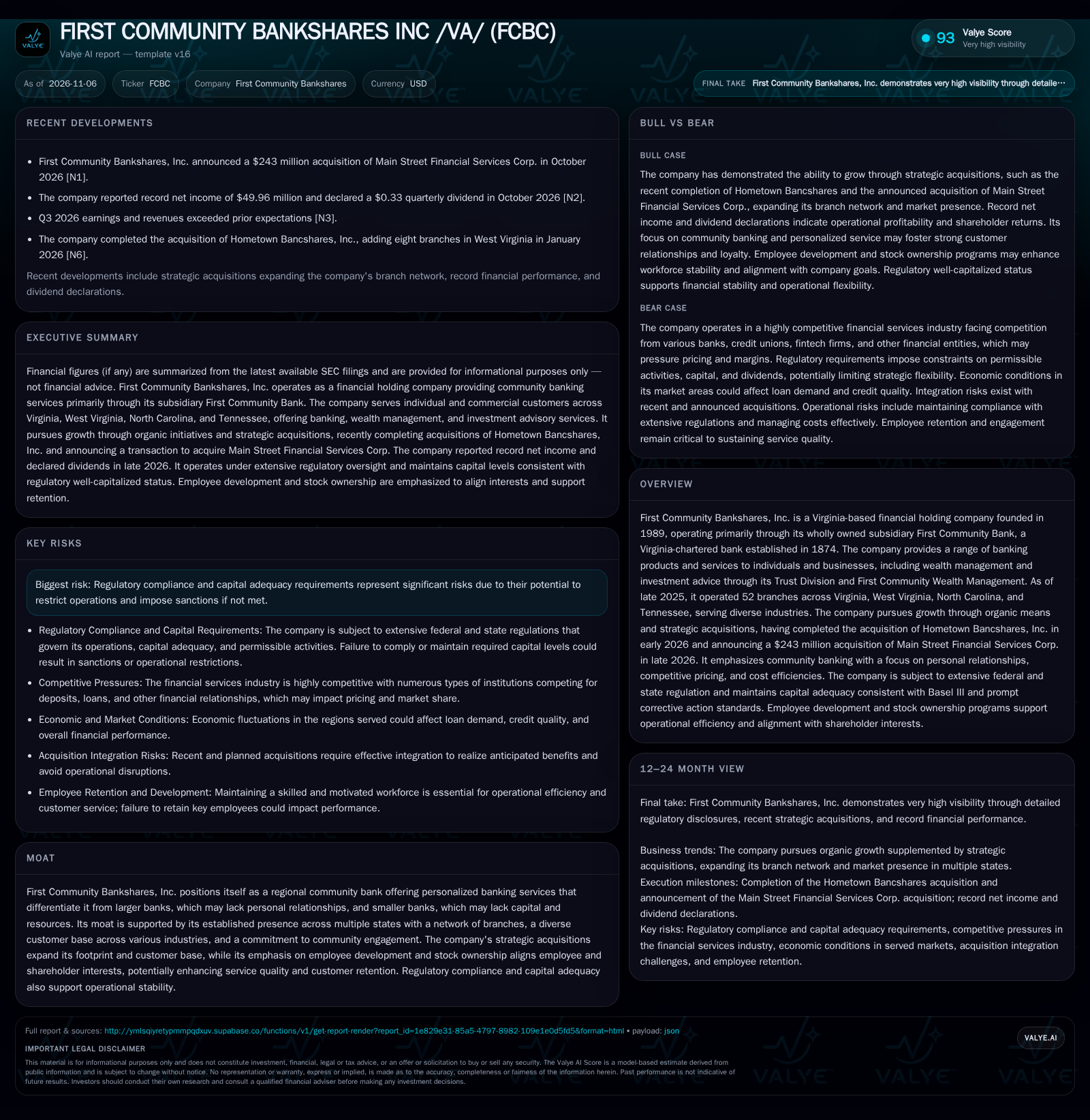
First Community Bankshares completed the acquisition of Hometown Bancshares in January 2026 and announced a $243 million deal for Main Street Financial Services in October, bringing its branch count to 60 across four states. Q3 2026 net income reached a record $49.96 million, with earnings exceeding expectations. These moves mark an aggressive expansion, but the company faces integration risk, regulatory scrutiny, and increasing competition from both traditional and digital financial institutions. The test is whether its community-banking model can scale profitably without eroding its core strengths. [N1] [N2] [N3] [N6]
First Community Bankshares is in the midst of a pivotal transformation. The company’s rapid expansion through two significant acquisitions in 2026—adding substantial branch presence and customer relationships—has propelled it to record earnings and a much larger regional footprint. But as it absorbs these new franchises and faces heightened competition from both established banks and digital challengers, the question is whether its community-banking DNA and operational discipline can scale without sacrificing profitability or customer loyalty. The next phase will test the limits and advantages of local relationship banking in an industry shaped by consolidation, technology, and regulatory scrutiny.
Recent Acquisitions and Record Earnings Drive Strategic Inflection
First Community Bankshares completed its acquisition of Hometown Bancshares in January 2026, expanding its branch network by eight locations in West Virginia and bringing the total to 60 branches across four states. This was quickly followed by the October 2026 announcement of a $243 million acquisition of Main Street Financial Services Corp., further increasing its reach and consolidating its status as a leading community bank in its region. Alongside these moves, the company reported record net income of $49.96 million in Q3 2026 and quarterly earnings that surpassed expectations. These developments collectively signal a deliberate push for scale and earnings growth, while also introducing integration complexity and additional regulatory oversight. [N1] [N2] [N3] [N6]
How Scale and Integration Shape Community Banking Economics
First Community Bankshares generates revenue primarily through interest income on loans and securities, supplemented by non-interest income from fees, wealth management, and trust services. The company’s expansion strategy—anchored in acquiring complementary banks—aims to drive volume growth in both lending and deposits, with the potential for cost synergies as overlapping functions are rationalized. With 60 branches, fixed costs for physical infrastructure and compliance remain significant, but greater scale may allow for incremental operating leverage if integration is effective.
The economics of community banking hinge on maintaining local deposit franchises, prudent underwriting, and relationship-driven pricing, which can support stable net interest margins. However, as the bank grows through acquisition, it must manage credit quality across a more diverse loan portfolio, and the cost of integration (technology, compliance, talent retention) can erode near-term profitability if not tightly controlled. Recent regulatory changes to CECL accounting for acquired loans may provide some earnings smoothing, but the underlying credit performance of new portfolios will be critical. The announced $243 million Main Street deal also represents a sizable capital deployment, and the company’s ability to maintain its well-capitalized status will depend on both earnings retention and effective risk management. [S1] [N1]
Community Focus Versus Scale: Navigating a Crowded Landscape
First Community Bankshares positions itself as a relationship-driven community bank, leveraging local knowledge and personal service to differentiate from larger national banks and digital-first competitors. Its geographic concentration across Virginia, West Virginia, North Carolina, and Tennessee allows for tailored product offerings and deeper customer engagement, particularly among small businesses and local industries. The recent acquisitions further consolidate its share in key regional markets.
However, the competitive landscape is intensifying. Larger banks can offer broader digital platforms, more sophisticated products, and aggressive pricing, while fintech entrants target high-margin segments such as payments and small business lending with lower overhead and faster onboarding. Credit unions and other regional banks provide additional pressure, often with tax or regulatory advantages. The challenge for First Community is to maintain its service edge and pricing discipline while scaling, without losing the attributes that underpin customer loyalty. Integration risk—cultural, operational, and technological—could open vulnerabilities if service quality declines or cost synergies fail to materialize. [S1]
If Integration Delivers: Margin Expansion and Regional Dominance
The favorable scenario for First Community Bankshares is one in which the integration of Hometown Bancshares and Main Street Financial Services is executed seamlessly. In this outcome, the company retains key staff, realizes cost synergies through overlapping branch consolidation and back-office efficiency, and leverages its expanded footprint to deepen relationships with business and retail customers. Cross-selling of wealth management and trust services to a larger client base could lift non-interest income, while enhanced scale supports stronger procurement and technology investments.
Evidence that would confirm this scenario includes sustained or improved net interest margin, stable or declining efficiency ratio, organic deposit growth in newly acquired markets, and continued outperformance of earnings relative to peer community banks. A low level of post-acquisition nonperforming assets and minimal customer attrition would further support the upside case. If the company can also demonstrate successful digital adoption without eroding its relationship model, the path to regional leadership and premium valuation becomes plausible.
Maintaining Growth While Managing Integration and Competitive Pressures
The most plausible near-term outcome is that First Community Bankshares achieves moderate earnings growth and efficiency gains from its recent acquisitions, but faces intermittent challenges integrating new branches and harmonizing cultures. Margins may remain steady, helped by disciplined underwriting and stable funding costs, but cost savings are partially offset by higher compliance and technology expenses.
In this scenario, the company retains its well-capitalized regulatory status and maintains dividend payments, but does not break out of the pack in terms of revenue growth or profitability relative to similarly sized peers. Evidence for this middle path would include stable nonperforming asset ratios, incremental improvements in core operating metrics, and a lack of significant negative surprises in loan quality or customer retention. Failure to accelerate fee income or realize substantial cost synergies would be a confirming sign that scale is not delivering transformative economics, but also not causing acute disruption.
Integration Missteps or Credit Deterioration Could Derail Momentum
The primary risk is that the rapid pace of acquisitions overwhelms management capacity, leading to integration missteps, operational inefficiencies, or customer attrition. Cultural clashes, technology incompatibilities, or loss of key personnel could erode service quality and disrupt the local relationship model. If economic conditions deteriorate in the bank’s core markets, credit losses could rise, especially in newly acquired loan portfolios where underwriting standards or borrower profiles may differ from legacy practices.
Further downside could materialize if regulatory scrutiny increases post-acquisition, resulting in higher compliance costs or constraints on growth and capital allocation. Early signs of this scenario would include a spike in nonperforming loans, rising efficiency ratio, negative operating leverage, or a cut in the dividend. A failure to maintain well-capitalized status, or a material decline in customer deposits, would further confirm that the expansion strategy is backfiring.
What Will Determine If Scale Enhances or Erodes the Community Banking Edge?
Organic deposit growth rates in the newly acquired branches would help test whether the bank is able to retain and expand customer relationships post-integration.
Trends in nonperforming loans and net charge-offs, especially in acquired portfolios, will be critical for assessing credit risk and integration quality.
Efficiency ratio movement (if disclosed) would indicate whether operating leverage and cost synergies are being realized.
Net interest margin stability or improvement would suggest the company is maintaining pricing discipline amid competition and integration.
Fee and non-interest income growth, particularly from wealth management and trust services, could confirm successful cross-selling and diversification.
Employee turnover rates and retention of key personnel in acquired branches (if disclosed) would be a leading indicator of cultural integration and service continuity.
Regulatory capital ratios should be monitored for any sign that acquisitions are straining balance sheet resilience or attracting increased scrutiny.
Customer satisfaction or net promoter scores (if disclosed) in legacy and acquired markets would help test whether the relationship model is scaling effectively.
Disclaimer: This is research-only, informational analysis and not investment advice. It may include AI-generated interpretation and general industry context. Always verify important details using primary sources.

Comments