
nLIGHT’s High-Power Laser Ambitions: Innovation, Defense Demand, and the Profitability Equation
nLIGHT’s technology leadership in high-brilliance lasers and fiber-based directed energy positions it at the forefront of mission-critical defense and industrial transformation. However, customer concentration, export controls, and persistent losses raise questions about the company’s ability to convert technical momentum into durable economic returns.
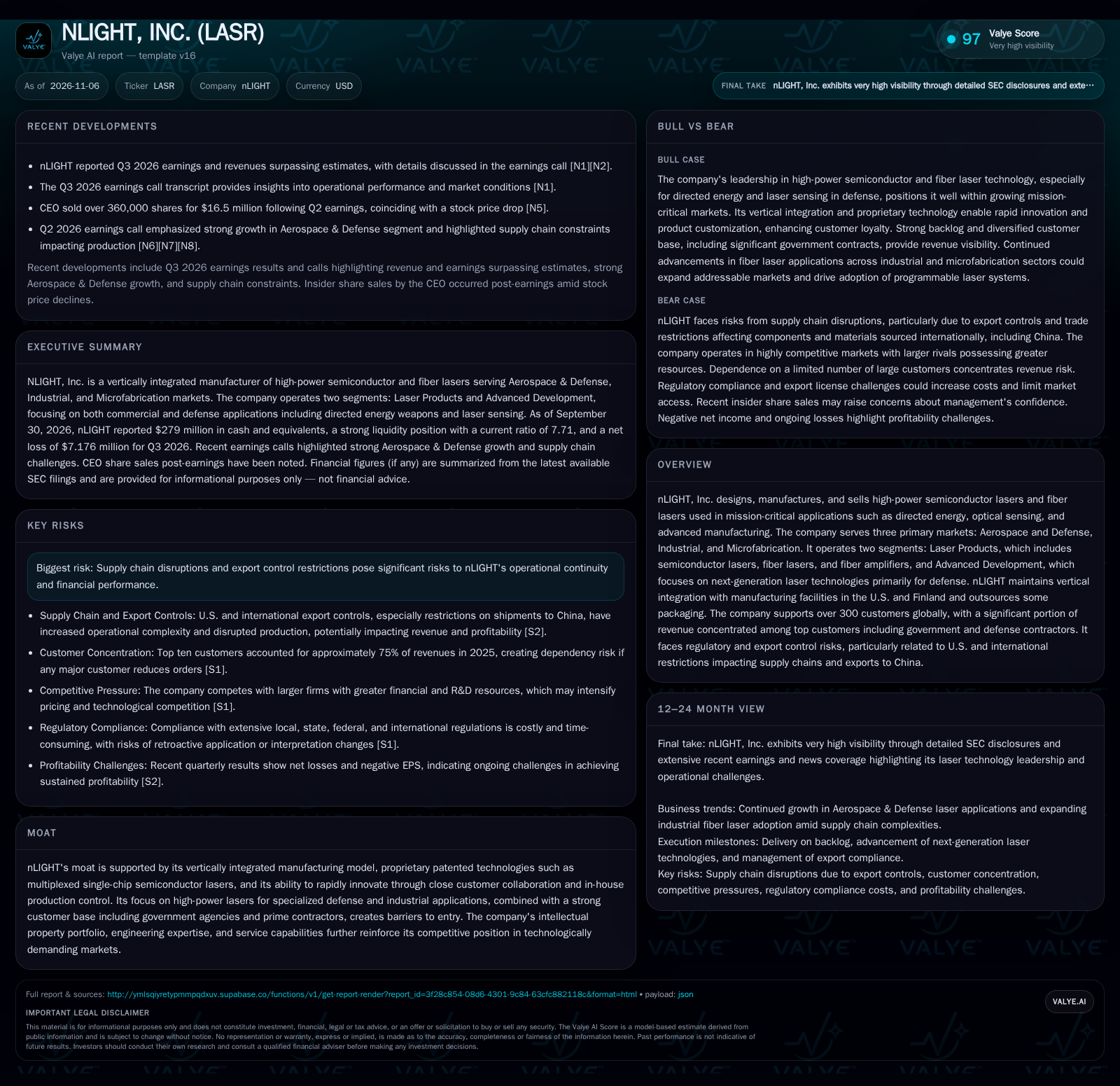
nLIGHT has delivered above-estimate Q3 2026 results with strong momentum in Aerospace & Defense lasers, but remains unprofitable and faces operational headwinds from supply chain constraints and regulatory challenges. [S1] [S2] [N1] [N2]
nLIGHT, Inc. is a vertically integrated innovator in high-power semiconductor and fiber lasers, targeting defense, microfabrication, and industrial markets. Its core strength lies in advanced laser architectures and programmable fiber systems, which have recently driven above-expectation results in the Aerospace & Defense sector. Yet, the company’s financial picture remains mixed: a significant revenue backlog and liquidity are offset by persistent losses, high customer concentration, and growing exposure to regulatory and supply chain disruptions. The coming quarters will test nLIGHT’s ability to translate technology and contract wins into sustainable profitability and market share gains.
Recent Results Signal Defense Momentum, but Profitability and Concentration Risks Linger
nLIGHT’s Q3 2026 earnings and revenue both exceeded consensus estimates, with management attributing outperformance largely to continued strength in the Aerospace & Defense segment. This segment benefits from growing deployment of directed energy and sensing solutions in defense applications, where nLIGHT’s high-power fiber lasers are increasingly favored for their precision and low operating costs. [N1] [N2]
As of December 2025, the company reported a $161.6 million backlog expected to be filled within 24 months, and $184.4 million in unfunded government contracts, providing a measure of short- to medium-term revenue visibility. [S1]
Despite a robust backlog and liquidity position—$279.4 million in cash and a current ratio of 7.71 as of September 2026—nLIGHT posted a Q3 2026 net loss of $7.176 million (EPS -$0.12), continuing a trend of negative earnings. [S2]
Customer concentration remains acute: the top ten customers, many of which are defense-related, accounted for roughly 75% of 2025 revenues, heightening the risk if any major account curtails orders. [S1]
How nLIGHT’s Vertically Integrated Model Shapes the Economics of Defense and Industrial Lasers
nLIGHT’s business model is anchored in the design, manufacture, and sale of high-power semiconductor and fiber lasers, targeting mission-critical applications where performance, customization, and reliability command premium pricing. The company’s vertical integration—from gallium arsenide wafer growth through laser packaging—enables rapid design cycles and tight quality control, which are critical in defense and advanced manufacturing markets.
Revenue is split between Laser Products (semiconductor/fiber lasers, amplifiers) and Advanced Development (R&D and prototyping for government/defense), with the former driving the bulk of sales and the latter supporting future product pipelines. The programmable and serviceable nature of nLIGHT’s fiber lasers allows for value-added features such as tunable beam profiles and high-speed modulation, which can support higher average selling prices (ASPs) in defense and precision industrial use cases.
Fixed costs are relatively high due to capital-intensive manufacturing and R&D, but the model offers potential operating leverage if sales volumes scale. However, the company’s persistent net losses suggest that current volumes and margins are insufficient to absorb overhead—likely exacerbated by episodic demand and customer concentration.
Capital needs are significant in both maintaining manufacturing capabilities and funding ongoing R&D, especially as nLIGHT seeks to stay ahead in a rapidly evolving field. The company reported cash and liquidity metrics for the period; these figures do not by themselves establish operating runway, investment capacity, financial flexibility, or financing capacity.
Technology Leadership Meets Intensifying Competition and Regulatory Headwinds
nLIGHT’s competitive edge is built on patented multiplexed single-chip architectures, deep vertical integration, and a track record of innovation in high-brilliance fiber lasers. These strengths matter most in defense and advanced industrial applications where performance, reliability, and customization are valued over commodity pricing.
However, the competitive landscape is formidable: nLIGHT faces rivals ranging from diversified industrial laser giants to defense-focused photonics specialists, many of whom possess greater scale, R&D budgets, or established government relationships. In the industrial segment, competition is particularly fierce, with price and service often trumping technical differentiation.
Switching costs for defense primes and industrial OEMs can be high due to the integration of lasers into complex systems and qualification requirements, but this also means that sales cycles are long and customer wins are lumpy. nLIGHT’s over-reliance on a handful of large customers, while indicative of deep relationships, exposes it to significant revenue swings if procurement priorities or supplier preferences shift.
Export controls and regulatory scrutiny—especially regarding shipments to China—have become more acute, constraining addressable markets and complicating supply chain management. The ability to navigate these restrictions while sustaining innovation and customer service is an increasingly important dimension of competitive advantage.
If Defense Modernization and Industrial Adoption Accelerate, Margin Expansion Could Follow
The most favorable scenario for nLIGHT is a sustained ramp-up in defense spending on directed energy and laser-enabled sensing, combined with accelerating adoption of fiber lasers in industrial and microfabrication settings. In this case, the company’s backlog would convert to revenue at higher-than-expected rates, and new contract wins—especially multi-year government awards—would provide incremental visibility and pricing leverage.
Rapid execution on existing backlog, successful qualification on next-generation defense programs, and expansion of programmable fiber laser adoption in automotive, electronics, and semiconductor manufacturing would drive top-line growth. If nLIGHT can leverage its vertically integrated platform to improve manufacturing yields and scale volumes, gross margins could expand, narrowing or reversing current losses.
Confirmation of this scenario would come from sequential backlog growth, new multi-year contract disclosures, rising gross margins, and a pivot to positive net income. Additional government funding for directed energy initiatives, publicized production ramp-ups, or visible wins in additive manufacturing would further validate the upside.
Falsification would occur if defense procurement were delayed, industrial adoption stalled, or if pricing pressure in core segments forced margin contraction despite higher volumes.
Operational Progress Offset by Ongoing Losses and Regulatory Tangles
The most plausible near-term outcome is a continuation of current trends: nLIGHT executes on its backlog, sees incremental growth in defense and selective industrial markets, but struggles to achieve break-even profitability. Revenue visibility is supported by government contracts and ongoing demand for high-performance lasers, yet customer concentration and episodic order flow create volatility.
Margins remain under pressure from supply chain costs, regulatory compliance, and the need to invest in R&D to keep pace with evolving defense requirements and industrial standards. Export controls and supply chain disruptions persist, especially regarding China, but are managed through mitigation strategies such as alternative sourcing and closer customer coordination.
The Advanced Development segment continues to deliver prototypes and R&D contracts, but these are not yet large enough to drive meaningful profitability. Industrial adoption grows, but at a pace that only partially offsets cyclical swings in defense procurement.
Evidence for this scenario would include steady (but not accelerating) revenue growth, continued net losses but with narrowing EBITDA margins, and a stable or slightly growing backlog. Falsification would require either a sharp acceleration into profitability or a significant deterioration in order flow or margin structure.
Supply Chain Shocks, Contract Delays, or Major Customer Losses Could Deepen Losses
In a negative scenario, nLIGHT faces compounding headwinds: key government contracts are delayed or canceled, export control regimes tighten further, and critical supply chain components become scarce or more expensive. If a top customer significantly reduces or terminates orders—given the 75% revenue concentration—the impact on revenue and manufacturing utilization would be severe.
Margins could compress further if nLIGHT is forced to absorb higher input costs or cut prices to retain share in increasingly commoditized industrial segments. Regulatory compliance costs could escalate, or new restrictions could block access to important international markets, especially China.
Talent retention and morale could suffer if the company fails to secure key wins or if management sentiment is perceived as negative—amplified by high-profile insider share sales.
This scenario would be confirmed by shrinking backlog, sequential declines in revenue, widening net losses, or public disclosure of major order cancellations or regulatory setbacks.
Concrete Developments That Will Define nLIGHT’s Trajectory
The pace and size of new defense contract awards, including any multi-year commitments or next-generation program wins, would help test the durability of the company’s revenue base.
Sequential changes in the backlog—especially if disclosed by segment or end-market—would provide early signals of demand momentum or attrition.
Gross margin trends, particularly in the Laser Products segment, would indicate whether manufacturing scale and pricing power are improving.
Disclosure of new industrial customer wins, especially in additive manufacturing or semiconductor microfabrication, would evidence penetration into higher-growth commercial markets.
The magnitude and rationale of any further insider share sales, if disclosed, could signal management’s confidence in long-term prospects.
Updates on export control regimes, supply chain resilience, and alternative sourcing strategies would shed light on operational risk management.
If disclosed, customer retention rates or the renewal cadence of large contracts would clarify the degree of recurring revenue and switching frictions.
Capital allocation choices—such as the scale and focus of R&D investment or any announced share repurchases or dilutive financings—would reveal management’s posture toward growth versus financial discipline.
Disclaimer: This is research-only, informational analysis and not investment advice. It may include AI-generated interpretation and general industry context. Always verify important details using primary sources.

Comments