
MasterBrand’s Profitability Dilemma: Leadership Flux, Cyber Governance, and the Quest for Margin Expansion
Despite generating over $1 billion in quarterly revenue, MasterBrand, Inc. finds itself at a turning point: recent losses, a high-profile CFO transition, and insider buying amid volatility signal both risk and resolve. The company’s robust cybersecurity governance and liquidity cushion provide operational ballast, but sustainable profitability and strategic clarity remain the key questions as management navigates industry headwinds.
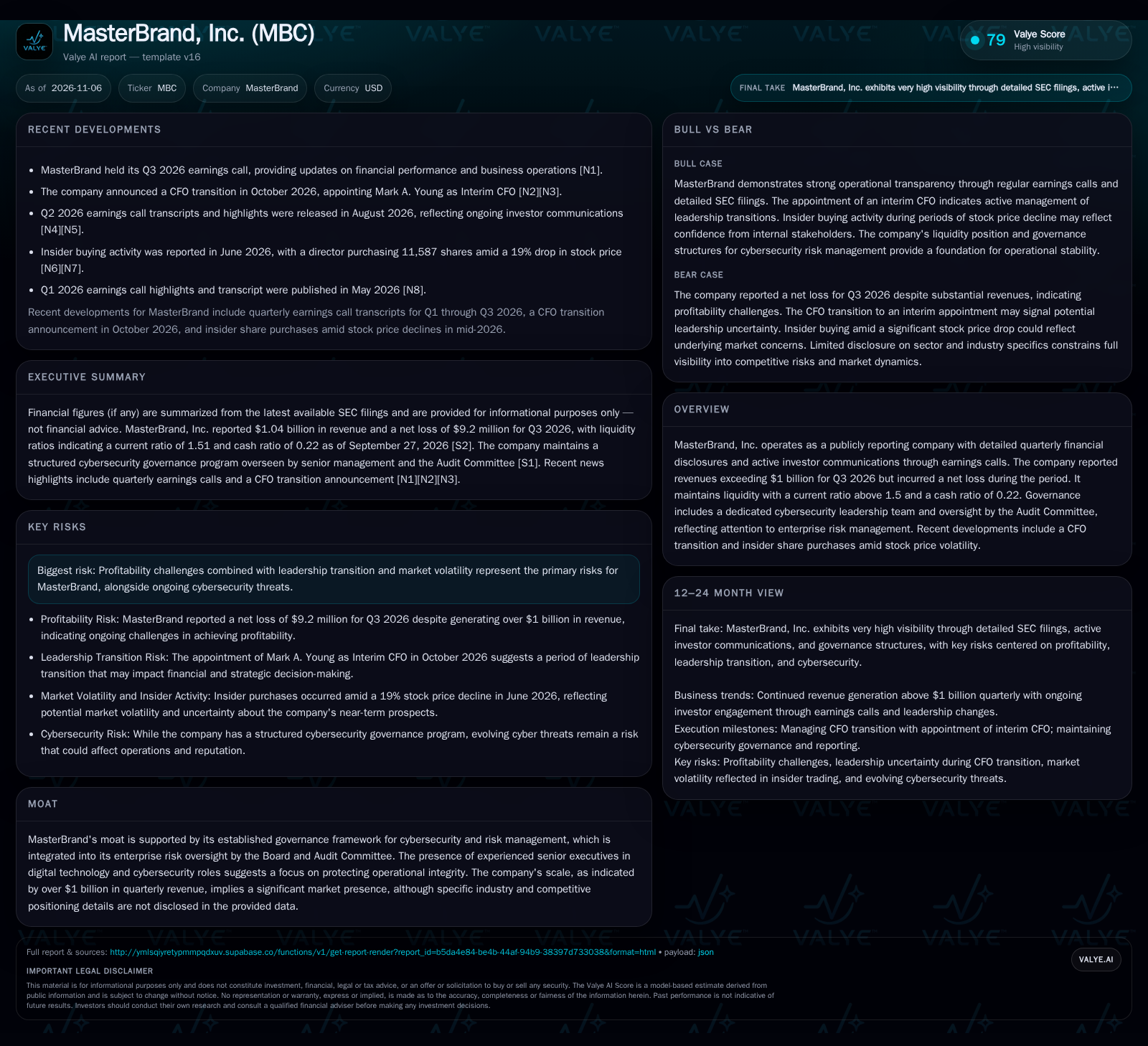
MasterBrand, Inc. reported $1.04 billion in Q3 2026 revenue but posted a net loss and faces a critical leadership transition with the appointment of an interim CFO. Liquidity metrics show a current ratio of 1.51 and cash ratio of 0.22. Insider share purchases during a steep stock drop and a mature cybersecurity governance framework reflect both internal confidence and operational discipline, but persistent profitability challenges and market uncertainty cloud the outlook. Margin restoration and leadership stability are essential for the next phase.
MasterBrand, Inc. stands at a crossroads after reporting over $1 billion in Q3 2026 revenue yet slipping into a net loss for the period. The recent CFO transition and insider buying amid a sharp stock drop highlight both internal volatility and possible confidence in the company’s long-term prospects. The coming quarters will test whether management can restore margins and stabilize leadership to capitalize on the company’s established market presence.
Recent Losses, Leadership Change, and Insider Buying: Setting the Stage
MasterBrand, Inc. reported $1.04 billion in revenue for the quarter ended September 27, 2026, but this scale did not prevent a net loss of $9.2 million, translating to a basic and diluted EPS of -$0.05 per share [S2]. This marks a period where top-line strength is undermined by profitability pressures. The company reported cash and liquidity metrics for the period; these figures do not by themselves establish operating runway, investment capacity, financial flexibility, or financing capacity. [S2] In October 2026, the appointment of Mark A. Young as Interim CFO initiated a leadership transition at a sensitive time [N2] [N3]. Meanwhile, a director’s purchase of 11,587 shares amid a 19% stock price drop in June 2026 points to either internal confidence in the company’s rebound potential or a perception of undervaluation [N6] [N7]. Together, these developments highlight a company with significant scale under pressure to prove operational discipline and strategic direction.
Scale Without Margin: The Economics Behind MasterBrand’s Profitability Challenge
MasterBrand’s ability to generate more than $1 billion in quarterly revenue suggests a business with broad market reach—likely in a category such as building products, home improvement, or related manufacturing, given the naming convention and historical context. However, the net loss indicates that cost pressures, margin compression, or operational inefficiencies are eroding profitability [S2]. In such sectors, gross margins are often susceptible to raw material price swings, wage inflation, and logistical bottlenecks, while fixed cost leverage can amplify both gains and losses. If MasterBrand’s revenue model is predominantly product-based, pricing power may be limited by competitive intensity and customer price sensitivity, while any mix shift toward lower-margin products or channels could further dilute profitability.
[S2] The company’s capital requirements will depend on its need for plant investments, technology upgrades (notably in cybersecurity), and working capital to support inventory or receivables. Operating leverage could work in MasterBrand’s favor if management can expand gross margins or contain SG&A, but the Q3 loss suggests that variable costs or overheads are currently outpacing revenue growth. Strategic cost control, pricing discipline, and possibly a shift toward higher-value offerings or services may be necessary to restore profitability.
Competitive Dynamics: Market Share, Substitutes, and the Cybersecurity Moat
While the report does not specify MasterBrand’s industry, the scale of quarterly revenue implies a leading position in a mature, possibly fragmented market—potentially cabinetry, home fixtures, or building products. In these sectors, competition is typically fierce, with both large national players and regional firms vying for contracts and consumer spending. Barriers to entry can be modest, especially if product differentiation is limited and price, distribution reach, or service quality are the main battlegrounds. MasterBrand’s robust cybersecurity governance—featuring an experienced Chief Digital and Technology Officer, a dedicated cybersecurity team, and Audit Committee oversight—could be a differentiator if digital operations, supply chain integration, or customer data protection are increasingly central to customer trust and contract awards [S1].
However, competitive threats are not static. Technological substitution (such as direct-to-consumer platforms, modular construction, or smart-home integrations) could erode traditional product-based business models. If MasterBrand cannot command premium pricing or drive recurring service-based revenues, its competitive position could be vulnerable to both established peers and disruptive entrants. The company’s scale provides some purchasing and distribution advantages, but maintaining or expanding share will likely depend on innovation, operational efficiency, and the ability to absorb or outpace sector cost inflation.
Margin Recovery and Leadership Stabilization Could Unlock Shareholder Value
The most favorable scenario for MasterBrand involves management executing a successful turnaround: restoring gross margins through pricing initiatives, cost discipline, and a possible mix shift toward higher-margin offerings. If the interim CFO transition is managed smoothly, with a permanent and experienced financial leader installed, the company could regain investor confidence and set a clear strategic path. Insider buying could prove prescient if it reflects genuine belief in a near-term rebound rather than a symbolic gesture.
Confirmation of this scenario would come from a return to quarterly profitability, visible improvement in gross or operating margins, and positive commentary on earnings calls about cost containment or pricing actions. Additional signs would include a permanent CFO appointment, further insider purchases, or new product launches that command premium pricing. A reduction in stock price volatility and evidence of market share gains would further validate the upside case.
Incremental Course Correction as the Most Likely Near-Term Outcome
Absent bold strategic moves or sector tailwinds, MasterBrand’s most probable trajectory is gradual operational improvement without a dramatic turnaround. Revenues are likely to remain above $1 billion quarterly, but margin pressures could persist if cost inflation and competitive pricing offset attempts at efficiency. Leadership transition may introduce some uncertainty, but the company’s governance structures and ongoing investor communications provide a degree of continuity.
Evidence for this scenario would include stable but unspectacular quarterly results, modest improvement in net income (possibly swinging between small losses and profits), and incremental progress on SG&A or COGS as a percentage of revenue. The appointment of a permanent CFO would help, but unless accompanied by clear strategic shifts, the company may remain a scale player with only modest margin expansion. Analyst and investor sentiment could remain cautious, reflected in muted stock price movements and limited multiple expansion.
Prolonged Losses and Leadership Uncertainty Threaten Strategic Flexibility
The risk scenario centers on MasterBrand’s inability to arrest losses, leading to sustained negative earnings and potential balance-sheet stress. If the interim CFO transition is prolonged or results in further executive turnover, strategic decision-making could be hampered at a critical juncture.
Confirmation of this scenario would come from consecutive quarters of net losses, declining cash balances, an elevated current-liabilities burden, or delays in appointing a permanent CFO. Additional warning signs include negative commentary on earnings calls, lack of new product or channel initiatives, or evidence of share loss to more agile or innovative competitors. A further decline in the stock price, especially if accompanied by insider selling rather than buying, would reinforce the downside risk.
Milestones That Will Clarify MasterBrand’s Profitability and Strategic Trajectory
Quarterly gross and operating margin trends—improvement would indicate progress on cost control or pricing power; deterioration would reinforce downside concerns.
Appointment of a permanent CFO and any strategic guidance or restructuring initiatives communicated by new leadership.
Sustained return to positive net income, particularly if accompanied by expanding EPS and improved cash flow from operations.
Disclosure (if any) of new product launches, channel partnerships, or service offerings that could shift the revenue mix toward higher-margin categories.
Insider trading activity—further insider purchases would support the upside narrative, while selling or inactivity could signal caution.
Public commentary or disclosures on customer retention, pricing discipline, or competitive wins/losses (if disclosed), which would help test the resilience of market share.
Cybersecurity incidents or governance updates—any material breach or failure in risk oversight could threaten reputation and operational continuity.
Disclaimer: This is research-only, informational analysis and not investment advice. It may include AI-generated interpretation and general industry context. Always verify important details using primary sources.

Comments