
NewtekOne’s SMB Banking Ambitions: Securitization, Noninterest Income, and the Regulatory High-Wire Act
NewtekOne, Inc. is redefining its approach to small business finance by leveraging a branchless national bank charter, proprietary technology, and a securitization-driven balance sheet. With a business model rooted in generating noninterest income through the sale of government-guaranteed loans and servicing rights, NewtekOne’s recent capital markets maneuvers and regulatory posture set the stage for both opportunity and risk.
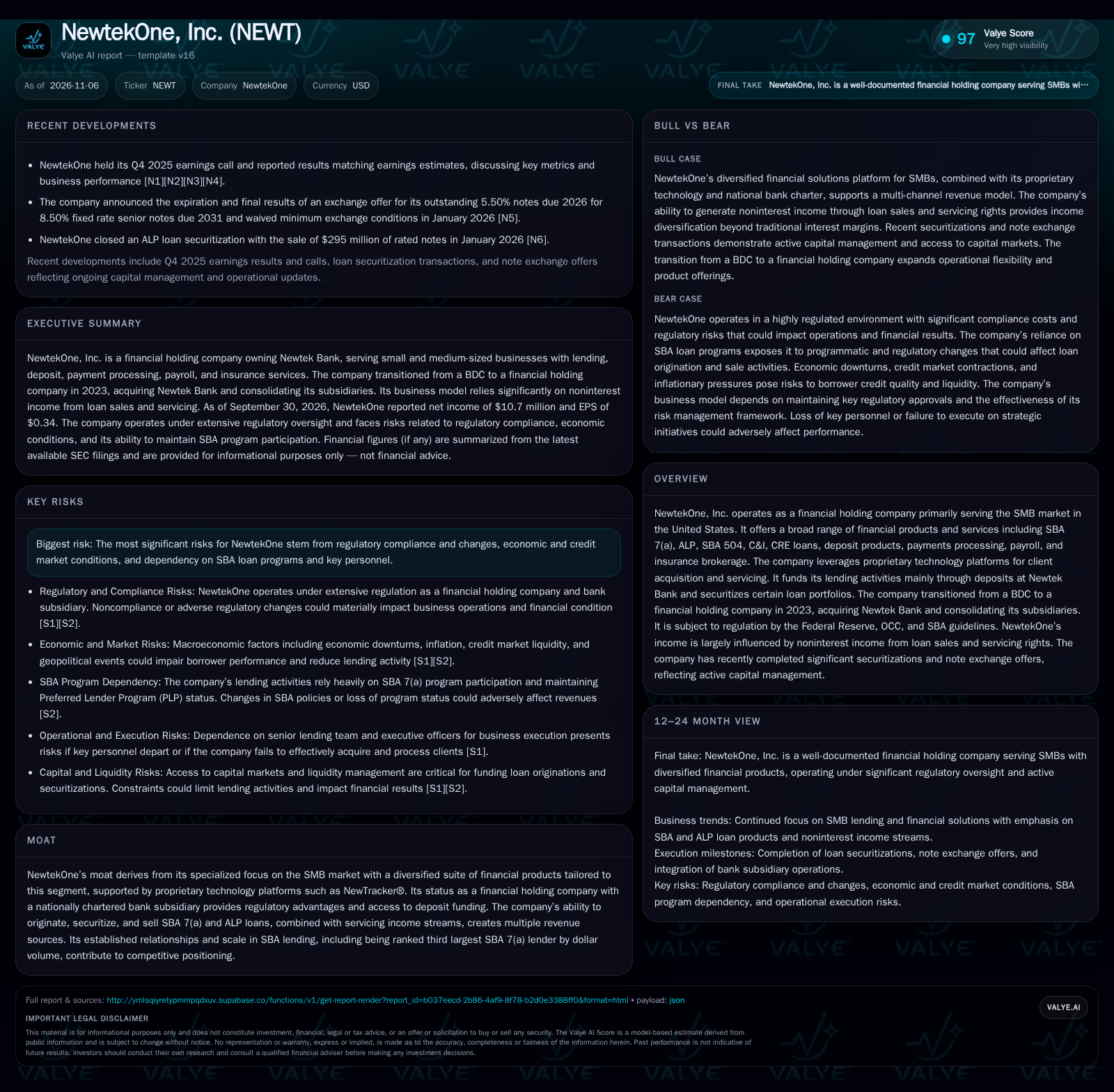
NewtekOne has transitioned from a BDC to a financial holding company, focusing on SMB lending via a digital-first, deposit-funded bank model. Its income stream leans heavily on selling SBA and ALP loans at premiums and retaining servicing rights. Recent large-scale securitizations and a note exchange reflect active capital management, but regulatory complexity and dependence on SBA programs remain central risks. Watch for loan origination volumes, securitization appetite, and regulatory developments.
NewtekOne, Inc. is executing a bold transformation in the U.S. small business banking sector. Having shifted from a Business Development Company to a regulated financial holding company with a branchless national bank, it now targets SMBs with a suite of lending, deposit, and business services. The company’s distinctive revenue model—built on noninterest income from loan sales and servicing—has enabled recent large-scale securitizations and capital raises. Yet, this approach also amplifies exposure to regulatory shifts and credit market cycles, making NewtekOne’s next phase a test of both innovation and risk management.
Recent Securitizations and Note Exchanges Reshape the Funding Toolkit
NewtekOne’s transformation since 2023 is anchored by several high-impact developments. First, the company’s conversion from a BDC to a financial holding company, paired with the acquisition of Newtek Bank, enabled it to fund lending through deposits and access broader financial products [S1]. This structural shift underpins its ability to originate and hold a diverse loan book, including SBA 7(a), ALP, and commercial loans.
As of January 2026, NewtekOne closed a $295 million ALP loan securitization, providing liquidity and off-balance-sheet funding for further originations [N6]. Around the same time, it completed a note exchange, swapping 5.50% notes due 2026 for new 8.50% fixed rate senior notes due 2031, reflecting a proactive approach to managing its capital structure and maturities [N5].
Financially, NewtekOne reported net income of $10.7 million and EPS of $0.34 for the quarter ended September 30, 2026, with cash and equivalents at $4.4 million [S2]. While these figures confirm profitability, they also highlight the company’s reliance on external capital markets and deposit inflows to sustain and expand its lending activities.
How Noninterest Income and Securitization Shape NewtekOne’s Earnings Engine
NewtekOne’s core economics diverge from traditional banks by prioritizing noninterest income over spread-based earnings. The company originates SBA 7(a) loans, often selling the government-guaranteed portions within 180 days at premiums that typically exceed 10% [S1]. This gain-on-sale model generates immediate revenue, while the retention of servicing rights creates an ongoing fee stream. The business also offers deposit products and ancillary services like payroll and insurance, but the outsized contribution comes from loan-related noninterest income.
Securitization plays a dual role: it recycles capital from originated loans, enabling higher throughput without ballooning the balance sheet, and it provides a market-based check on loan quality and pricing. The company’s ALP loan securitizations, such as the $295 million deal in January 2026, suggest a scalable platform if investor appetite holds [N6].
Fixed costs are relatively high due to regulatory compliance and technology investments (e.g., NewTracker®), but the model offers operating leverage if origination volumes rise. However, the approach is capital-intensive: funding growth depends on deposit flows and periodic access to capital markets, making the business sensitive to shifts in investor sentiment and interest rates.
SMB Focus, Proprietary Tech, and National Charter: Competitive Advantages and Their Limits
NewtekOne’s competitive positioning hinges on its specialized focus on SMBs—a segment often under-served by traditional banks due to higher perceived risk and customization needs. Its proprietary technology platform (notably NewTracker®) is designed to streamline client acquisition and prospect management, potentially lowering origination costs and improving speed.
The branchless, digitally native approach enables national reach, avoiding the fixed costs of physical branches. Its ability to originate, securitize, and sell SBA and ALP loans, combined with the retention of servicing rights, provides revenue diversity and recurring fee income. The national bank charter further enhances credibility and funding flexibility through insured deposits.
However, these advantages are not insurmountable. Other fintechs, challenger banks, and established regional banks are targeting SMBs with digital solutions and may replicate aspects of NewtekOne’s model. The company’s dependence on the SBA 7(a) program and regulatory status creates concentration risk: a change in program rules or loss of Preferred Lender Program (PLP) status could erode its edge [S2].
If Origination Scales and Securitization Markets Remain Open, Fee Income Could Accelerate
In a favorable scenario, NewtekOne leverages its technology platform and bank charter to accelerate loan origination, particularly in SBA 7(a) and ALP products. Robust demand from SMBs, coupled with stable or rising loan sale premiums in the secondary market, could boost noninterest income and support higher returns on capital.
Continued investor appetite for ALP and SBA loan securitizations would allow NewtekOne to recycle capital efficiently, supporting a virtuous cycle of origination, sale, and reinvestment. Deposit growth—especially in high-yield or zero-fee business accounts—would further reduce reliance on wholesale funding and enhance net interest margins.
Evidence supporting this scenario would include rising origination volumes, sustained or increasing gain-on-sale margins, successful repeat securitizations with favorable pricing, and stable or improving regulatory relationships (e.g., retention of PLP status). Accelerating fee income and operating leverage would likely be visible in upward-trending noninterest revenue and pre-provision earnings.
Sustained SMB Demand Meets Regulatory and Funding Friction
The most plausible trajectory for NewtekOne is moderate growth in loan originations, balanced by the realities of regulatory compliance, capital markets volatility, and competitive encroachment. The company continues to generate the bulk of its income from loan sales and servicing, but premiums may fluctuate with credit cycles and investor appetite for securitized assets.
Deposit growth remains steady but not explosive, and fee-based ancillary services provide incremental but not transformative contributions. Regulatory costs and the need to maintain SBA program status exert a persistent drag on margins. The company’s ability to execute depends on retaining key personnel and managing compliance as its scale increases.
Confirmation of this scenario would be visible in stable origination and securitization volumes, consistent (if variable) gain-on-sale margins, and an operating expense base that grows in line with revenues. Any material disruption to the SBA program, regulatory framework, or capital markets access would skew outcomes to the downside.
Regulatory or Capital Market Shocks Could Disrupt the Originate-to-Sell Model
The principal risk is a disruption in NewtekOne’s ability to originate and sell loans at attractive premiums, either due to macroeconomic stress, liquidity contraction in the secondary market, or adverse regulatory changes. If SBA program rules tighten, PLP status is lost, or loan sale premiums compress, the economics of the originate-to-sell model would deteriorate rapidly.
Capital market volatility could hinder the company’s ability to complete securitizations or refinance maturing debt, while rising compliance costs could outpace revenue growth. In this scenario, deposit inflow may slow and losses on held loans could rise, pressuring capital ratios and forcing a retrenchment in lending activity.
Evidence of this downside would include declining loan origination volumes, shrinking gain-on-sale or securitization premiums, regulatory actions or restrictions, or the need to raise dilutive capital at unfavorable terms. A spike in nonperforming assets or material credit losses would further exacerbate financial stress.
Milestones and Metrics That Will Define NewtekOne’s SMB Banking Strategy
SBA 7(a) and ALP loan origination volumes—quarterly and annual trends will reveal market traction and operational scalability.
Average gain-on-sale premiums for government-guaranteed loan portions—if disclosed, a critical indicator of secondary market conditions and revenue quality.
Securitization activity and pricing—frequency, size, and investor demand for NewtekOne’s loan-backed securities will test capital markets access.
Deposit growth by product type—particularly in high-yield business and commercial accounts, which influence funding costs and mix.
Regulatory status updates, including PLP status and any OCC or Federal Reserve supervisory actions.
Noninterest income as a share of total revenue—a useful metric to test the resilience of the fee-driven model.
Credit performance on held-for-investment loans, especially unguaranteed SBA 7(a) loans and any trends in loss reserves.
Retention and turnover of senior lending team and executive officers, given the importance of key personnel to execution.
Disclaimer: This is research-only, informational analysis and not investment advice. It may include AI-generated interpretation and general industry context. Always verify important details using primary sources.

Comments