
Great Southern Bancorp’s Commercial Real Estate Concentration: Navigating Regulatory Scrutiny and Interest Rate Volatility
With robust profitability but outsized exposure to commercial real estate, Great Southern Bancorp faces a pivotal period where regulatory focus, funding strategy, and evolving risk management practices may redefine its growth prospects and risk profile.
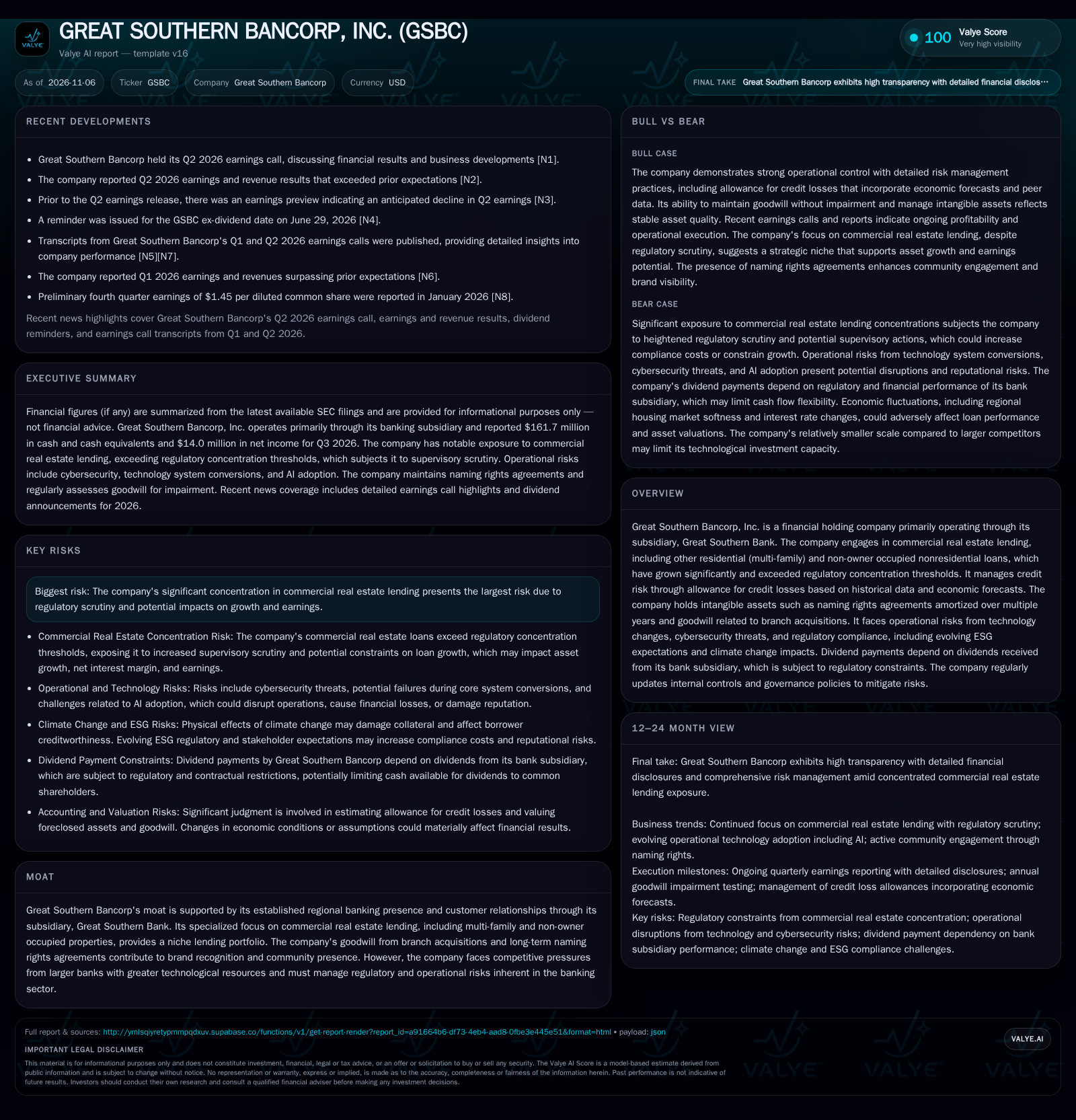
Great Southern Bancorp reported $14.0 million in Q3 2026 net income, but its commercial real estate loan exposure exceeds regulatory concentration thresholds, leading to elevated scrutiny. A sharp rise in short-term borrowings was used to fund a major purchase of agency mortgage-backed securities and to replace maturing brokered deposits. The company’s early adoption of new hedge accounting standards aims to stabilize earnings in a volatile rate environment, but future performance hinges on regulatory reactions and credit quality in its CRE portfolio. [S2]
Great Southern Bancorp stands at a crossroads: while it continues to deliver strong quarterly earnings and maintain a visible community presence, its substantial concentration in commercial real estate lending has pushed it into a zone of heightened regulatory oversight. The recent surge in short-term borrowings to fund a large-scale investment in agency mortgage-backed securities signals both a tactical response to funding needs and a potential shift in risk profile. Meanwhile, early adoption of new hedge accounting rules is intended to cushion the impact of interest rate swings on reported results. The coming quarters will test the company’s ability to balance growth ambitions, regulatory expectations, and the inherent risks of its lending strategy.
Material Shifts in Funding and Regulatory Exposure Define 2026 Backdrop
Great Southern Bancorp reported $14.0 million in net income for Q3 2026, with basic and diluted EPS of $1.29 and $1.27, respectively [S2]. Despite this profitability, the company’s loan book remains heavily tilted toward commercial real estate (CRE), with total CRE loans exceeding 300% of tier 1 capital plus allowance as of December 2025—a threshold that triggers elevated regulatory scrutiny [S1]. In 2026, short-term borrowings rose sharply from $330.9 million at year-end 2025 to $995.5 million by September 30, 2026, largely to finance a $400 million purchase of agency mortgage-backed securities (MBS) and to replace maturing brokered deposits [S2]. Additionally, the company early-adopted new hedge accounting rules, redesignating $400 million in interest rate swaps to better align with its variable-rate loan portfolio and manage income volatility [S2]. Each of these developments signals a business under pressure to manage both asset growth and risk in a changing regulatory and funding environment.
Earnings Drivers and Balance Sheet Dynamics in a CRE-Centric Model
Great Southern Bancorp’s primary earnings engine is the spread between interest earned on loans—dominated by commercial real estate, multi-family, and non-owner occupied properties—and the cost of funding those loans. The sharp increase in short-term borrowings to acquire $400 million in agency MBS/CMOs suggests a tactical effort to deploy excess liquidity or offset runoff in core deposits, but it also raises questions about funding cost sensitivity and duration mismatch [S2]. In a rising-rate environment, reliance on overnight borrowings can compress net interest margins if asset yields lag liability repricing. CRE lending may offer higher yields but typically carries higher credit risk and lower liquidity than residential or consumer portfolios. The company’s allowance for credit losses is based on historical and forecast data, but any adverse turn in the CRE cycle could pressure both asset quality and provisioning needs. Operating leverage is possible if loan growth and margin expansion outpace expense growth, but capital needs could rise if regulators demand higher buffers or restrict asset growth due to concentration risks. The cited source reports dividend-related activity; that disclosure alone does not establish dividend-policy continuity, management confidence, or a material constraint on capital flexibility. [S1]
Niche Focus and Regional Strengths Versus Scale and Digital Investment Gaps
Great Southern Bancorp’s regional presence and longstanding customer relationships, particularly in CRE lending, provide some insulation from direct competition with national banks. The company’s naming rights agreements and community engagement bolster its brand but do not confer a structural moat against larger, better-capitalized competitors. Larger banks can outspend GSBC on digital infrastructure, compliance, and product breadth, potentially attracting commercial borrowers with integrated treasury or tech-enabled services. Community banks and credit unions may compete on relationship lending and local knowledge but may lack GSBC’s scale in CRE. Non-bank lenders and fintechs are less of a direct threat in the company’s core markets but could become more relevant if digital origination and underwriting models gain traction. The question is whether GSBC’s specialization in CRE can continue to deliver superior risk-adjusted returns without amplifying downside exposure as regulatory and economic cycles evolve.
CRE Cycle Remains Benign and Funding Strategies Enhance Returns
If regional CRE markets remain resilient and loan performance holds steady, Great Southern Bancorp could continue to generate above-peer net interest margins thanks to its niche lending focus. Successful deployment of recently purchased agency MBS/CMOs, if coupled with stable or falling funding costs, could further boost interest income. The early adoption of new hedge accounting standards could smooth earnings, reducing reported volatility from interest rate swings and improving investor confidence. Regulatory scrutiny may moderate if the bank demonstrates robust risk management and maintains strong capital and credit metrics. Confirmation of this scenario would include continued low CRE delinquencies, stable or rising net interest margin, positive trends in noninterest income, and regulatory filings showing no new restrictions or remediation directives.
Balancing Growth and Oversight as CRE Exposure Caps Expansion
The most plausible trajectory is that Great Southern Bancorp maintains profitability but faces ongoing regulatory constraints on CRE concentration and asset growth. Net interest margins may come under pressure as funding costs rise and competitive deposit pricing intensifies. Asset quality likely remains stable, but provisioning may tick up as a precaution against economic or sectoral shocks. The company’s ability to generate incremental earnings from agency MBS/CMOs will hinge on the spread between investment yields and short-term borrowing costs. Dividend growth may be limited by regulatory capital requirements and the need to retain earnings. Evidence for this scenario would be steady quarterly earnings, gradual increases in credit loss allowances, and management commentary focused on compliance, risk management, and prudent balance sheet growth.
CRE Credit Deterioration Triggers Regulatory Action and Margin Compression
Should regional CRE markets weaken—due to rising vacancies, falling valuations, or tenant distress—GSBC could see a spike in nonperforming loans, forcing higher provisions and eroding net income. Regulatory authorities might respond to elevated CRE concentration by imposing growth caps, mandating higher capital ratios, or requiring de-risking of the loan portfolio, all of which would constrain earnings capacity. The reliance on short-term funding could exacerbate liquidity pressures if market rates rise or investor confidence wanes. Disruption from technology or cyber incidents could further strain operations, especially if resources are diverted to remediation. This scenario would be confirmed by rising CRE delinquencies, negative trends in regulatory capital ratios, new supervisory actions, or a material decline in reported earnings and dividends.
Concrete Markers for Testing the Durability of Great Southern’s CRE-Centric Model
Trends in nonperforming CRE loans and charge-offs: a useful metric would be quarterly disclosure of CRE delinquency rates and net charge-off ratios.
Net interest margin progression relative to funding mix changes: monitoring the spread between asset yields and short-term borrowing costs would help test margin resilience.
Updates on regulatory feedback or formal actions related to CRE concentration: any new restrictions, growth caps, or required capital actions would directly impact the thesis.
Quarterly changes in allowance for credit losses, especially as economic forecasts evolve.
Deposit growth or attrition trends, particularly in core versus brokered deposits, as a signal of funding stability.
Earnings contribution and risk profile of the agency MBS/CMO portfolio, especially in a changing rate environment.
Evidence of cyber or technology-related disruptions, if disclosed, as these could materially impact operations or compliance.
Dividend payout sustainability relative to subsidiary performance and regulatory capital constraints.
Disclaimer: This is research-only, informational analysis and not investment advice. It may include AI-generated interpretation and general industry context. Always verify important details using primary sources.

Comments