
Tootsie Roll Industries: Stable Operations Meet Shifting Regulatory and Trade Realities
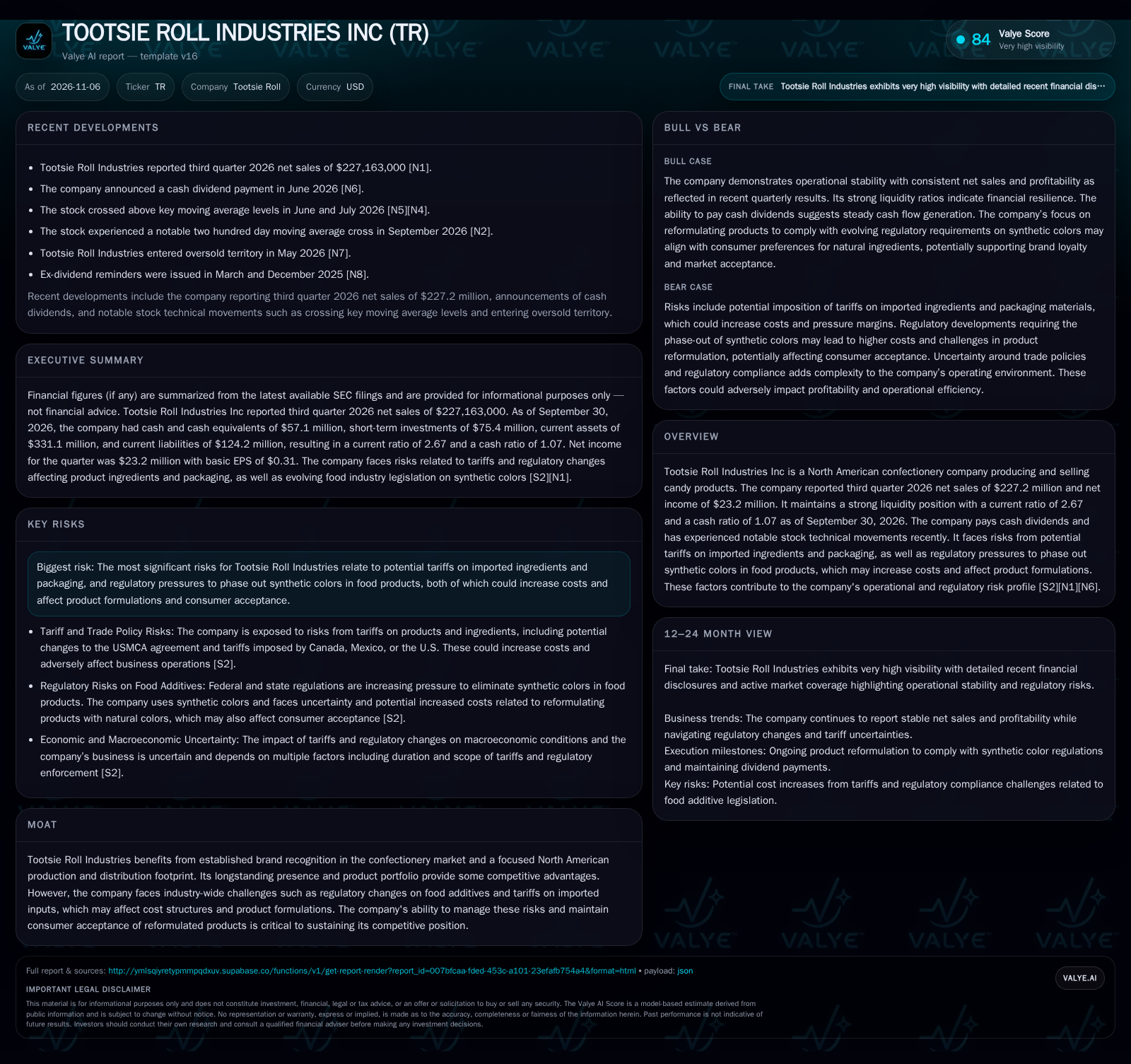
Tootsie Roll Industries maintains steady sales, profitability, and a robust balance sheet, but faces rising uncertainty from regulatory pressures on food additives and potential tariffs on ingredients and packaging. The company's ability to manage reformulation costs and sustain consumer loyalty will determine whether its operational stability translates into future growth or margin compression.
The business faces heightened risk from possible tariffs on imported ingredients and new regulations phasing out synthetic colors, which could increase costs and disrupt product formulations. The company's ability to adapt its product mix and control input costs will shape the next phase of performance [S2] [N1] [N6].
Tootsie Roll Industries stands as a rare example of operational consistency in the North American confectionery sector, posting steady sales and earnings for the third quarter of 2026. However, this stability is increasingly tested by external forces: regulatory mandates to reformulate products without synthetic colors and the looming threat of tariffs on imported ingredients and packaging. These factors could reshape cost structures, product offerings, and consumer loyalty, making Tootsie Roll’s next chapter less predictable than its past.
Recent Performance and Emerging External Pressures
Tootsie Roll Industries reported third quarter 2026 net sales of $227.2 million and net income of $23.2 million, representing ongoing operational profitability [S2] [N1]. As of September 30, 2026, the company held $57.1 million in cash and $75.4 million in short-term investments, with a current ratio of 2.67 and a cash ratio of 1.07 [S2]. The cited source reports dividend-related activity; that disclosure alone does not establish dividend-policy continuity, management confidence, or a material constraint on capital flexibility. The company reported cash and liquidity metrics for the period; these figures do not by themselves establish operating runway, investment capacity, financial flexibility, or financing capacity. [N6] Both factors could drive up costs and necessitate product reformulation, directly impacting profitability and consumer acceptance.
How Tootsie Roll Makes Money: Cost Structure, Margin Drivers, and Capital Needs
Tootsie Roll generates revenue primarily through the sale of branded confectionery products in North America, where established brand equity supports stable pricing and relatively predictable demand. The company’s business model is characterized by high fixed costs in manufacturing and distribution, with variable costs tied to ingredients, packaging, and logistics. Because many of these inputs (such as sugar, cocoa, and packaging materials) are globally sourced, Tootsie Roll is exposed to commodity price volatility as well as potential tariff shocks.
Operating leverage is a feature of this model: incremental sales can drive margin expansion when factories run at high utilization, but sharp input cost increases or volume declines can quickly compress margins. The cited source reports dividend-related activity; that disclosure alone does not establish dividend-policy continuity, management confidence, or a material constraint on capital flexibility. In the event of significant regulatory or tariff-driven cost inflation, Tootsie Roll may face difficult trade-offs between absorbing costs, passing them on via price increases, or reducing dividend payouts.
The need to reformulate products to comply with new synthetic color regulations could entail upfront R&D and marketing expenses, as well as possible supply chain adjustments. If natural colorants are more expensive or less stable, the gross margin profile may erode unless offset by pricing actions or improved operating efficiency.
The interplay between fixed and variable costs in Tootsie Roll’s manufacturing operations also suggests that scale economies could be a critical factor in mitigating inflationary pressures. If the company can maintain or grow production volumes despite reformulation challenges, fixed costs can be spread over a larger output, cushioning margin impacts. Conversely, any sustained volume decline would exacerbate margin compression due to underutilized capacity. Additionally, the company’s capital expenditure plans, particularly investments in flexible manufacturing technologies or supply chain automation, could influence its long-term cost competitiveness and ability to adapt quickly to regulatory changes. Monitoring capital allocation priorities would provide insight into how management balances near-term margin pressures with strategic resilience.
Brand Strength Meets Industry-Wide Headwinds
Tootsie Roll’s core advantage lies in its deep brand recognition and a focused North American distribution strategy. In a fragmented confectionery market, established brands often benefit from shelf space access, consumer familiarity, and modest pricing power. However, these advantages are increasingly offset by industry-wide challenges: regulatory scrutiny of food additives, evolving consumer preferences toward 'clean label' products, and exposure to global supply chain disruptions.
The primary competitor set includes other legacy confectionery brands, private label products, and newer entrants focused on natural ingredients. If Tootsie Roll can successfully reformulate without sacrificing taste or brand equity, it may retain its core customer base. Conversely, if reformulations lead to inferior product experience or higher retail prices, share could shift toward competitors better able to manage these transitions. Substitutes such as healthier snacks or premium natural candies could also capture incremental demand if Tootsie Roll’s offerings are perceived as lagging regulatory or consumer trends.
The evolving consumer landscape also introduces nuanced risks and opportunities around product innovation and marketing strategy. As consumer preferences shift toward transparency and ingredient simplicity, Tootsie Roll’s ability to communicate the benefits of reformulated products without alienating traditional customers will be paramount. This may require targeted segmentation and differentiated branding approaches to retain core loyalists while appealing to health-conscious demographics. Furthermore, the competitive threat from private label and artisanal brands, which often emphasize natural ingredients and local sourcing, could intensify if Tootsie Roll’s reformulation efforts are perceived as insufficiently authentic. The company’s scale and distribution reach remain advantages, but only if matched by credible product positioning aligned with emerging consumer values.
Margin Resilience Through Successful Reformulation and Cost Pass-Through
The most favorable outcome for Tootsie Roll involves efficient compliance with new synthetic color regulations and successful navigation of tariff-related cost pressures. If the company can reformulate its products using natural colors without significant increases in per-unit cost—or can pass those costs through to consumers without eroding volume—it could maintain or even expand margins. Strong brand loyalty may enable modest price increases, especially if competitors face similar input cost inflation.
Additional signals could include successful new product launches aligned with 'clean label' trends and the absence of material volume losses following price increases.
In a scenario where Tootsie Roll successfully leverages its reformulation experience, the company might also capitalize on operational efficiencies beyond cost pass-through. For example, optimizing supply chain logistics to source natural colorants at scale or renegotiating supplier contracts could offset incremental input costs. Moreover, the introduction of new product variants aligned with clean label trends could diversify revenue streams and reduce reliance on legacy SKUs vulnerable to regulatory scrutiny. If consumer acceptance proves robust, these innovations might enhance brand equity and create pricing power that extends beyond mere cost recovery. Strategic partnerships or co-branding initiatives with health-focused retailers or influencers could further amplify market penetration and support margin resilience.
Adapting to Higher Costs While Preserving Core Profitability
The most plausible trajectory is one in which Tootsie Roll absorbs some level of cost inflation from both tariffs and regulatory reformulation, but manages to preserve profitability through a combination of incremental price increases, cost control, and operational efficiencies. Gross and operating margins could compress modestly, but the company’s established brand and scale should allow it to remain profitable and continue paying dividends.
Confirmation of this scenario would come from modest but sustained net income and cash flow, stable or slightly lower margins, and continued evidence of consumer acceptance of reformulated products. If disclosed, data on unit volumes and price/mix effects would help confirm that the company is not sacrificing significant market share in the process.
Margin Compression and Volume Loss from Unmanaged Cost Shocks
An adverse scenario would see Tootsie Roll unable to offset higher costs from tariffs and regulatory mandates, either because reformulation raises costs more than expected or because price increases drive consumers to competitors. This could result in significant margin compression, negative operating leverage, and possibly declining sales volumes as price-sensitive customers switch to alternatives.
Indicators supporting this scenario would include a sharp decline in gross and operating margins, reduced net income, dividend cuts or suspension, and evidence of market share loss. Negative consumer feedback on reformulated products or retailer pushback on higher prices would also be warning signs.
Factors That Will Shape Tootsie Roll’s Next Phase
Gross margin trends following reformulation and any new tariffs—if disclosed—would be critical for assessing cost pass-through and operational efficiency.
Unit volume and price/mix data, particularly in the wake of reformulated product launches, would help determine whether price increases are sustainable or eroding demand.
Consumer acceptance of reformulated products, as measured by customer feedback, repeat purchase rates, or market research—if available—would test the durability of brand loyalty.
Tariff developments and changes to USMCA or other trade agreements that affect ingredient and packaging costs could materially alter the company’s cost base.
Cost and timeline disclosures related to R&D or supply chain investments for reformulation would clarify near-term margin risks.
Competitive response and market share dynamics, especially among natural/clean label confectionery brands, would show whether Tootsie Roll is keeping pace with industry shifts.
If disclosed, SKU rationalization or portfolio adjustments in response to changing regulations would signal how the company is managing complexity and cost.
Disclaimer: This is research-only, informational analysis and not investment advice. It may include AI-generated interpretation and general industry context. Always verify important details using primary sources.

Comments