
Atlassian’s Cloud Migration and AI Bet: Margin Tension Meets Platform Ambition
Atlassian’s deliberate shift from legacy Data Center products to cloud-native SaaS, underscored by substantial AI investment, is reshaping its economics and risk profile. With margin pressures from higher hosting and R&D spend, the company’s ability to monetize AI features, retain customers during migration, and defend its ecosystem against deep-pocketed and AI-native rivals will determine whether it can sustain growth and platform relevance.
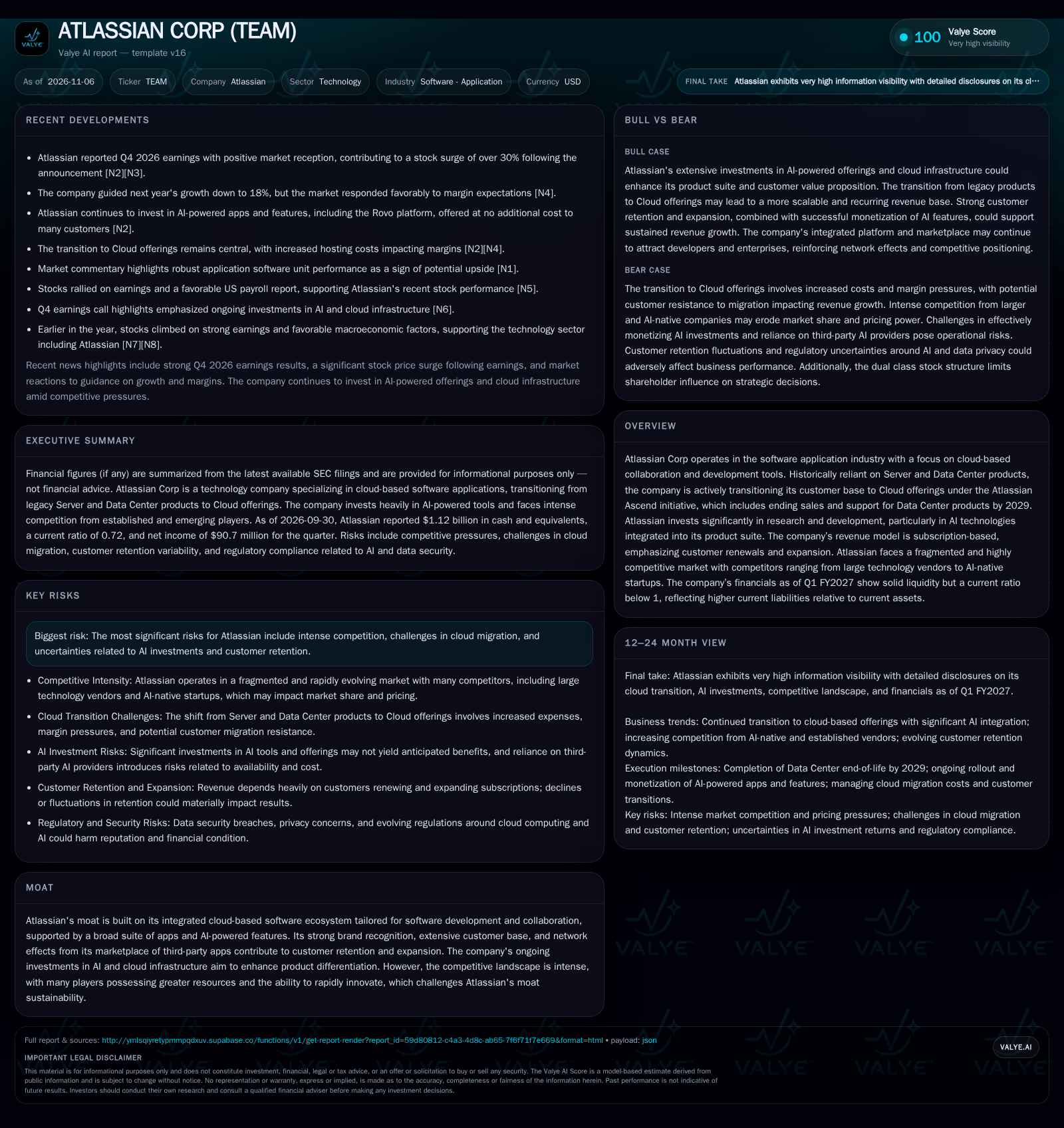
Atlassian’s pivot to cloud and aggressive AI integration is driving a new phase of growth, but at the cost of near-term margins and heightened dependence on customer retention and successful up-sell of new features. While the market rewarded improved margin guidance and the long-term potential of its platform, the company must navigate rising costs, competitive intensity, and the challenge of monetizing AI investments to justify its valuation and strategic roadmap. [S2] [N2] [N4] [N6]
Atlassian’s transition from on-premise to cloud-native software under the Atlassian Ascend initiative is at a pivotal point, marked by the end-of-life of Data Center products and the rapid integration of AI-powered features across its platform. The company’s Q4 2026 earnings beat and improved margin guidance were met with a sharp stock rally, but the underlying story is one of rising costs, uncertain monetization of AI investments, and a mounting need to retain and expand its customer base as competition intensifies. The next phase will test whether Atlassian can convert its heavy R&D spend and platform breadth into sustainable value amid shifting industry economics and evolving enterprise buyer expectations.
Cloud Migration, AI Investment, and Margin Dynamics Define the Present
Atlassian’s Q4 2026 results catalyzed a more than 30% surge in its stock price after the company paired an 18% revenue growth outlook for the next year with improved margin expectations, signaling the market’s pivot to profitability as a primary concern. [N2] [N3] [N4] The company’s ongoing transition away from Data Center products—ending new sales as of March 2026 and support by March 2029—puts cloud migration at the center of its strategy, but also exposes it to increased hosting and R&D costs as it invests heavily in AI-powered features like the Rovo platform. [S2] [N2] [N4] Many of these AI enhancements are currently offered at no additional cost to customers, which, while supporting adoption, puts near-term pressure on margins. The company reported a current ratio of 0.72 for the period. [N2] [N4] [N6] [S2] The company’s ability to retain and expand customers remains a critical variable, as fluctuations in these metrics could materially affect subscription revenue and the entire economics of the cloud transition. [S2]
How Atlassian’s Subscription Model Is Being Reshaped by Cloud and AI
Atlassian’s core business is driven by recurring subscription revenue from cloud-based collaboration and development tools, historically complemented by perpetual or term licenses for Data Center and Server products. The migration to a pure cloud model is shifting Atlassian’s revenue recognition to a more ratable, contract-driven cadence, providing visibility but also introducing lag in reflecting downturns or churn. [S2]
AI-powered features are being bundled into existing cloud subscriptions—often at no additional charge—raising the company’s hosting and R&D costs without a commensurate uplift in per-seat pricing or contract value. This dynamic places pressure on gross margins, especially as AI adoption increases infrastructure usage. Atlassian’s high R&D spend, particularly in AI and platform integration, is a double-edged sword: it could unlock new value and stickiness, but it also raises the hurdle for profitable growth.
Fixed costs in cloud infrastructure and R&D are significant, suggesting that higher customer adoption and successful up-sell of advanced features would be required to drive operating leverage. However, if customer migration lags or churn rises—whether due to feature gaps, migration pain points, or pricing resistance—the company’s ability to scale profitably could be undermined.
The company’s dual-class stock structure also centralizes strategic control, which could accelerate bold investments but may limit shareholder influence over capital discipline. [S2]
Defending the Platform: Atlassian’s Edge and Its Erosion Risks
Atlassian’s competitive position has historically rested on its integrated suite of collaboration and development tools—anchored by products like Jira, Confluence, and Trello—and a thriving third-party app marketplace. This ecosystem could increase switching friction and network effects, supporting customer retention and expansion.
However, the competitive landscape is rapidly intensifying. Large cloud vendors (such as Microsoft and Google) bundle collaboration tools with broader enterprise suites, often at aggressive price points and with deep integration into existing IT environments. Simultaneously, AI-native startups are targeting specific software development and workflow automation niches with highly specialized, sometimes autonomous, solutions that can leapfrog incumbents in certain use cases.
Atlassian’s moat is under pressure from both directions: the risk that large incumbents can outspend and out-integrate, and that nimble startups can innovate faster in AI-driven features. The company’s reliance on third-party AI models and integration providers introduces additional risk—if these partners change terms or restrict access, Atlassian’s ability to deliver differentiated features could be impaired. While its brand and marketplace remain valuable, the sustainability of its moat will depend on successful customer transition to cloud, high retention, and the ability to monetize new AI functionality without eroding margins.
AI Monetization and Seamless Cloud Migration Unlock Operating Leverage
In the most favorable scenario, Atlassian executes a high-conversion migration from Data Center to Cloud, retaining the vast majority of its enterprise customers and successfully up-selling them on new AI-powered features. If the Rovo platform and other AI enhancements drive measurable productivity gains for customers, Atlassian could justify higher per-seat pricing or introduce premium AI tiers, directly monetizing its R&D investments.
Successful integration of third-party and proprietary AI models—leading to differentiated, sticky offerings—would reinforce network effects and reduce churn. If cloud infrastructure costs moderate (e.g., through scale or improved efficiency), the company could see margin expansion alongside recurring revenue growth, with operating leverage from its fixed cost base.
Evidence confirming this scenario would include sustained renewal rates above historical averages, clear customer expansion (in seats or contract value), announced monetization of AI features (such as premium add-ons), and upward gross margin trends despite higher AI usage. Additionally, positive customer case studies or public endorsements of Atlassian’s AI capabilities would support the thesis.
Cloud Transition Drives Growth, but Margin Gains Are Gradual and Patchy
The most plausible middle path is one where Atlassian achieves steady, but not seamless, migration of its installed base to the cloud, with retention rates that fluctuate but remain within historical norms. AI-powered features continue to be offered as value-adds, but meaningful direct monetization is slow to materialize, keeping pressure on gross margins.
R&D and hosting expenses remain elevated as the company continues to invest in platform breadth and AI differentiation. Revenue growth is sustained by subscription renewals and moderate expansion, but is offset by occasional churn or slower conversion of legacy Data Center customers. Competitive pressures from both large vendors and AI-native startups limit pricing power and force Atlassian to keep bundling more features at flat or only modestly higher prices.
Confirming evidence would be stable, but not accelerating, renewal rates and customer expansion metrics, gross margins that improve incrementally but remain below pre-cloud-transition levels, and continued commentary from management about balancing investment needs with profitability. Falsifying evidence would include a sudden drop in retention or gross margin, or clear signs that customers are resisting migration or adoption of new features.
Migration Pains, AI Monetization Stalls, and Competitive Encroachment
In an adverse scenario, a significant portion of Data Center customers either resist migration to cloud or defect to competitors, leading to a decline in renewal rates and subscription revenue. If AI-powered features fail to deliver differentiated value or cannot be monetized, Atlassian’s hosting and R&D spend becomes a drag on margins with little offsetting revenue.
Escalating competition—either from bundled solutions offered by large vendors or targeted offerings from AI-native startups—could further erode Atlassian’s market share and pricing power. Reliance on third-party AI models may expose the company to cost increases or loss of access, compounding the risk. If regulatory or data privacy concerns emerge around AI features, customer adoption could be further hampered.
Evidence confirming this scenario would include a material drop in retention or renewal rates, negative revenue growth, deteriorating gross margins, customer complaints or publicized migration failures, and management guidance cuts. Falsifying evidence would be steady or improving retention and margin metrics despite ongoing competitive and cost pressures.
Milestones That Will Determine the Success of Atlassian’s Cloud and AI Strategy
Quarterly customer retention and expansion rates (if disclosed), as these directly drive subscription revenue and indicate migration success.
Gross margin trends in the cloud segment, especially as AI-powered features are rolled out more broadly.
Explicit monetization of AI features—such as premium tiers, add-ons, or usage-based pricing—would help test whether investments are translating to revenue.
Migration rate of legacy Data Center customers to cloud offerings, particularly among large enterprise accounts.
R&D and cloud hosting expense as a percentage of revenue, indicating whether operating leverage is materializing or if costs are outpacing growth.
Customer adoption metrics for new AI-powered features (if disclosed), such as usage rates or customer satisfaction scores.
Updates on partnerships or terms with third-party AI model providers, which could impact cost structure and feature delivery.
Any regulatory developments or data privacy incidents affecting AI-powered products, as these could affect customer confidence and adoption.
Disclaimer: This is research-only, informational analysis and not investment advice. It may include AI-generated interpretation and general industry context. Always verify important details using primary sources.

Comments