
TrustCo Bank’s Capital Management and Earnings Stability: Shareholder Returns Meet Sector Headwinds
The real test lies in sustaining returns as market and credit conditions evolve.
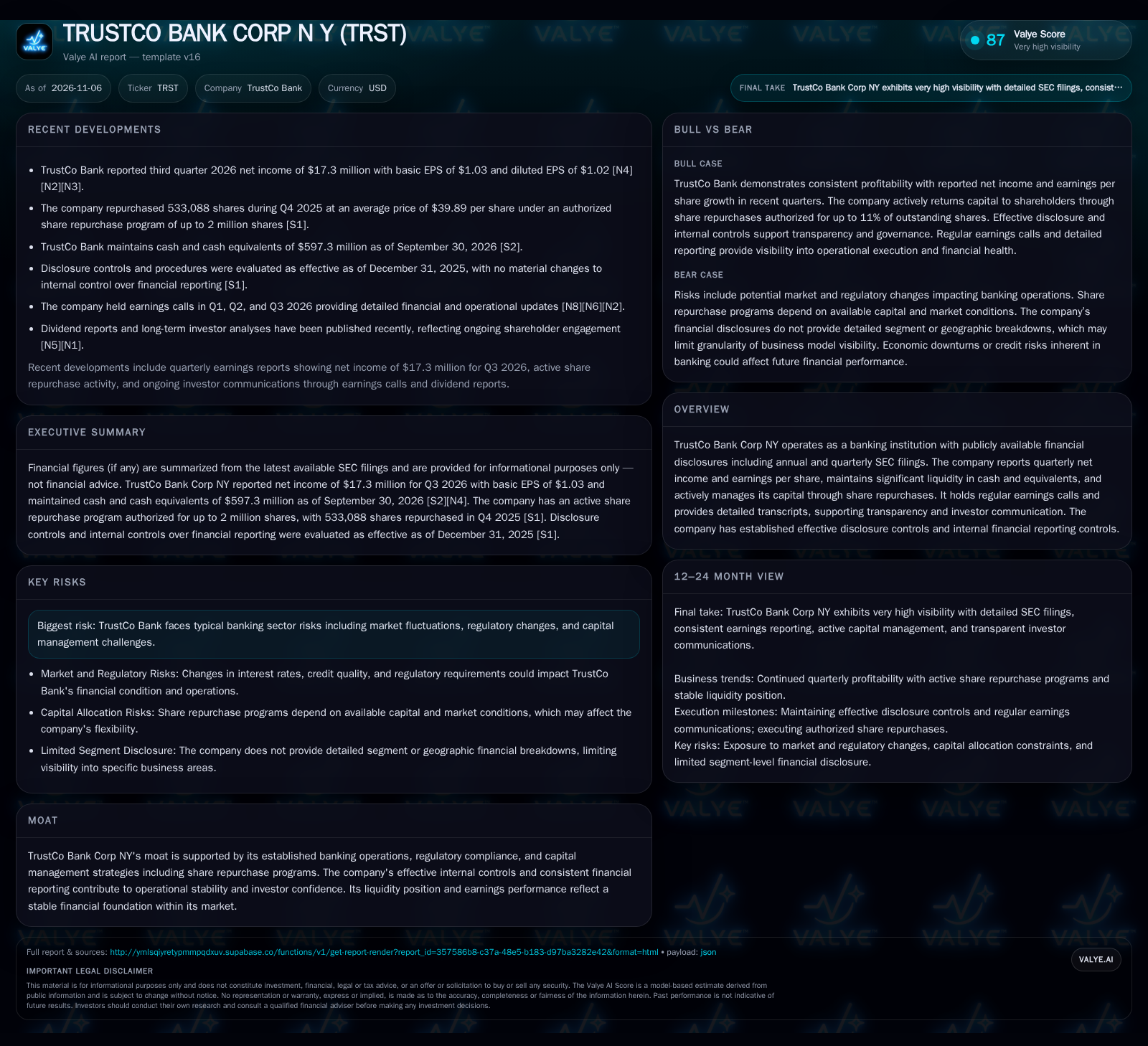
TrustCo Bank reported $17.3 million in Q3 2026 net income, maintains $597.3 million in cash, and is executing an 11% share repurchase authorization through 2026. These moves underscore a focus on shareholder returns and operational transparency, but the absence of segment detail and sector-wide risks leave open questions about long-term outperformance and sensitivity to external shocks. [S2] [S1] [N4]
With quarterly net income and a commitment to disclosure, the bank projects stability and shareholder focus. Yet, as with all regional banks, underlying risks—interest rate volatility, regulatory shifts, and limited segment visibility—could test the durability of its current performance. The question is whether TrustCo can continue to translate operational transparency and capital returns into sustainable value creation in a changing financial environment.
Recent Capital Actions and Operating Results Shape 2026 Profile
TrustCo Bank reported net income of $17.3 million for the third quarter of 2026, translating to $1.03 in basic earnings per share and $1.02 diluted. The bank’s cash and cash equivalents stood at $597.3 million as of September 30, 2026. An active share repurchase program, authorized for up to 2 million shares (about 11% of the company’s outstanding shares), remains in effect through December 2026; 533,088 shares were repurchased in Q4 2025 at an average price of $39.89. Disclosure controls and internal controls over financial reporting were evaluated as effective as of the end of 2025, with no material changes reported since. [S1] [S2] [N4]
Banking Fundamentals: How TrustCo Earns and Deploys Capital
TrustCo Bank’s core operating engine is characteristic of traditional regional banking: gathering deposits, originating loans, managing spreads, and earning fees. Net interest margin (NIM) and loan/deposit mix are the primary drivers of revenue and profitability. The bank’s reported net income signals that its spread business, at least recently, has supported positive operating leverage, with fixed costs (such as personnel and branch infrastructure) leveraged across a stable deposit and loan base.
The company reported cash and liquidity metrics for the period; these figures do not by themselves establish operating runway, investment capacity, financial flexibility, or financing capacity. However, this also means a portion of assets may be earning below-market returns in a high-rate environment, potentially compressing NIM if not actively redeployed. The share repurchase program is a direct capital deployment lever, returning surplus equity to shareholders and potentially boosting per-share metrics—though it also reduces the capital cushion available for organic or inorganic growth.
Absent segment or geographic breakdowns, it is unclear how much earnings are driven by particular lines (e.g., commercial vs. consumer lending, fee income, or mortgage origination). This opacity limits insight into the drivers of recent performance, the sustainability of margins, and the bank’s sensitivity to rate or credit cycle inflections.
A critical dimension to TrustCo’s capital deployment strategy involves balancing the trade-off between returning capital to shareholders and retaining sufficient equity to buffer against credit and interest rate shocks. In a rising rate environment, the timing and scale of share repurchases must be carefully calibrated to avoid undermining regulatory capital ratios or liquidity cushions. Moreover, the reinvestment of cash into higher-yielding assets requires nimble asset-liability management to prevent margin erosion. If the bank’s asset mix is skewed toward longer-duration loans or fixed-rate assets, rapid rate increases could compress net interest margins unless offset by repricing or deposit cost management. Thus, capital deployment decisions are inherently linked to the bank’s sensitivity to interest rate cycles and credit risk dynamics.
Where TrustCo Bank Sits in a Crowded Regional Banking Landscape
TrustCo operates in a sector defined by intense competition from both traditional banks and non-bank financial intermediaries. Its reported stability and active capital management offer advantages in investor perception, but the lack of segment disclosure makes it difficult to assess whether TrustCo has a durable edge in particular markets or products.
In regional banking, differentiation often comes from relationship banking, local market knowledge, and risk management discipline. Larger competitors may benefit from technology and scale, while fintechs and digital banks challenge incumbents on convenience and cost. TrustCo’s emphasis on disclosure controls and regular communication could build stakeholder trust, but the true test is whether it can maintain or grow share in key markets—especially as digital adoption accelerates and cost pressures rise.
Switching frictions in banking remain moderate: customers are sticky due to inertia and product bundling, but are not immune to better rates or digital experiences elsewhere. TrustCo’s ability to retain and expand its customer base may hinge on its service model, technology investments, and local reputation—factors not fully illuminated by current disclosures.
TrustCo’s competitive positioning also hinges on its ability to integrate technology-driven efficiencies without sacrificing the personalized service that regional banks traditionally leverage. As fintech entrants erode margins through automation and scale, incumbent banks must selectively invest in digital platforms that enhance customer experience and reduce operational costs. However, such investments require upfront capital and may pressure near-term earnings, creating a tension between innovation and profitability. The bank’s capacity to execute these investments effectively while maintaining prudent risk management will influence its ability to defend market share and sustain returns. Additionally, the evolving regulatory landscape around data privacy and cybersecurity imposes compliance costs that could disproportionately affect smaller regional players lacking scale economies.
Sustained Margin and Repurchase Execution Drive Shareholder Outperformance
The most favorable scenario is one where TrustCo continues to generate robust net interest margins and manages credit quality effectively, allowing for ongoing profitability and full execution of the share repurchase authorization. In this case, per-share earnings and book value would benefit, supporting above-peer returns even as sector headwinds persist.
A confirming signal would be continued quarterly net income growth, stable or rising NIM, and updates showing that the repurchase program is being fully utilized at attractive prices. If disclosed, improvements in fee income, cost efficiency ratios, or loan growth would further strengthen the case.
Falsification would come from margin compression, a pause or reduction in repurchases due to capital needs, or rising credit losses that erode earnings and capital. Early warning signs could include a drop in quarterly profitability or a material decline in cash reserves without offsetting asset growth.
Profitability Persists but Sensitivity to Sector Dynamics Remains
If disclosed, steady NIM and manageable credit costs would reinforce this view. However, limited segment granularity means that any negative surprises (such as a spike in non-performing assets or a sharp drop in fee revenue) could be masked until they materially affect results.
The base scenario would be challenged or falsified by a sustained decline in earnings, regulatory intervention, or evidence that capital is being depleted faster than anticipated (e.g., from loan losses or adverse market movements).
Margin Pressure, Regulatory Change, or Credit Events Disrupt Stability
A less favorable outcome arises if TrustCo faces a combination of interest rate compression, deteriorating credit quality, or adverse regulatory changes. In this scenario, net income could fall sharply, reducing the bank’s ability to return capital to shareholders and potentially forcing a cutback in the repurchase program or dividends.
Confirmation would come from a sequential decline in quarterly net income, a shrinking cash position, or management commentary signaling caution on capital allocation. Material increases in loan loss provisions, if disclosed, or a regulatory finding of ineffective controls would further validate this scenario.
However, a lack of transparency about business line exposures could amplify investor uncertainty if negative trends emerge.
Milestones That Will Reveal If TrustCo’s Playbook Is Durable or Vulnerable
Quarterly trends in net interest margin (NIM), if disclosed, as a leading indicator of earnings power and rate sensitivity.
Execution pace of the share repurchase program—updates on shares retired and average repurchase price versus book value.
Changes in cash and cash equivalents, especially if driven by loan growth, deposit outflows, or asset mix shifts.
Any disclosure of non-performing loans, charge-offs, or loan loss provisions, which would clarify credit risk exposure.
Regulatory filings or management commentary on internal controls, capital adequacy, or findings from examinations.
Evidence of digital banking adoption, technology investment, or branch rationalization to test competitive adaptation.
If disclosed, segment or geographic revenue/profit breakdowns that would illuminate business model strengths or vulnerabilities.
Disclaimer: This is research-only, informational analysis and not investment advice. It may include AI-generated interpretation and general industry context. Always verify important details using primary sources.

Comments