
Atlas Lithium: From Permitting to Production—Unlocking Brazil’s Hard-Rock Lithium Ambitions
Atlas Lithium has cleared critical regulatory hurdles and installed processing infrastructure at its Neves Project in Brazil’s Lithium Valley, but the company remains pre-revenue with material net losses and faces the capital, execution, and market risks typical of early-stage lithium developers.
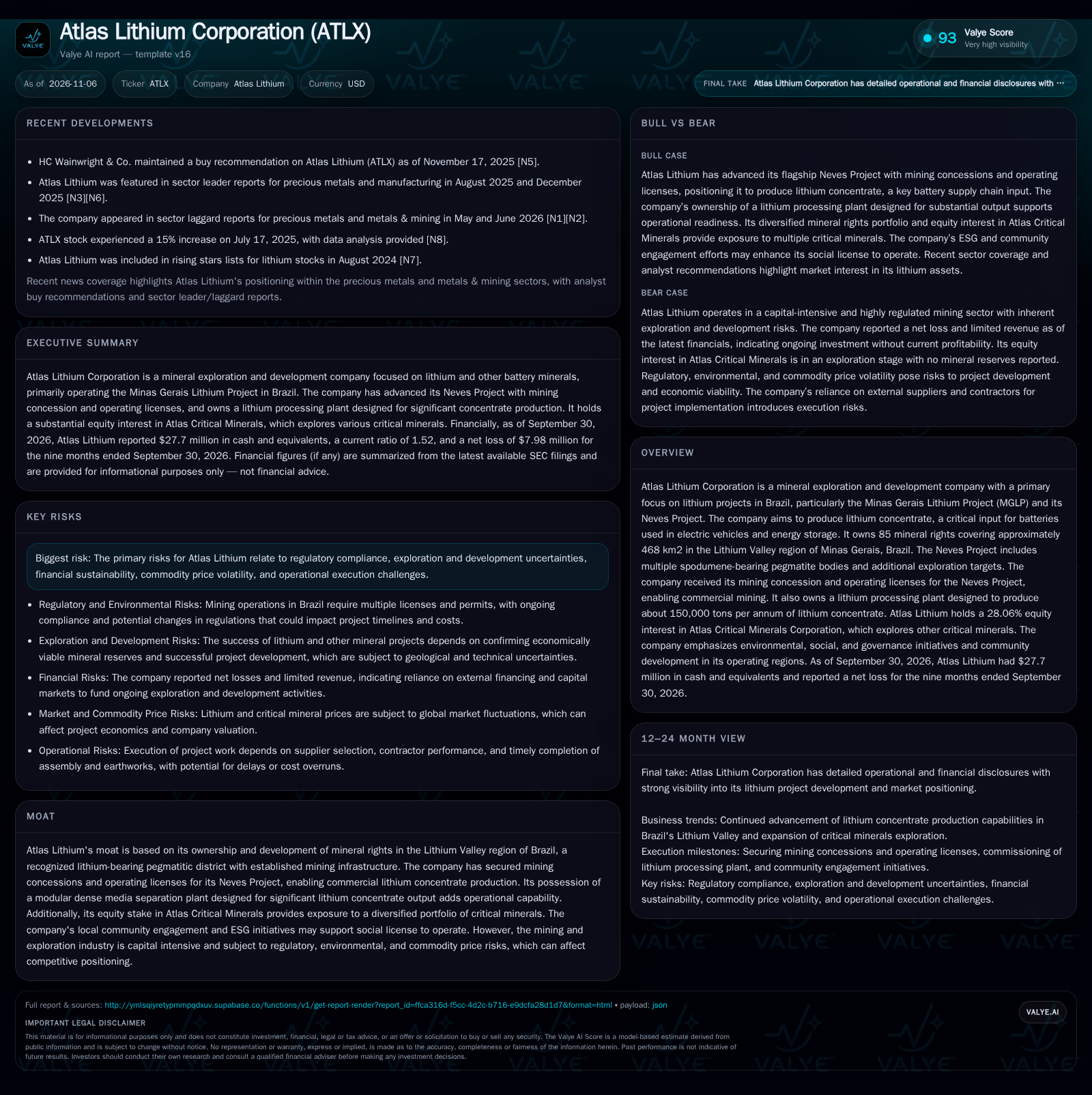
Atlas Lithium has secured mining and operating licenses for its flagship Neves Project in Brazil and received a dense media separation (DMS) plant designed for 150,000 tons/year of lithium concentrate production. While these milestones advance the company toward commercial output, Atlas remains pre-revenue with a $7.98 million net loss for the nine months ended September 2026 and a cash balance of $27.7 million. The path forward hinges on its ability to ramp production, manage costs, and prove the economic viability of its assets in a volatile lithium market. [S1] [S2]
Atlas Lithium Corporation has transitioned from the exploration phase to early-stage project development at its Neves Project in Brazil’s Lithium Valley, securing key mining and environmental permits and installing processing capacity for lithium concentrate. The next phase will test whether Atlas can convert its permitted and equipped site into meaningful production, navigate Brazil’s regulatory and community landscape, and withstand the capital and commodity price volatility that defines the global lithium supply chain. [S1] [S2]
Atlas Lithium’s Regulatory Wins and Processing Plant Arrival Set the Stage—But Not Yet the Revenue
Atlas Lithium’s most material recent developments are the receipt of a perpetual mining concession (May 2025) and an operating license (October 2024) for its flagship Neves Project in Brazil’s Lithium Valley, unlocking the right to mine and process lithium concentrate without volume restrictions. The company has also taken delivery of a modular dense media separation (DMS) plant designed to produce 150,000 tons/year of lithium concentrate, a critical battery precursor. Despite these advances, Atlas remains pre-revenue, with only $74,386 in revenue and a net loss of $7.98 million for the nine months ended September 30, 2026. Cash and equivalents stand at $27.7 million. These facts indicate that Atlas has navigated key regulatory and infrastructure hurdles, but has yet to demonstrate commercial-scale production or profitability. [S1] [S2]
Lithium Project Economics: High Fixed Costs, Steep Ramps, and Exposure to Commodity Cycles
The core business model for Atlas Lithium is to extract spodumene ore from its Neves Project, process it via its DMS plant into lithium concentrate, and sell this concentrate into the global battery supply chain. In hard-rock lithium projects, the cost structure is typically dominated by high up-front capital expenditures (mine development, plant installation, permitting), significant fixed operating costs (labor, equipment maintenance, energy), and variable costs tied to ore grade, recovery rates, and logistics. Once production ramps, incremental volumes can deliver strong operating leverage if market prices are favorable and plant utilization is high.
Atlas’s current financials show the pre-commercial phase: negligible revenue, ongoing net losses, and reliance on cash reserves. The company reported cash and liquidity metrics for the period; these figures do not by themselves establish operating runway, investment capacity, financial flexibility, or financing capacity. Achieving break-even and long-term value depends on (1) the ability to reach and sustain high plant throughput and recoveries, (2) cost control in mining and processing, and (3) selling concentrate at prices that exceed all-in costs. With no current disclosure of offtake agreements or contract pricing, Atlas’s revenue model may initially rely on spot or short-term sales, exposing it to lithium price volatility.
A critical economic consideration for Atlas Lithium is the sensitivity of its project economics to fluctuations in lithium prices and operating costs. Given the capital-intensive nature of hard-rock lithium mining, small changes in commodity prices or cost inputs can disproportionately affect profitability. For instance, energy costs, which can be substantial in mineral processing, may vary due to regional factors or global energy markets, impacting operating margins. Additionally, the ore grade and recovery rates are inherently variable and can influence the volume of concentrate produced per ton of ore mined. Effective mine planning and metallurgical optimization are therefore essential to mitigate these risks and improve cost predictability.
From a financing perspective, the transition from pre-revenue to sustained production often requires multiple capital infusions, which can dilute existing shareholders or increase leverage. The timing and terms of such financings depend on market conditions, investor appetite for lithium projects, and the company’s demonstrated operational progress. Strategic partnerships or offtake agreements, if secured, can enhance financing options by providing revenue visibility and reducing perceived execution risk. Conversely, reliance on spot market sales during ramp-up phases exposes the company to price volatility, which can complicate cash flow forecasts and investment planning.
Brazilian Lithium Valley: Strategic Location, but Crowded Field and Substitution Risks
Atlas Lithium’s competitive positioning is anchored by its large mineral rights footprint (468 km2) in Brazil’s Lithium Valley, a region with growing infrastructure, government support, and proximity to key ports. The company’s early move to secure mining and operating licenses and its modular plant installation provide a head start in a region attracting both domestic and multinational lithium developers.
However, the global lithium market is intensely competitive, with established producers in Australia, Chile, and China, and new entrants racing to capitalize on battery demand. Brazil’s regulatory and community frameworks can create both entry barriers and ongoing compliance costs. Substitution risk also looms: direct lithium extraction (DLE), brine-based projects, and recycling technologies could shift the competitive landscape over time. Atlas’s exposure to other critical minerals via its stake in Atlas Critical Minerals offers optionality, but with no current reserves, this does not yet translate into tangible diversification.
Atlas Lithium’s location within Brazil’s Lithium Valley offers logistical advantages, including proximity to infrastructure and potential end-users in the battery supply chain. However, this advantage must be weighed against the competitive intensity within the region, where multiple developers vie for similar resources and market attention. Differentiation through operational efficiency, cost leadership, or securing binding offtake contracts will be critical to establishing a sustainable market position. Moreover, Brazil’s evolving regulatory environment and social license requirements may impose additional compliance costs or operational constraints, which competitors in other jurisdictions might avoid, affecting relative competitiveness.
Technological advancements in lithium extraction and processing also pose both risks and opportunities. While Atlas currently utilizes dense media separation technology suited for spodumene concentrate, emerging methods such as direct lithium extraction from brines or enhanced recycling could alter demand dynamics for hard-rock lithium. The company’s ability to adapt to such shifts, either through process innovation or portfolio diversification, will influence its long-term resilience. Additionally, the environmental footprint and sustainability credentials of lithium projects are becoming increasingly important to customers and regulators, potentially impacting permitting timelines and market access.
From Permits to Profits: What Rapid Ramp and Market Tailwinds Could Unlock
A favorable scenario for Atlas Lithium would see the Neves Project successfully commissioned, the DMS plant operating at or near its 150,000 ton/year design capacity, and concentrate sold into a robust market with supportive lithium prices. If Atlas can demonstrate reliable throughput, high recovery rates, and cost discipline, it may achieve positive cash flows and attract strategic partners or offtake customers. Early mover status in Brazil’s Lithium Valley could make Atlas a preferred supplier for regional battery or EV manufacturers seeking to localize supply chains.
Evidence that would confirm this scenario includes public disclosure of multi-year offtake agreements at attractive pricing, plant utilization rates approaching nameplate capacity, and sequential revenue growth with narrowing or reversing net losses. Announcements of successful expansion to new pegmatite targets or resource upgrades would further strengthen the case.
A Long Ramp to Steady-State: Probable Delays, Incremental Progress, and Capital Needs
The most plausible outcome is a gradual production ramp at Neves, with intermittent operational challenges, cost overruns, or technical setbacks typical for first-time mine operators in emerging regions. Atlas may sell initial concentrate volumes at spot or short-term contract prices, exposing it to market swings and margin volatility.
Confirming evidence would include steady, albeit modest, increases in production and sales volumes, continued net losses but shrinking on a per-ton basis, and disclosures of interim financing or equity raises. Failure to secure long-term offtake or persistent technical bottlenecks would support this base scenario.
Execution Stumbles or Market Reversal: When Permits Alone Aren’t Enough
The adverse scenario features significant delays or cost overruns in commissioning the DMS plant or mine operations, resulting in missed production targets and accelerating cash depletion. If lithium prices weaken or Atlas cannot secure reliable buyers, the economics of the Neves Project could become untenable, forcing asset sales, project mothballing, or highly dilutive financings. Regulatory setbacks, community opposition, or environmental incidents could further constrain progress or add costs.
Confirmation would come from repeated downward revisions to production guidance, sharp increases in reported cash burn, new debt or emergency equity financings, and disclosures of legal or regulatory disputes. A lack of disclosed offtake partners or continued minimal revenue would also support this downside outcome.
Milestones That Will Determine Atlas Lithium’s Transition from Developer to Producer
Commissioning progress and operational status of the Neves Project DMS plant—updates on throughput, recovery rates, and technical performance would help test operational readiness.
First meaningful lithium concentrate sales—disclosure of volumes, realized pricing, and customer types would clarify commercial viability.
Announcement of multi-year offtake agreements or strategic partnerships—such deals would improve revenue visibility and reduce price volatility exposure.
Any technical or regulatory setbacks—such as environmental non-compliance, permitting delays, or community disputes could materially affect the timeline or cost structure.
Progress on exploration or resource delineation for additional pegmatite targets—resource upgrades would support long-term growth and optionality.
Updates on Atlas Critical Minerals’ exploration results or resource conversion—if disclosed, these could provide diversification or future value levers.
Disclaimer: This is research-only, informational analysis and not investment advice. It may include AI-generated interpretation and general industry context. Always verify important details using primary sources.

Comments