
Black Titan Corp: HCM Distribution, Customization Depth, and the Challenge of Scaling Profitably in Southeast Asia
Black Titan Corp, through its TalenTec subsidiary, operates as a distributor and implementation specialist for third-party human capital management software across Southeast Asia. With a heavy reliance on Oracle PeopleSoft, deep project-based services, and new leadership focused on blockchain, the company faces both opportunity and pressure as the region’s digital HR adoption accelerates but margin and control challenges persist.
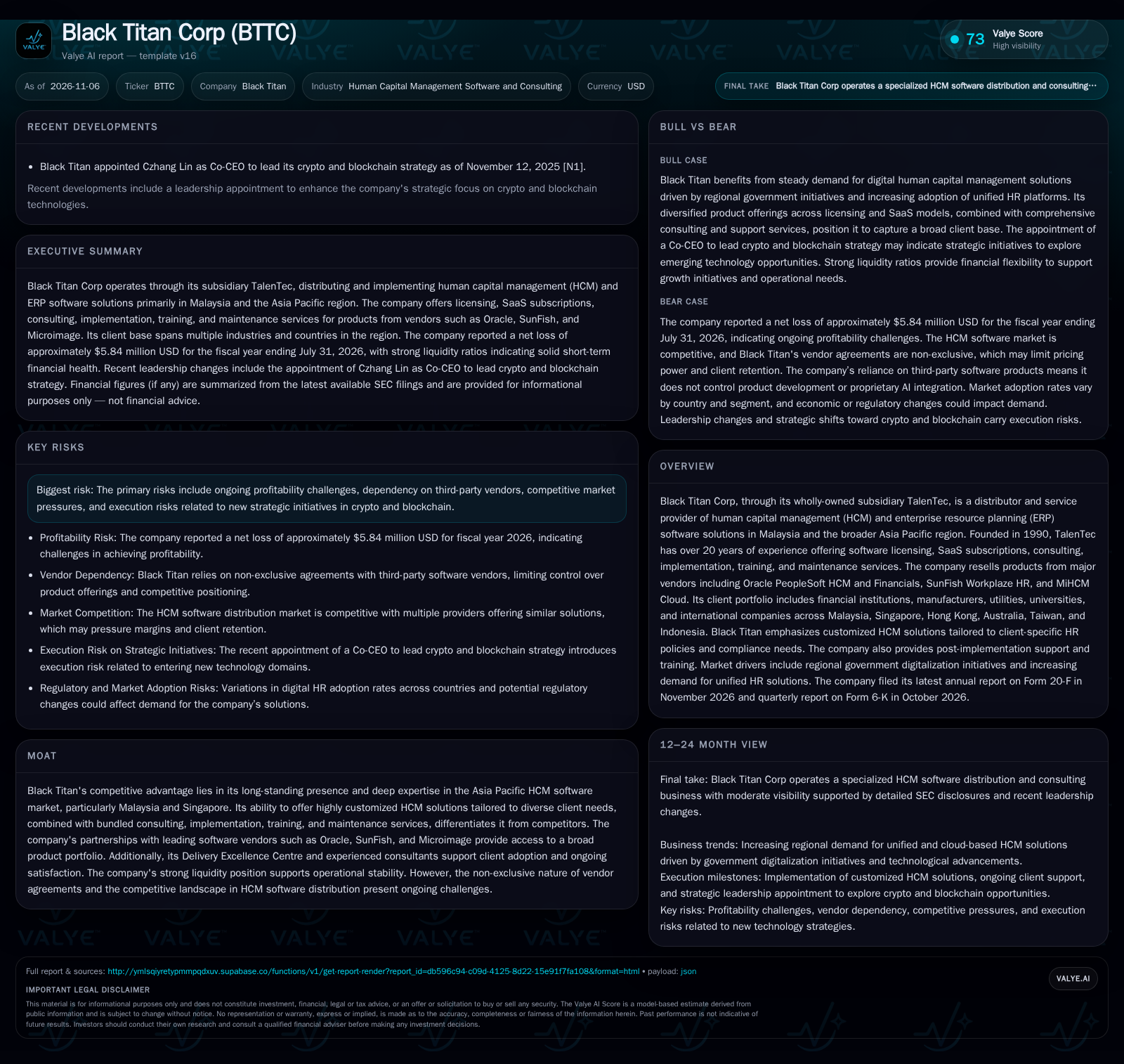
Black Titan’s business centers on reselling and customizing HCM software for clients across Southeast Asia, with most revenue tied to Oracle PeopleSoft and a service-heavy model. Recent financials show reported liquidity position but continued net losses, highlighting the tension between project complexity, vendor dependency, and the need for differentiated value as the market matures. A new Co-CEO brings blockchain ambitions, but profitability and execution remain core questions. [S1] [N1]
Black Titan Corp stands at a strategic crossroads: its TalenTec subsidiary has carved out a niche as a specialist in distributing and tailoring third-party HCM and ERP software across Southeast Asia, serving a diverse client base from banks to universities. Yet while regional demand is buoyed by digital transformation mandates and the shift to unified HR systems, Black Titan’s business model—anchored in complex, service-intensive projects and heavy reliance on Oracle PeopleSoft—faces mounting challenges.
Heavy Oracle Dependency, Service-Driven Model, and New Blockchain Ambitions Define Black Titan’s Current State
Black Titan Corp’s revenue mix in 2025 and 2026 was dominated by Oracle PeopleSoft HCM/Financials (about 70%), with SunFish Workplaze HR and MiHCM Cloud contributing smaller shares, underscoring a heavy reliance on a single vendor ecosystem. This concentration exposes the company to product roadmap risks and limits its control over feature innovation or pricing. [S1]
The company’s model bundles software licensing or SaaS subscriptions with consulting, implementation, and maintenance, resulting in project cycles that can last from six to 24 months—reflecting both a high-touch approach and a potentially lumpy revenue stream. [S1]
The company reported a current ratio of 4.4 for the period. [S1]
A recent leadership change—the appointment of Czhang Lin as Co-CEO to lead a new crypto and blockchain strategy—signals a strategic pivot to explore emerging technology domains, but also introduces fresh execution risk given the company’s legacy in traditional HCM software distribution. [N1]
Project-Heavy Customization Drives Revenue—But At What Cost?
Black Titan’s economics are shaped by its dual role as a software distributor and a high-touch professional services provider. Revenue is generated through a mix of software licensing/SaaS subscriptions and bundled consulting, implementation, training, and support. Contracts typically run one to three years, but the company’s emphasis on custom, client-specific HCM solutions means that projects are resource-intensive and can stretch over multi-quarter or multi-year cycles. [S1]
This service-heavy approach provides the opportunity for higher total contract values and deeper client integration, but it also introduces significant fixed costs around skilled personnel and project management. Operating leverage is limited unless scale and process efficiencies can be achieved—especially as the company does not own the core software IP and must share economics with vendors.
Because the company’s vendor agreements are non-exclusive, Black Titan is exposed to pricing pressures and cannot guarantee renewal, leading to potential volatility in both licensing and services revenue. The need to continually invest in technical expertise and maintain strong vendor relationships also creates ongoing capital requirements, even if short-term liquidity appears robust. If the company successfully migrates clients to SaaS and managed service models, recurring revenue and margin visibility could improve, but this transition is not yet clearly established.
Customization Depth Versus Margin Pressure in a Crowded HCM Landscape
Black Titan’s primary differentiator is its ability to deliver highly tailored HCM solutions that meet specific regional compliance and HR policy requirements, leveraging decades of implementation experience in Southeast Asia. This specialization helps win contracts with financial institutions, manufacturers, and universities that require local expertise and hands-on support. [S1]
However, the company operates in a highly competitive market with numerous local and international HCM software distributors and systems integrators, many of whom also resell Oracle, SunFish, or MiHCM solutions. Because vendor agreements are non-exclusive, clients can easily compare offerings or switch providers, limiting switching costs and reducing pricing power. As SaaS adoption accelerates, new entrants and cloud-native platforms may further intensify price and retention pressure.
Black Titan’s lack of proprietary software IP constrains its ability to differentiate on product features or innovation speed. Its competitive edge is thus rooted in services depth, local relationships, and execution reliability—advantages that are valuable but difficult to scale without eroding margins.
If Customization Becomes Stickier and Blockchain Bets Pay Off
A favorable outcome for Black Titan would involve the company leveraging its deep regional expertise to become the go-to partner for complex HCM deployments, particularly for clients with multi-country operations and strict regulatory needs. If its customization and post-implementation support prove critical to client retention, the company could see higher renewal rates, more multi-year contracts, and growing recurring revenue from SaaS and managed services.
The recent appointment of a Co-CEO to lead crypto and blockchain strategy could pay off if Black Titan is able to credibly integrate blockchain-based features (such as secure credentialing, payroll automation, or cross-border compliance tools) into its service mix or form new partnerships with vendors eager to embed these technologies. This would both diversify the revenue base and enhance competitive differentiation.
Confirmation of this scenario would require evidence of margin expansion, rising renewal rates, longer contract durations, and the successful launch (and adoption) of blockchain-enabled solutions. Falsification would be indicated by continued margin compression, stalled revenue growth, or lack of uptake for new technology initiatives.
Sustained Service Revenue, Ongoing Margin Squeeze, and Incremental Tech Adoption
The most plausible near-term scenario is that Black Titan continues to generate the bulk of its revenue from project-based HCM software distribution, with a steady but competitive flow of consulting and maintenance contracts. The company’s service-heavy model keeps it relevant for clients requiring bespoke implementation, but vendor dependency and non-exclusive agreements constrain pricing and margin improvement.
Incremental progress may be made toward SaaS and recurring revenue, but the transition is likely gradual given the complexity of client environments and the need for ongoing customization. Blockchain and crypto initiatives may remain exploratory or pilot-stage, with limited immediate impact on core financials.
Evidence supporting this scenario would include stable or modestly growing revenue, persistent net losses or thin margins, and incremental (rather than transformative) changes in contract structure or technology mix. If the company discloses new large-scale SaaS wins or blockchain-driven product launches, this would shift the base case toward the upside.
Vendor Churn, Project Delays, and Unproven Strategic Pivots Threaten Stability
A negative outcome could materialize if Black Titan loses a major vendor relationship (e.g., Oracle PeopleSoft) or faces more aggressive competition from cloud-native HCM platforms, leading to reduced renewal rates, lost contracts, or price undercutting. Project delays or implementation failures could further undermine client trust and revenue stability, especially given the long project cycles and high customization expectations.
If the company’s blockchain strategy fails to gain traction—either due to client skepticism, lack of vendor support, or regulatory barriers—resources may be diverted with little financial return, worsening losses. The risk of mounting fixed costs without corresponding revenue gains could pressure liquidity over time, despite the current reported balance sheet position.
This scenario would be confirmed by declining total revenue, contract attrition, growing net losses, and lack of adoption for new initiatives. Early warning signs would include vendor exits, project cancellations, or negative client references.
Testing Black Titan’s Thesis: Service Stickiness, Vendor Reliance, and New Tech Initiatives
Renewal and retention rates for software and service contracts—if disclosed—would clarify how sticky Black Titan’s client relationships truly are and the degree of recurring revenue.
Gross margin trends, especially as the mix shifts between licensing/SaaS and services, will indicate the company’s ability to scale without sacrificing profitability.
Any evidence of new or lost vendor partnerships, particularly with Oracle or other major suppliers, would materially impact future revenue streams and product access.
Pipeline and win rates for SaaS-based contracts versus traditional licensing would reveal the pace of transition toward higher-margin, recurring revenue.
Progress on blockchain or crypto-related product launches, client pilots, or strategic partnerships—along with associated revenue contributions—will be critical to evaluating the viability of the new technology strategy.
Client industry mix and geographic diversification trends could show whether Black Titan is successfully expanding beyond its core markets or overexposed to regional economic shifts.
Disclaimer: This is research-only, informational analysis and not investment advice. It may include AI-generated interpretation and general industry context. Always verify important details using primary sources.

Comments