
Vogenx: Liquidity Buys Time, But Clinical and Capital Execution Will Define Value
With over $82 million in liquid assets and no product revenue, Vogenx stands at the classic early-stage biotech crossroads. Its ability to convert clinical promise—led by mizagliflozin for post-bariatric hypoglycemia—into regulatory progress and eventual market traction will determine whether current market optimism proves justified or fleeting.
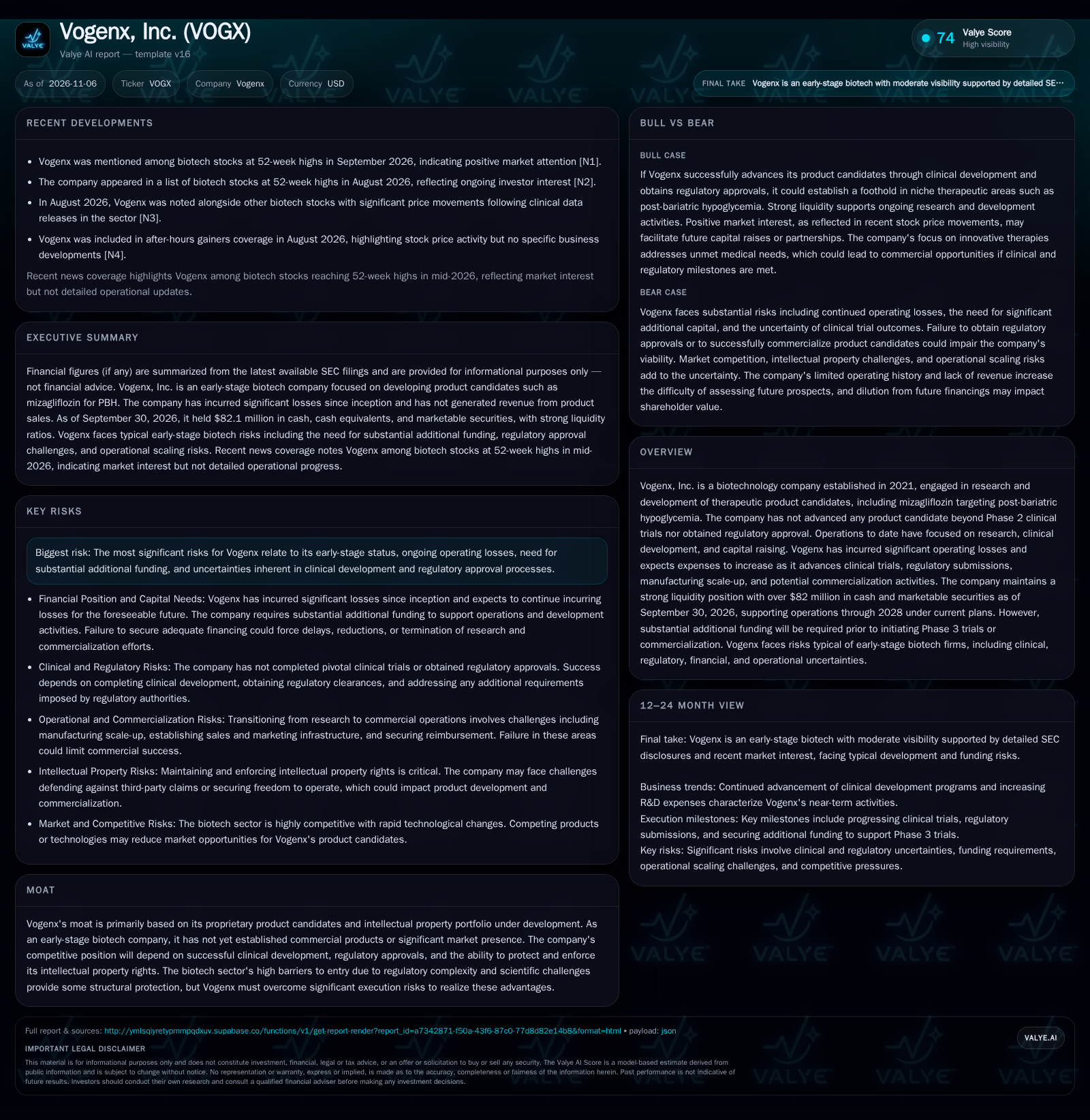
Vogenx, Inc. is an early-stage biotech with $82.1 million in liquid assets as of September 2026 and no approved products or commercial revenue. The company’s future hinges on advancing mizagliflozin beyond Phase 2 trials, securing regulatory approvals, and raising significant capital for late-stage trials and commercialization. Recent market highs reflect speculative interest, but substantial execution and funding risks remain. [S1] [N1] [N2] [N3]
Vogenx, Inc. represents the archetype of a high-potential, high-risk early-stage biotech: well-capitalized for now, but entirely pre-revenue and dependent on both clinical and financial breakthroughs to create lasting value. With $82.1 million in liquid reserves as of September 2026, the company has the runway to pursue the next leg of development for its lead candidate mizagliflozin, targeting post-bariatric hypoglycemia. However, with no pivotal trials completed and commercialization a distant prospect, the real test will be whether Vogenx can translate reported liquidity position and investor interest into clinical progress and, ultimately, a sustainable business model. [S1] [N1] [N2] [N3]
Where Vogenx Stands: reported cash balance, No Revenue, and Market Buzz
As of September 30, 2026, Vogenx reported $5.1 million in cash and cash equivalents and $77.0 million in short-term investments, totaling $82.1 million in liquid assets—significantly outweighing its current liabilities of $842,470 and resulting in a current ratio above 98. The company has not generated any product revenue and remains in the clinical development phase, with its lead candidate mizagliflozin not yet past Phase 2 trials or near regulatory submission. Recent news cycles have seen Vogenx’s stock price reach 52-week highs, but these moves reflect market sentiment rather than concrete business milestones. The combination of substantial liquidity and a lack of late-stage clinical data defines both the company’s near-term flexibility and its enduring risk profile. [S1] [N1] [N2] [N3]
Funding-Driven Model: R&D Burn Versus Future Commercial Potential
Vogenx’s current economics are typical of early-stage biotech: no product revenue, high R&D expenditures, and a reliance on external financing. The company has incurred net losses of $5.8 million for the first nine months of 2026, with an accumulated deficit of $16.6 million as of September 30, 2026. These losses are expected to grow as Vogenx advances clinical trials, initiates manufacturing scale-up, and prepares for potential commercialization—all activities that require substantial cash outlays before any revenue realization. [S1]
If clinical development succeeds and regulatory approval is obtained, the economics could shift dramatically. Biotech therapies addressing unmet needs—such as post-bariatric hypoglycemia—can command premium pricing and, if protected by strong intellectual property, may enjoy several years of limited competition. However, this future is highly contingent: failure at any stage can render sunk R&D costs unrecoverable, while success could open the door to high-margin, high-volume sales if adoption is robust and payer reimbursement is secured.
Operating leverage is inherently high in this model: fixed costs for R&D and regulatory compliance dominate until a product launch, after which incremental sales can drive rapid margin expansion. However, the transition from development to commercialization typically requires additional investment in sales, marketing, and manufacturing infrastructure, which means capital needs may spike before positive cash flow is achieved.
Barriers and Headwinds: IP, Clinical Execution, and the Biotech Gauntlet
Vogenx’s competitive moat, at this stage, is largely theoretical—built on proprietary product candidates and developing intellectual property rather than established market share. The lead indication, post-bariatric hypoglycemia, represents a niche but potentially underserved market. If mizagliflozin demonstrates compelling efficacy and safety in later-stage trials, first-mover advantage and IP protection could provide a window for value capture.
However, the broader biotech sector is fiercely competitive, with larger pharmaceutical companies, other biotechs, and academic groups all pursuing overlapping metabolic and endocrine indications. Fast followers or alternative mechanisms of action could erode Vogenx’s opportunity, especially if competitors reach the market first or offer superior clinical profiles.
Switching costs in rare disease or specialty indications can be moderate if a product becomes the standard of care, but achieving that status requires not just approval but compelling clinical data, physician adoption, and reimbursement support. Regulatory complexity and the high cost of clinical trials create barriers to entry, but these same hurdles also increase execution risk for Vogenx.
From Clinic to Market: How Success Could Compound
In a favorable scenario, Vogenx’s mizagliflozin advances successfully into and through Phase 3 trials, demonstrating statistically significant benefits for post-bariatric hypoglycemia with a clean safety profile. Regulatory approval—either as a standalone or via a partnership with a larger pharmaceutical company—would validate years of investment and unlock the potential for commercial sales in an underserved indication.
This could lead to rapid revenue growth, especially if payer coverage is secured and the drug is adopted by specialist physicians. The company’s liquidity would enable it to negotiate from a position of strength, either retaining full commercialization rights (with higher risk/reward) or out-licensing to a partner (trading upside for near-term milestone payments and lower risk).
Evidence that would confirm this trajectory includes: successful completion of pivotal trials, positive regulatory feedback (such as Fast Track or Breakthrough Therapy designation), announced commercial partnerships, and initial revenue guidance post-approval. Conversely, delays in trial enrollment, inconclusive data, or regulatory setbacks would weaken the upside case.
Clinical Progression and Capital Raising: The Most Likely Next Steps
The most plausible outcome for Vogenx over the next 12–24 months is incremental clinical progress with mizagliflozin, supported by ongoing R&D activity and careful cash management. [S1]
Given the typical timelines and costs for late-stage biotech development, Vogenx will almost certainly need to raise more capital (equity or partnership) prior to commercialization. Moderate delays or additional expenses are common at this stage, and the risk of dilution for existing shareholders is high.
Falsification would involve rapid cash depletion, failed clinical trials, or an inability to secure new funding, all of which could force a strategic pivot or asset sale.
Clinical or Funding Failure: The Path to Value Erosion
The primary risk for Vogenx—shared by most early-stage biotechs—is the failure of its lead candidate in pivotal trials, which would likely eliminate the near-term commercial opportunity and leave the company with limited salvage value. Even with reported liquidity position, a negative clinical outcome could force retrenchment, layoffs, or a search for strategic alternatives (e.g., asset out-licensing or sale at distressed valuations).
Intellectual property challenges or competitive setbacks (such as a rival therapy gaining approval first) would further erode the company’s prospects.
Evidence confirming the downside would include failed clinical endpoints, regulatory rejections, negative safety signals, or a material increase in cash burn without offsetting financing. A sharp drop in market capitalization following such developments would also be expected.
What Will Determine Whether Vogenx Delivers on Its Clinical Ambitions?
Progression of mizagliflozin into and through pivotal (Phase 3) clinical trials, including trial initiation dates, enrollment rates, and top-line data disclosures.
Updates on regulatory interactions, such as feedback from the FDA or EMA, and any designation that could accelerate review (Fast Track, Breakthrough Therapy, etc.).
Cash burn rate and quarterly liquidity updates, as these will determine the timing and urgency of future capital raises.
Announcements of new equity financing, partnership deals, or non-dilutive funding (if disclosed), which would signal market confidence and reduce near-term funding risk.
Milestones related to manufacturing scale-up or commercial readiness (if disclosed), as these are prerequisites for a successful product launch.
Intellectual property developments, including new patent grants or resolutions of IP challenges (if disclosed), to assess the durability of any future competitive advantage.
Competitive landscape changes—such as rival therapies entering pivotal trials or gaining approval for the same indication—which could affect Vogenx’s market opportunity.
Market reactions to clinical and regulatory news, providing a secondary gauge of investor confidence and perceived execution risk.
Disclaimer: This is research-only, informational analysis and not investment advice. It may include AI-generated interpretation and general industry context. Always verify important details using primary sources.

Comments