
El Pollo Loco’s Expansion Strategy: Remodeling, Loyalty, and Scaling Cash Flow
With system-wide sales growth and ongoing unit expansion, El Pollo Loco is leveraging remodels and digital engagement to drive relevance in the fast-casual segment.
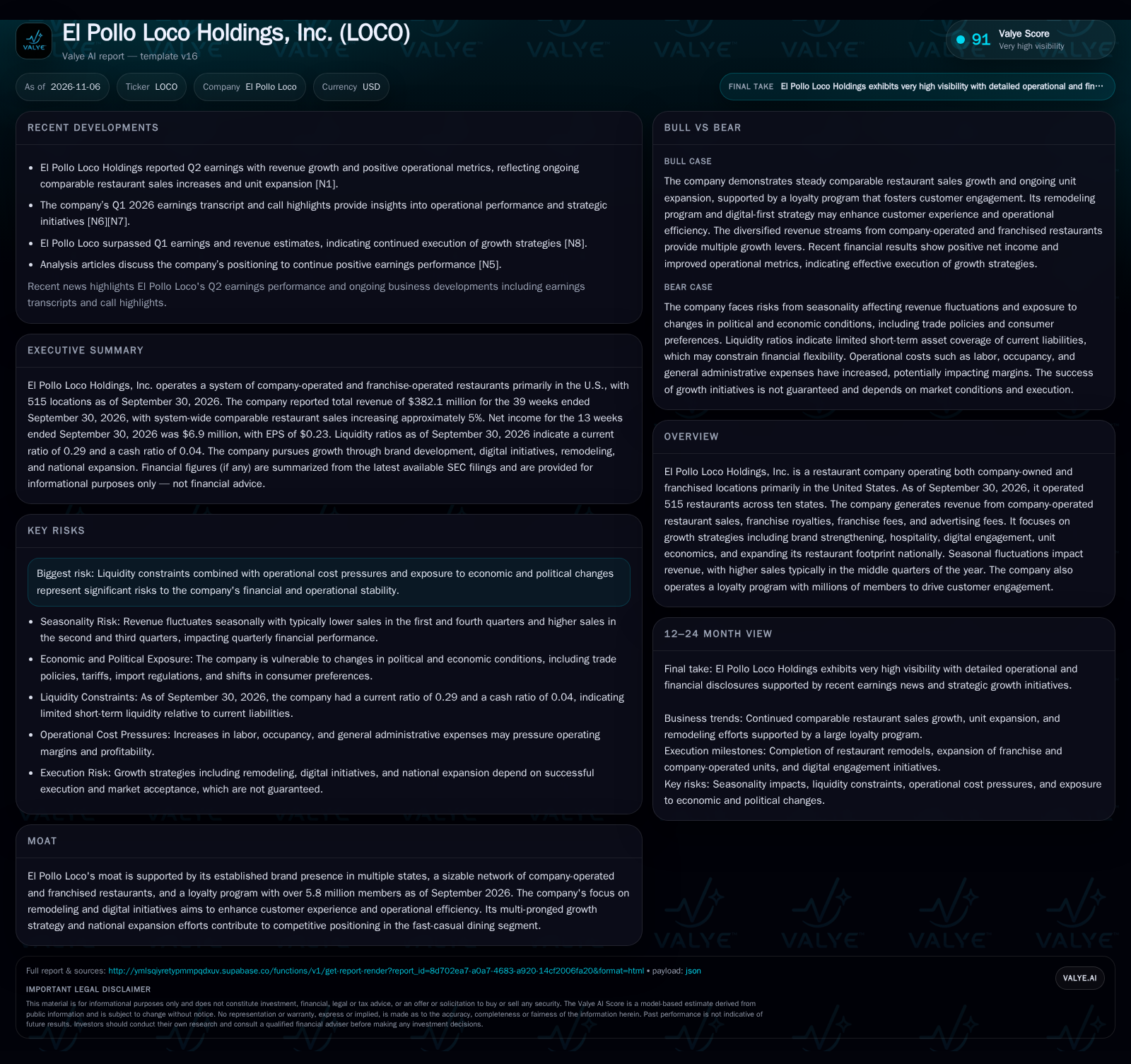
El Pollo Loco continues to post solid comparable sales growth and open new restaurants, supported by a large loyalty program and an active remodel initiative. [S2]
El Pollo Loco Holdings, Inc. is pursuing growth on multiple fronts: steady comparable sales gains, a remodeling program aimed at refreshing its store base, and a digital-first approach epitomized by its large loyalty program. This creates a tension between the ambition to scale and the practical need to preserve margins and potential financial flexibility—especially as the fast-casual landscape becomes more competitive and operationally demanding.
Growth Momentum Meets Liquidity Constraints in 2026
The company reported $382.1 million in revenue for the first 39 weeks of 2026, with system-wide comparable restaurant sales up nearly 5% for both the recent quarter and year-to-date—a sign of resilient demand and successful sales strategies. Unit expansion continues, with 12 new restaurants (3 company-operated, 9 franchised) opened and 45 remodels completed in the same period. The Loco Rewards loyalty program now counts over 5.8 million members, providing a foundation for digital engagement and potentially higher visit frequency. The company reported cash and liquidity metrics for the period; these figures do not by themselves establish operating runway, investment capacity, financial flexibility, or financing capacity. [S2]
Revenue Streams, Cost Pressures, and the Economics of Expansion
Franchising changes the revenue and cost mix; actual segment margins depend on the company's disclosed economics. In the most recent quarter, company-operated restaurant revenue was $105.4 million, with franchise and advertising fees contributing $20.9 million. This mix allows for revenue diversification, but also means that growth in company-operated units brings higher fixed and variable costs—particularly labor, occupancy, and food inputs. Recent cost data shows food and paper at $25.8 million, labor at $32.1 million, and occupancy/other operating expenses at $28.2 million for the quarter. Operating leverage is achievable as volumes rise, but wage inflation, rent escalation, and administrative costs can compress margins if not offset by pricing or traffic gains. The remodel program and digital initiatives are capital- and resource-intensive, with uncertain near-term payback. Given the low current and cash ratios, any misstep in cost control or traffic could quickly translate to margin pressure or the need for external financing. [S2]
Franchise expansion, in contrast, offers higher-margin, asset-light growth, but franchise fee and royalty streams are smaller per unit and depend on franchisee health and system-wide brand strength. If El Pollo Loco can shift the mix toward franchise-driven growth while maintaining brand standards, it could enhance return on invested capital and reduce direct exposure to operating cost volatility.
The interplay between franchising and company-operated units introduces a nuanced dynamic in capital allocation decisions. While franchising reduces capital expenditure and operational risk for the company, it also limits direct control over customer experience and operational execution—factors critical in a competitive fast-casual environment. Therefore, the company must balance the benefits of asset-light growth against the potential dilution of brand consistency and customer satisfaction, which could impact long-term system-wide sales growth and royalty income. Furthermore, the timing and scale of remodel investments require careful prioritization to avoid overextension of capital while maximizing the impact on customer retention and incremental sales.
Brand Strength, Digital Engagement, and the Fast-Casual Battleground
El Pollo Loco’s competitive position is anchored by its established brand, especially in the Southwestern U.S., and a network of 515 restaurants across ten states. The company’s loyalty program, with 5.8 million members, provides a digital touchpoint and a potential moat if it can drive repeat visits and personalized marketing. However, the fast-casual segment is crowded, with competitors ranging from regional Mexican concepts to national chains with greater scale and digital reach. Sustained differentiation may depend on menu innovation, speed of service, and the success of digital ordering and engagement platforms. Remodeling and store refreshes can improve customer perception and operational efficiency but require ongoing investment.
Digital engagement through a loyalty program can serve as a powerful tool for data-driven decision-making, enabling segmentation and personalized marketing that could increase guest frequency and average ticket size. However, the effectiveness of such programs depends heavily on the quality of data analytics and the ability to translate insights into actionable promotions without eroding margins through excessive discounting. Additionally, as digital ordering becomes more prevalent, the company must ensure that its technology infrastructure supports seamless integration with third-party delivery platforms and in-house operations, as friction in these areas could negate the benefits of increased digital engagement.
In the context of fast-casual competition, menu innovation plays a pivotal role in sustaining differentiation and driving repeat visits. Yet, innovation must be balanced with operational simplicity to maintain speed of service and cost efficiency. Introducing new menu items or limited-time offers can attract trial and broaden appeal, but these initiatives require robust supply chain management and staff training to avoid execution risks. Moreover, as consumer preferences evolve toward health-conscious and convenience-oriented options, the company’s ability to anticipate and respond to these trends will influence its competitive positioning and growth trajectory.
Leveraging Remodels and Loyalty to Drive Sustainable Margin Expansion
In a favorable scenario, El Pollo Loco’s remodel program and digital initiatives generate a tangible uplift in traffic and average check, boosting same-store sales beyond the current 5% pace. If loyalty program data enables targeted promotions and improved retention, digital ordering penetration could rise, supporting labor efficiency and higher margins. Franchise expansion accelerates, shifting the unit mix toward asset-light, higher-margin revenue streams. Evidence for this scenario would include continued outperformance on comparable sales, rising franchise royalty and fee income as a share of total revenue, and margin expansion even as unit growth continues.
Incremental Growth with Persistent Margin and Liquidity Tension
The most plausible trajectory is continued modest same-store sales growth and incremental unit expansion, with remodels and digital initiatives delivering gradual improvements but not transformative gains. Operational cost pressures—including labor and occupancy—remain, and the company manages to offset these through pricing and menu tweaks, but margin expansion is limited. Liquidity remains tight, constraining the pace of company-operated growth and making external financing or a focus on franchise-led expansion more likely. Progress is steady but exposed to shocks from wage inflation, consumer demand swings, or execution missteps.
Margin Compression and Capital Constraints Limit Strategic Flexibility
In a negative scenario, rising labor, food, and occupancy costs outpace sales growth, compressing restaurant-level and corporate margins. If remodels and digital investments fail to drive incremental traffic or check size, the company could see stagnating or even declining comparable sales. Liquidity constraints could force a pullback in new unit development or require expensive external financing, which would further pressure earnings. Franchisees, facing the same margin headwinds, could slow expansion or reduce reinvestment, threatening system-wide growth. Downside evidence would include declining or flat same-store sales, sequential margin erosion, a further drop in the current ratio, and negative free cash flow. Early warning signs might also include franchisee closures or reduced interest in new development agreements.
What Will Determine El Pollo Loco’s Ability to Scale and Defend Margins?
Sustained system-wide comparable restaurant sales growth above the 4-5% range would indicate successful execution of traffic and check-driving initiatives.
Franchise versus company-operated unit growth rates—if disclosed—would clarify the strategic tilt and margin implications of expansion.
Progress on remodel completions and their impact on same-store sales uplift, if quantified, would help test the ROI of capital spending.
Changes in labor, food, and occupancy cost trends as a percentage of revenue will reveal whether cost inflation is being managed or absorbed.
Growth in loyalty program membership and, more importantly, its impact on visit frequency and digital ordering penetration—if disclosed—would validate digital strategy efficacy.
Franchisee health, as evidenced by new development agreements, franchisee closures, or system-wide royalty collection rates, would show the resilience of the asset-light model.
Seasonal revenue and margin patterns, especially in the first and fourth quarters, should be monitored for outsized volatility or deviation from historical norms.
Disclaimer: This is research-only, informational analysis and not investment advice. It may include AI-generated interpretation and general industry context. Always verify important details using primary sources.

Comments