
bioAffinity Technologies: Commercializing AI-Driven Lung Diagnostics Amid Capital and Adoption Hurdles
bioAffinity’s CyPath® Lung test leverages AI and flow cytometry to address the critical challenge of early-stage lung cancer detection, but the path to sustainable commercialization is complicated by funding needs, regulatory uncertainties, and the realities of market adoption.
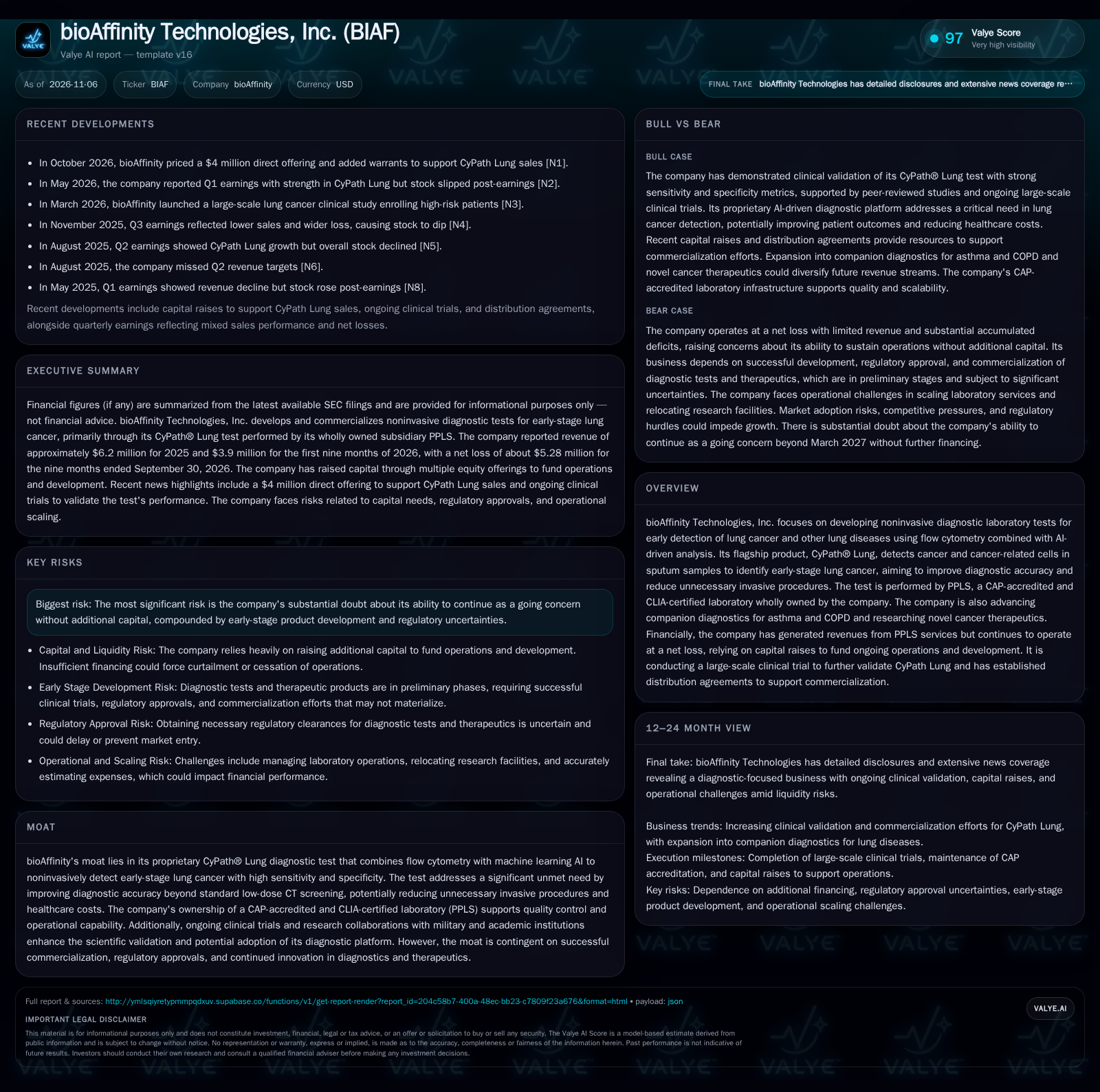
bioAffinity Technologies has achieved early clinical and commercial milestones with its CyPath® Lung diagnostic test, showing high sensitivity and specificity for early-stage lung cancer. The company is scaling up through clinical trials and new distribution channels, but ongoing net losses and an explicit going-concern warning highlight acute capital dependence. Success hinges on broad clinical validation, payer acceptance, and the company’s ability to secure additional funding by 2027. [S2] [N1] [N3]
bioAffinity Technologies sits at the intersection of AI-enabled diagnostics and urgent clinical need, offering a noninvasive sputum-based test for early-stage lung cancer through its CyPath® Lung platform. The company has demonstrated strong clinical metrics and begun to generate revenue via its CLIA-certified laboratory, yet it remains in a precarious financial position, with a substantial net loss and explicit warnings about its ability to continue as a going concern past March 2027 without new capital. The next phase of value creation depends on clinical trial results, commercial adoption, and the ability to manage operational scale while securing additional funding.
Recent Developments Reshape bioAffinity’s Commercialization Trajectory
Several developments over the past year have altered bioAffinity Technologies’ near-term outlook. Most notably, the company completed a $4 million direct offering with warrants in October 2026 to fund CyPath® Lung sales and working capital, underlining ongoing capital needs. [N1] Operationally, bioAffinity launched a large-scale clinical trial in March 2026 enrolling high-risk patients with indeterminate pulmonary nodules, aiming to further validate CyPath® Lung’s clinical performance and support broader adoption. [N3] As of September 30, 2026, the company reported $3.9 million in revenue for the year-to-date but continued to operate at a net loss of $5.28 million. [S2] The company’s current assets stand at $3.83 million against current liabilities of $2.53 million, with an explicit statement of substantial doubt regarding its ability to continue as a going concern beyond March 2027 without additional capital. [S2] These facts highlight both progress in clinical validation and active commercialization, as well as persistent financial risk.
Diagnostic Revenue Model Faces Scaling and Margin Challenges
bioAffinity’s primary revenue stream comes from clinical diagnostic testing performed in its wholly owned, CAP-accredited laboratory. The economics of diagnostic labs are shaped by test volume, reimbursement rates, payer mix, and operational efficiency. CyPath® Lung’s clinical performance—92% sensitivity, 87% specificity, and 88% accuracy for small nodules—could support premium pricing and payer adoption if validated at scale. [S2] However, the current revenue base ($3.9 million in the first nine months of 2026) is insufficient to cover operating expenses, as evidenced by persistent net losses. [S2]
Scaling this business will require significant increases in test volume, which depend on physician adoption, payer coverage, and integration into lung cancer screening workflows. Fixed costs—laboratory infrastructure, compliance, and R&D—dominate at this stage, so operating leverage could improve if volume ramps. Variable costs per test (reagents, labor, logistics) must remain low to preserve gross margin as volume grows. The capital-intensive nature of laboratory expansion and ongoing R&D for pipeline diagnostics and therapeutics means recurring capital raises are likely unless the company achieves breakeven volume or secures non-dilutive funding.
Future revenue diversification could come from companion diagnostics (asthma, COPD) and novel therapeutics, but these are in early development and not yet revenue-generating. If CyPath® Lung can demonstrate clear clinical and economic value—reducing unnecessary invasive procedures and downstream costs—it could justify higher reimbursement, but widespread payer acceptance remains unproven.
Navigating a Crowded Lung Diagnostics Market with AI-Driven Differentiation
bioAffinity competes in a crowded and rapidly evolving lung diagnostics landscape. Its main differentiator is the use of flow cytometry combined with machine learning to analyze sputum samples, offering a noninvasive alternative to tissue biopsy or low-dose CT alone. The test’s high sensitivity and specificity for early-stage lung cancer could position it favorably against traditional cytology, imaging, and emerging liquid biopsy approaches. [S2]
However, barriers to entry in diagnostics are lower than in therapeutics, and competitors—ranging from established diagnostics companies to startups leveraging genomics or proteomics—are continually seeking to improve early detection. Adoption by clinicians will depend on robust clinical trial validation, real-world evidence, workflow integration, and payer reimbursement. CAP and CLIA accreditation for the company’s laboratory supports credibility, but national scale requires broader commercial partnerships or payer coverage.
The company’s ongoing large-scale clinical trial and recent federal distribution agreement may help establish clinical and commercial legitimacy. Yet, the risk remains that larger diagnostics firms, with established sales channels and payer relationships, could accelerate competing offerings or bundle tests, potentially compressing pricing or limiting adoption.
Clinical Validation and Payer Adoption Unlock a Step-Change in Volume
The most favorable outcome for bioAffinity is that its large-scale clinical trial demonstrates CyPath® Lung’s ability to improve the positive predictive value of lung cancer screening, leading to strong guideline endorsements and broad payer coverage. This, in turn, drives significant acceleration in test volume, allowing the company to leverage its existing laboratory infrastructure and approach operating breakeven.
Proof points would include peer-reviewed publication of trial data, positive endorsements by major clinical societies, and announcements of payer contracts or reimbursement approvals. If the company’s federal distribution agreement translates into substantial orders and recurring revenue, it could further validate commercial traction. Expansion into companion diagnostics for asthma and COPD—if validated and commercialized—would diversify revenue and enhance the platform’s value. Under this scenario, successful fundraising or non-dilutive grants would support continued R&D and operational growth.
Incremental Adoption and Ongoing Capital Raising Define the Middle Path
The most plausible path is one of incremental clinical validation and modest commercial adoption. The large-scale trial yields positive but not game-changing results, leading to gradual increases in physician adoption and payer engagement rather than immediate guideline inclusion. Revenue continues to grow, but at a pace insufficient to achieve near-term profitability, requiring further dilutive equity raises or strategic partnerships to fund operations through at least 2027.
Evidence supporting this scenario would be steady, if unspectacular, revenue growth; periodic capital raises; and continued investment in R&D and pipeline diagnostics. Watch for mixed signals in quarterly earnings—such as revenue gains offset by persistent net losses and cash burn—as indicators of this middle ground. This scenario would also see the company maintaining regulatory compliance and laboratory accreditation, but facing ongoing challenges in scaling test volume and achieving national payer coverage.
Capital Shortfall and Market Barriers Threaten Continuity
The adverse scenario features one or more critical breaks in the value chain: the large-scale clinical trial fails to deliver compelling evidence, limiting clinical adoption and stalling payer reimbursement. In this context, revenue growth stagnates or declines, and the company is unable to raise sufficient capital to fund ongoing operations. This scenario is underscored by the explicit going-concern warning, which states that bioAffinity may not be able to continue as a going concern beyond March 2027 without additional funding. [S2]
Additional risks include operational setbacks—such as delays in relocating research operations or issues maintaining laboratory accreditation—as well as competitive displacement by larger, better-funded diagnostics players. Under these conditions, bioAffinity could be forced to curtail development, seek a distressed sale, or wind down operations. Confirming evidence would include negative trial results, failed fundraising efforts, or announcements of cost-cutting measures and staff reductions.
Milestones and Metrics That Will Shape bioAffinity’s Value Proposition
Results and peer-reviewed publication of the large-scale clinical trial for CyPath® Lung—especially sensitivity, specificity, and impact on clinical decision-making.
Updates on payer coverage decisions and reimbursement rates for CyPath® Lung; contracts with major commercial insurers or Medicare would be pivotal.
Trends in test volume processed at the PPLS laboratory; a useful metric would be quarterly growth in billable diagnostic tests, if disclosed.
Revenue growth relative to operating expenses and cash burn; specifically, whether revenue gains are sufficient to narrow net losses over consecutive quarters.
Progress on the development and validation of companion diagnostics for asthma and COPD, including pilot study results or regulatory submissions.
Updates on capital raising—either equity offerings or non-dilutive grants—and management’s guidance on cash runway through 2027.
Operational updates on the relocation of research facilities and the maintenance of CAP and CLIA accreditation.
Announcements regarding new distribution agreements, partnerships, or expansion into additional geographies.
Disclaimer: This is research-only, informational analysis and not investment advice. It may include AI-generated interpretation and general industry context. Always verify important details using primary sources.

Comments