
TPG Mortgage Investment Trust: Portfolio Resilience Tested by Earnings Pressure, Merger Uncertainty, and Shifting Mortgage Markets
TPG Mortgage Investment Trust (MITT) faces a complex landscape: persistent earnings pressure, challenging market dynamics, and the integration risks of its proposed Cherry Hill merger. With a diversified portfolio anchored by non-agency residential assets and proprietary origination via Arc Home, MITT’s near-term performance will hinge on managing funding costs, capitalizing on securitization capabilities, and navigating volatile credit spreads.
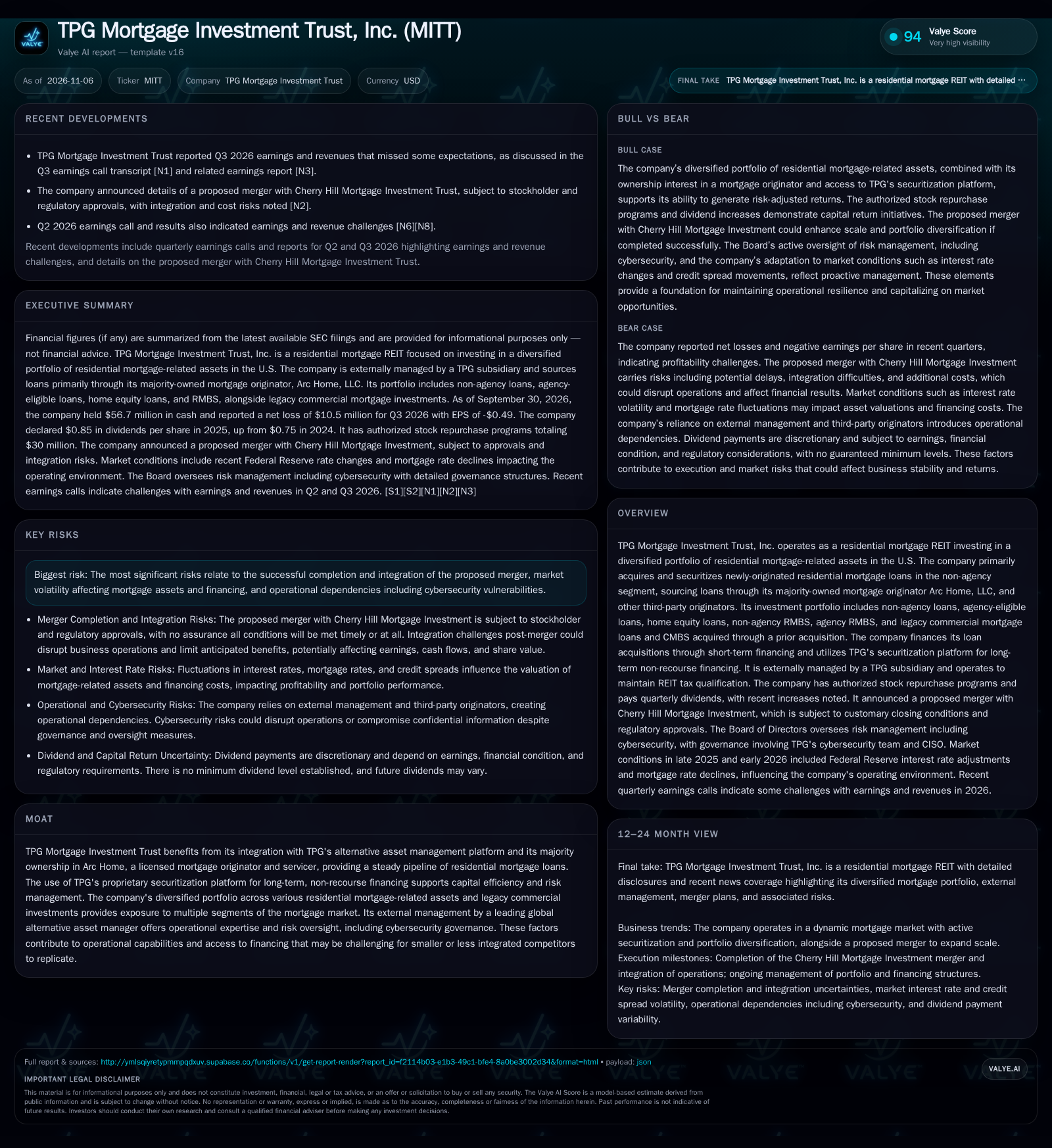
MITT is a residential mortgage REIT with a focus on non-agency loans, sourcing assets through its majority-owned originator Arc Home and external channels. The company reported a net loss in Q3 2026 and has missed earnings expectations for two consecutive quarters, underscoring profitability challenges. The pending Cherry Hill merger could provide scale and diversification, but also introduces execution and integration risks. Market headwinds include interest rate volatility and tightening credit spreads, which impact both asset values and funding economics. MITT’s ability to convert short-term financing into long-term, non-recourse structures and maintain dividend stability will be critical to its investment case in the coming quarters. [S2] [N1] [N3] [N8]
TPG Mortgage Investment Trust (MITT) is at a critical juncture. Its core strategy—a diversified, risk-adjusted portfolio of residential mortgage assets sourced via direct origination and third-party channels—now faces significant profitability pressure amid challenging market conditions and two consecutive quarters of missed expectations. The company’s pending merger with Cherry Hill Mortgage Investment could provide a step-change in scale and diversification, but also brings its own set of execution and integration challenges. As MITT navigates volatile funding markets, evolving credit spreads, and the need for operational discipline, the next several quarters will be a litmus test for its ability to deliver on its REIT mandate.
Q3 Losses, Dividend Uncertainty, and Merger Execution Define the Current Moment
TPG Mortgage Investment Trust reported a net loss of $10.5 million for Q3 2026, translating to basic and diluted EPS of -$0.49. This marks the second consecutive quarter of earnings and revenue shortfalls, as Q2 2026 also saw results below expectations. The company held $56.7 million in cash at the end of Q3, and while authorized stock repurchase capacity remains, dividend payments—$0.85 per share in 2025, up from $0.75 in 2024—are not assured for the future. Against this backdrop, MITT is pursuing a merger with Cherry Hill Mortgage Investment, which, if completed, could reshape its portfolio and risk profile. However, management has flagged risks related to merger completion, integration, and potential cost overruns. These developments underscore a period of heightened operational and strategic uncertainty for MITT. [S2] [N1] [N2] [N3] [N8]
How MITT’s Portfolio Construction and Funding Model Drive Returns—and Risks
MITT generates revenue primarily through net interest income and gains on the sale or securitization of residential mortgage loans. Its portfolio construction—anchored by non-agency and agency-eligible loans, home equity loans, and RMBS—enables yield pickup beyond agency-only peers but exposes the company to greater credit and liquidity risk. Direct origination via Arc Home (66% owned) provides access to newly originated loans and servicing economics, but also brings exposure to origination market cyclicality and operational risk.
On the funding side, MITT relies on short-term warehouse lines to acquire assets, then seeks to convert these into long-term, non-recourse, non-mark-to-market securitizations through TPG’s platform. This structure can mute liquidity risk and reduce exposure to sudden margin calls, but the transition is not frictionless—timing mismatches between asset sourcing and securitization, or adverse market conditions, can drive NIM compression or mark-to-market volatility. The use of external management (TPG Angelo Gordon) introduces another layer of fees, which can pressure core earnings during periods of asset underperformance.
Dividend payments are a core part of the REIT value proposition, but are ultimately a function of distributable net income, which is vulnerable to swings in prepayment rates, credit performance, and funding costs. The company’s capital allocation—balancing buybacks, dividends, and new investments—must be nimble to adapt to changing market conditions.
Securitization Capabilities and Origination Pipeline: Where MITT May Stand Out—And Where It’s Exposed
MITT’s integration with TPG’s securitization platform offers a structurally advantaged pathway to long-term, non-recourse financing, differentiating it from smaller or less integrated mortgage REITs that may face higher funding costs or greater liquidity risk. Majority ownership in Arc Home provides a proprietary origination pipeline, potentially enhancing asset quality control and loan selection versus REITs that rely solely on third-party flow.
However, the company faces stiff competition from other non-agency mortgage REITs, specialty finance companies, and GSE-backed entities, all of which are seeking yield in a crowded market. The external management structure, while providing institutional expertise, can also be a double-edged sword—management fees may erode returns, and alignment with public shareholders is always a question in externally managed REITs.
Substitute products—such as agency RMBS, whole loan sales, or direct lending vehicles—could attract capital flows away from MITT’s core non-agency segment if risk-adjusted spreads compress further. Moreover, any deterioration in Arc Home’s origination volumes or credit performance would directly impair MITT’s ability to source and monetize attractive assets.
If Securitization Pipelines Flow and the Merger Delivers Scale, Recovery Is Plausible
A favorable scenario for MITT would require several moving parts to align: the successful completion and smooth integration of the Cherry Hill merger, stabilization or further tightening in RMBS credit spreads, and an improvement in origination margins at Arc Home. If MITT can efficiently convert a high volume of newly originated loans into long-term, non-recourse securitizations, it could lock in attractive spreads and reduce funding volatility.
Evidence confirming this scenario would include: a return to positive EPS, improved book value per share, successful execution of accretive securitizations, and visible merger synergies in the form of reduced per-loan costs or enhanced asset diversification. A competitive advantage in sourcing and financing, combined with scale benefits from the merger, could set MITT apart in the next cycle.
Navigating Margin Pressure and Execution Risk in a Volatile Mortgage Market
The most plausible near-term scenario is one of continued earnings volatility as MITT manages through challenging market conditions and the operational complexity of the merger process. Margins may remain under pressure due to a combination of elevated funding costs, tight credit spreads, and uncertain origination volumes from Arc Home.
Incremental progress on portfolio repositioning—such as opportunistic exits of legacy commercial assets or selective buybacks—could provide some support to book value, but any material improvement in profitability likely requires either a market tailwind (e.g., wider credit spreads or lower funding costs) or a successful merger integration. Evidence supporting this scenario would include continued (but reduced) net losses, stable cash balances, moderate buyback activity, and management commentary emphasizing risk management and operational discipline.
Adverse Credit or Integration Shocks Could Compound Profitability and Liquidity Strains
Downside risk centers on further deterioration in earnings, driven by a combination of adverse credit performance in the non-agency loan book, widening funding spreads, or operational disruption from a troubled merger integration. If Arc Home’s origination pipeline slows significantly or credit losses rise, MITT could face both lower asset returns and elevated servicing costs.
A failed or delayed Cherry Hill merger could leave the company with stranded integration costs, limited portfolio diversification, and weakened investor confidence. Dividend reductions or suspensions could follow, especially if distributable net income falls below minimum REIT requirements. Evidence confirming a downside scenario would include: additional quarters of negative EPS, declining book value per share, increases in non-performing loans or loan loss provisions, and missed or reduced dividend payments.
Testing the Thesis: What Will Determine MITT’s Path Forward
Quarterly net interest margin (NIM) trends—if disclosed—would clarify the impact of funding and asset yield dynamics on core profitability.
Origination volumes and credit performance at Arc Home, especially non-agency and non-QM loan production, will indicate the health of MITT’s proprietary pipeline.
Execution and sizing of new securitizations: volume, pricing, and terms relative to market benchmarks will reveal MITT’s ability to convert assets to stable funding.
Merger integration milestones: regulatory approvals, cost synergies, and operational unification with Cherry Hill should be tracked for signs of smooth or troubled execution.
Book value per share evolution, especially in relation to peer mortgage REITs, will help assess the effectiveness of portfolio and risk management.
Disclosure of non-performing loan rates or realized credit losses, if provided, would offer insight into underlying asset quality stress.
Any commentary or disclosures regarding refinancing risk and mark-to-market exposure on short-term financing lines would help evaluate liquidity resilience.
Disclaimer: This is research-only, informational analysis and not investment advice. It may include AI-generated interpretation and general industry context. Always verify important details using primary sources.

Comments