
Power REIT at a Crossroads: Monetization, Concentration Risk, and the Challenge of Surviving a Liquidity Squeeze
The company's future hinges on asset monetization, capital structure management, and its ability to diversify income streams away from its troubled Greenhouse Portfolio.
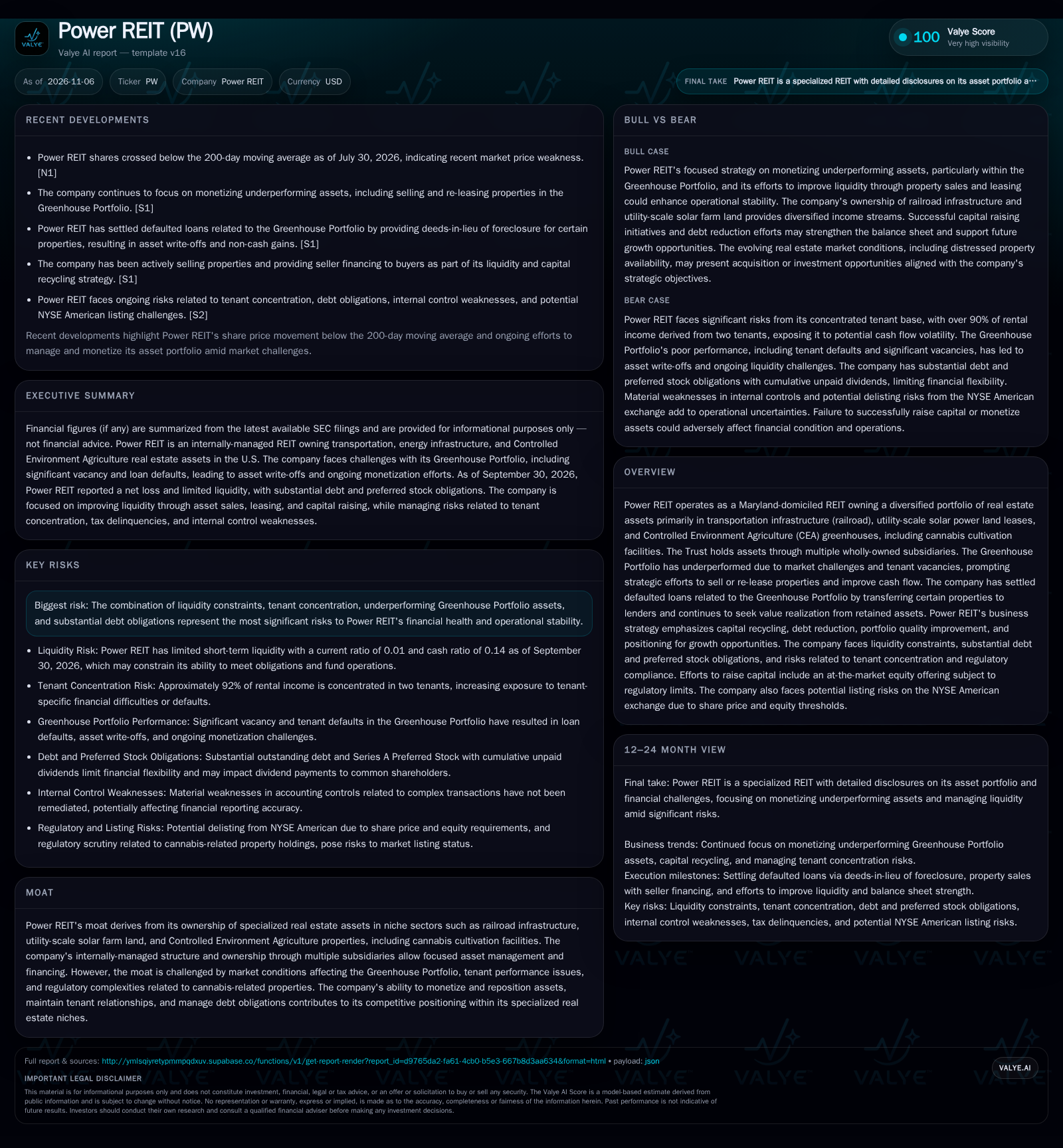
Power REIT’s business now revolves around monetizing and repositioning a troubled asset base, with survival contingent on successful asset sales, tenant diversification, and balance sheet repair. The company’s concentrated rental income, minimal liquidity, and unresolved tax and debt issues mean its future remains highly uncertain. [S1] [S2]
Power REIT stands at a critical juncture, with its future hinging on the successful monetization of underperforming assets and urgent efforts to shore up liquidity. As it races to sell or re-lease troubled properties—particularly within its Greenhouse Portfolio—Power REIT’s ability to diversify income, manage debt, and maintain its public listing will determine whether it can pivot from survival mode to a path of recovery and growth. [S1] [S2]
Liquidity Crunch and Tenant Dependence Define the Immediate Outlook
The company reported cash and liquidity metrics for the period; these figures do not by themselves establish operating runway, investment capacity, financial flexibility, or financing capacity. The company also posted a net loss of about $135,713 for the third quarter and faces an accumulated deficit of roughly $52.5 million. [S2]
The risk profile is compounded by substantial leverage: $19.7 million in debt and $8.5 million par value in Series A Preferred Stock with $2.6 million in unpaid cumulative dividends. [S2]
Operationally, the Greenhouse Portfolio remains a drag, with significant vacancies, poor tenant performance, and ongoing property tax delinquencies that could trigger tax foreclosures as early as 2026. [S1] [S2]
How Asset Monetization and Lease Structures Drive—and Limit—Earnings Potential
Power REIT’s revenue model is fundamentally based on lease income from specialized real estate assets—railroad infrastructure, solar farm land, and greenhouses. In theory, such assets can offer stable, long-term cash flow if tenants are financially robust and contracts are well-structured. However, with the Greenhouse Portfolio underperforming and the company reliant on only two tenants for almost all income, the economics have shifted from a stable yield play to a distressed-asset monetization story.
Asset sales and seller-financing arrangements have become central to the company’s capital recycling strategy. The economics of these transactions depend on the company’s ability to realize book or above-book value on sales, the pricing of seller financing (risk-adjusted returns), and the speed at which proceeds can be redeployed or used to reduce debt. However, in distressed real estate markets—especially for cannabis-linked greenhouses—realization values are typically pressured, and sales may take place at a discount.
The company’s fixed obligations are high, with substantial debt service and preferred stock dividends accruing regardless of operating performance. This creates a structural mismatch: lease income is largely fixed, but so are outflows, leaving little margin for error if occupancy or rent collection falters. The absence of a diversified tenant base further amplifies this risk, as even minor lease disruptions could cascade into a cash shortfall.
Operating leverage is currently negative: incremental asset sales may reduce interest expense, but until the Greenhouse Portfolio is stabilized or replaced with performing assets, there is little prospect of margin expansion. The company’s ability to raise equity capital is also limited by regulatory and exchange constraints, further restricting potential financial flexibility. [S1] [S2]
Specialization in Niche Assets Offers Differentiation but Heightens Vulnerability
Power REIT’s moat centers on its ownership of specialized real estate assets—particularly railroad infrastructure, utility-scale solar land, and controlled environment agriculture (CEA) properties. In normal market conditions, such assets can be attractive due to their niche nature, potential for long-term leases, and, in the case of infrastructure, high switching costs for tenants.
However, this specialization is a double-edged sword. The Greenhouse Portfolio, once seen as a growth lever, has suffered from sectoral headwinds (notably in cannabis), tenant distress, and regulatory complexity. These factors have eroded the value proposition and increased vacancy rates. The solar and rail assets remain core, but heavy tenant concentration means Power REIT lacks the diversification that protects most REITs against single-tenant risk.
Relevant competitors include other infrastructure and specialty REITs, as well as private capital targeting distressed real estate. In contrast to diversified REITs, Power REIT’s tenant and asset base is much narrower, making it more susceptible to sector-specific downturns and less able to pivot quickly. The company’s internally managed structure and subsidiary-based asset holding model provide some flexibility in managing and financing discrete assets, but do not offset the concentration and liquidity risks inherent in the current portfolio. [S1]
A Turnaround Hinges on Successful Asset Sales and Tenant Diversification
The most favorable pathway for Power REIT involves rapidly monetizing vacant or underperforming greenhouse assets at or near book value, using proceeds to reduce debt and address tax delinquencies. If the company can re-lease remaining greenhouse properties—potentially to non-cannabis tenants—while maintaining the stability of its two major revenue sources, it could gradually rebuild cash flow and restore some measure of potential financial flexibility.
A successful conversion of preferred shares to common equity, or a favorable renegotiation of exchange listing requirements, could also reduce delisting risk and enhance access to capital markets. Over time, adding new tenants—particularly in the solar or infrastructure space—would reduce income concentration and support a more resilient earnings profile.
Evidence of this scenario would include: announced property sales at or above carrying value, new lease agreements with creditworthy tenants, reduction in outstanding debt and preferred obligations, and stabilized or growing cash balances. Improvement in occupancy rates and a reduction in property tax delinquencies would further validate the turnaround.
Stabilization Remains Elusive Without Major Asset Realizations
The most plausible path forward is one of continued operational and financial stress as Power REIT works through its asset monetization program. Property sales may occur, but at discounted values, limiting the ability to meaningfully reduce leverage or address tax and dividend arrears. The company may be able to maintain its two core tenant relationships, but without new tenants or successful re-leasing of greenhouse properties, income concentration and cash flow volatility will persist.
Regulatory and exchange listing pressures will likely continue, with the company walking a tightrope to avoid delisting and further capital market limitations. Incremental improvements in liquidity or operating performance are possible, but absent a step-change in asset monetization or tenant diversification, Power REIT is unlikely to transition to a growth phase in the near term.
Confirmation of this scenario would be continued but slow asset sales, flat or declining occupancy, persistent tax and debt delinquencies, and ongoing warnings or actions from the NYSE American regarding listing compliance. Any improvement would likely be incremental rather than transformative. [S1] [S2]
Liquidity Exhaustion, Tenant Loss, and Forced Asset Liquidation
The adverse scenario materializes if Power REIT is unable to complete timely asset sales or re-leasing efforts, resulting in further liquidity depletion. If one of the two major tenants defaults or terminates their lease, the impact on cash flow could be catastrophic, triggering debt covenant breaches or forced sales at distressed prices.
Tax delinquency-related foreclosures could erode the asset base further, while unresolved internal control weaknesses may lead to additional financial reporting issues or regulatory sanctions. Delisting from the NYSE American would restrict access to capital and reduce investor confidence, possibly leading to a downward spiral of forced asset disposals and creditor actions.
Evidence of this downside would be missed debt or dividend payments, acceleration of tax foreclosure actions, abrupt loss of a major tenant, or a formal delisting notice. Further declines in liquidity metrics and negative developments in financial reporting controls would also be confirming signals.
Milestones That Will Shape Power REIT’s Survival and Recovery Prospects
Progress on selling or re-leasing vacant Greenhouse Portfolio properties—especially at or near carrying value—would be a direct indicator of monetization success.
Changes in tenant roster or the signing of new lease agreements, particularly with tenants outside the cannabis sector, would help test the company’s diversification efforts.
Any reduction in outstanding debt, preferred stock, or unpaid dividends would signal improved balance sheet health and reduced financial distress.
Announcements regarding the status of NYSE American listing compliance, or evidence of successful preferred-to-common equity conversions, would clarify capital market access.
Updates on property tax payments or the resolution of delinquent taxes would help gauge the risk of tax foreclosure and asset erosion.
If disclosed, trends in cash flow from operations versus cash burn rates would provide a real-time measure of liquidity risk.
Remediation of internal control weaknesses, as evidenced by audit findings or management disclosures, would reduce the risk of future financial reporting surprises.
Material changes in the company’s relationship with its two core tenants—such as renewals, terminations, or rent adjustments—would have an outsized impact on the company’s forward outlook.
Disclaimer: This is research-only, informational analysis and not investment advice. It may include AI-generated interpretation and general industry context. Always verify important details using primary sources.

Comments